Board & BedsideCLINICAL KNOWLEDGE FOR THE REAL WORLD

Category: Study Guides

FNP board study guides, practice questions and cheat sheets from Board & Bedside.

  • FNP Review Courses and Question Banks. How to Choose Yours.

    FNP Review Courses and Question Banks. How to Choose Yours.

    By Daniel Borkert, FNP-C
    Last reviewed November 12, 2026. Product details checked against the sellers’ own pages on November 12, 2026.

    Students who passed the exam rarely name one product. They name a stack, three to five products, each one bought for something different, a course to learn the content, a book for review, one or two question banks for practice questions, and a predictor for one check near the end.

    The cost sits in putting the stack together. A second or third product bought late and under anxiety, before a format has had time to prove itself, is where preparation money gets wasted.

    This comparison scores fifteen products by what each one can actually be used for, with prices and guarantee terms read on the sellers’ own pages. One of the fifteen is sold by this site, and that sale is disclosed in the short statement directly below. The picks by test date and budget sit in the matching section further down.

    Board and Bedside sells its own FNP question bank, and that bank is one of the products compared in this article. It is scored by the same criteria in the same table as every other product named here, and its scores are not adjusted because it is ours. No product in this comparison pays for its place here, this page carries no affiliate links.

    What I used when I sat for the exam

    Two of the products in this comparison are ones I used myself, and that belongs on the record beside the disclosure above. I certified in 2018, through the AANPCB exam, the body that now operates as NPCB. My preparation ran on two products that split the work the way this article keeps describing. Fitzgerald carried the content review. I took it as a recorded live course, MP3 audio with a printed workbook, and I went through both several times, listening to the audio on my drive to and from my nursing job. Of the two, Fitzgerald was the one I found most helpful at the time. Leik was my question practice. I bought a secondhand copy and went through it less, using it mainly for reviewing questions.

    Both products have changed since 2018. Fitzgerald’s course and Leik’s book, now in its Sixth Edition, are judged in the table below on their current versions and the criteria in this article, with no advantage from my history with them. What I would tell a student now is what my own preparation amounted to. Take a review course like Fitzgerald first, then work on lots of practice questions from multiple different question banks.

    What actually separates these products

    Students who passed and posted about it describe using three to five products together, each one for something different.

    • A course teaches the content.
    • A book covers a condensed review and test taking technique.
    • One or two question banks supply the practice questions.
    • A predictor or readiness test checks the candidate’s readiness near the end.

    The choice that matters is therefore not which product is best, but which product does which job in a stack, at what total cost, and whether its claims about itself survive reading.

    Four differences matter most.

    The first is whether a bank explains its wrong answers. A candidate can reuse an explanation on the next question. An answer letter cannot be reused, and a bank that gives only the letter grades the work without teaching.

    The second is whether a readiness score says what it is based on. A candidate needs a score that tells them where they stand, and a score with no stated basis cannot tell them that. It can frighten a candidate who is ready, and it can reassure a candidate who is not. Students have posted scores in the 60s and then passed, so a low score by itself is not a verdict.

    The third is which exam a bank was built for. A bank built for a candidate’s own exam, ANCC or NPCB, is a different purchase from one built for the other exam and sold to candidates for both.

    The fourth is the real total cost to test day. That total is not the price on the sales page by itself. It is that price, plus any renewals a candidate has to pay to keep access until the test, plus the second product most students end up buying later.

    The nine criteria below include a test for each of those differences, and for the rest of what a purchase turns on, for any product, named here or not.

    For a reader who wants the answers first, the picks in brief are these. Leik covers the whole stack in one purchase, at $129.99 one time. On a tight budget the picks run by exam, AANP FNP Mastery at np-examprep for the NPCB candidate at $25 per month, and BoardVitals for the ANCC candidate at $189 for the 3 month plan.

    Where the gap is content rather than questions, the scored routes are Fitzgerald’s on demand course at $399 and APEA’s live course at $590. For practice questions alone, at the lowest total cost, the pick is Board and Bedside’s bank at $35.10 one time. The matching section below gives each pick in full, with its reasoning.

    How the fifteen products score

    Twelve products, scored on the nine criteria. Judgments use one scale throughout.

    • Strong means the seller’s own evidence settles the criterion at the standard the criteria call good.
    • Adequate means the criterion is met in part, or met with a stated condition or limit.
    • Weak means the evidence shows the criterion largely unmet, or met in name only.
    • Cannot settle means the evidence available does not decide the cell, and the text under the table says why.

    Three more labels record an absence rather than a judgment. None offered and None mean the seller offers nothing under that heading, and Not stated means the seller’s pages say nothing about it.

    Every price was checked on the seller’s own page on November 12, 2026.

    Product Price, checked November 12, 2026 Rationales Style Predictor Format Guarantee Cost Updates Sample Count
    APEA Bundles $451.95 for 3 months and $485.95 for 6 months; live course $590; MyQBank alone $115 for 3 months Strong Cannot settle Weak Strong Adequate Adequate Adequate Weak Adequate
    Fitzgerald On demand course $399; QBank $179 for 365 days; packages to $1,099 Strong Adequate Adequate Strong Adequate Adequate Strong Weak Strong
    Barkley Courses $399.50 to $918.50 by format and tier; readiness test $29.95 each Adequate Cannot settle Adequate Strong Adequate Adequate Adequate Adequate Weak
    Leik Book $129.99 one time; flashcards $149.99 sold separately Strong Strong Adequate Adequate Cannot settle Strong Adequate Adequate Strong
    SMNP Live Study Group $729 for 6 weeks; self paced bundle $349 per month Cannot settle Cannot settle Weak Strong Weak Weak Adequate Adequate Strong
    BoardVitals ANCC bank $139 to $279 by term; AANP bank $159 to $299 by term Strong Cannot settle None offered Adequate Strong Adequate Not stated Adequate Adequate
    UWorld Not stated publicly; pricing appears inside an account at checkout Strong Weak Adequate Adequate None Cannot settle Adequate Strong Strong
    FNP Mastery, by Higher Learning Technologies $59.99 per month or $349.99 per year on the seller’s website; app store prices differ Strong Cannot settle Weak Adequate Adequate Adequate Not stated Strong Strong
    AANP FNP Mastery, at np-examprep $25 per month, cancel anytime; all payments final Strong Cannot settle None offered Adequate None Strong Not stated Weak Strong
    Archer Review Not stated on the FNP page as served Strong Cannot settle Adequate Adequate Weak Cannot settle Adequate Not stated Adequate
    Med-Challenger $199 per year or $19 per month, continuing education credit included Adequate Cannot settle None offered Adequate Cannot settle Strong Adequate Strong Strong
    Mometrix $99.99 per month, subscription; built for the ANCC exam only Adequate Cannot settle None offered Adequate Adequate Adequate Adequate None offered Adequate
    Cohen Review Question bank $99 per month or $219 one time for 3 months Strong Cannot settle None offered Adequate Weak Adequate Adequate Adequate Weak
    TrueLearn SmartBank $109 for 30 days to $269 for 365 days Strong Cannot settle Adequate Adequate Cannot settle Adequate Not stated Strong Strong
    Board and Bedside $35.10 one time, against a list price of $89.99 Strong Adequate None offered Adequate Adequate Strong Adequate Strong Weak

    Board and Bedside. Board and Bedside’s bank finishes first in this field on total cost, $35.10 one time with no renewal, and its 30 day money back guarantee is a full refund with no conditions, the most collectable refund term on any bank here.

    Its free sample stands at the top of the field’s scale on volume of the product itself: 35 of the bank’s own questions, each with the full rationale apparatus, can be worked before paying, 25 of them on open pages with nothing to sign up for and 10 more as a printable set by email. The sample is spread across the site’s pages rather than gathered as one trial, and no part of it recurs. The table scores the full 35 a student can work before paying.

    It finishes last or tied last on question count, at 650 the smallest stated count in the field. Its format is a PDF in a ZIP file, with no tutor mode and no app; its timed practice is a self timed second pass that every volume prescribes at 60 to 90 seconds a question, and the timed full length exam in its line is a separate product, the mock.

    Board and Bedside also sells 300 flashcards and a separate timed mock exam. The bundle adds a 10 week study planner with an importable calendar file. There is no live teaching, no recorded course, and no app.

    Each question is a case vignette with a patient presentation, four options, and one best answer. Of the 650 questions, 629 open with a patient’s age and presentation. All but five present a patient situation, and every question is tagged with the exam domain it tests.

    The bank has no predictor and does not publish an update schedule. Its stated update practice is to flag and re-review affected questions when a guideline changes, and buyers received a corrections round in November 2026.

    Its rationales meet the standard UWorld, Archer, and Leik state outright. Every wrong option is explained for every one of the 650 questions.

    What the scoring describes is a low cost question set with full rationales that supplies the practice questions in a stack. It does not teach the content and it does not check readiness.

    APEA. Students posting on allnurses between 2016 and 2021 praised APEA’s question bank explanations, the tutor mode that gives the information behind each question, and reports on Reddit from 2025 and 2026 praise its videos in the same practical terms. A student who passed in April 2026 adds a buying rule from her own spending: the in person course is the same content as the videos, so a student paying for the parts separately should buy the cheaper videos.

    The predictor pattern from the older reports now has numbers on it. One student scored 59 percent on the APEA predictor against its 67 percent goal, then averaged 74 percent on APEA questions in the week before the exam, and passed; another scored 68 percent, said the predictor showed her where she was weak, and passed.

    The older reports cover earlier bundles and an earlier predictor, not the products priced in the table above.

    Fitzgerald. Students posting on allnurses between 2015 and 2021 valued Fitzgerald for depth and for specific teaching, and in the same reports warned that the course goes deeper than the exam in places and that its questions felt much harder than the real exam. Reports on Reddit from 2025 and 2026 agree on the depth and split on the rest.

    The lectures are called good for practice and less useful for the test itself; the live review earns a strong instructor and a shrug about whether it changed anything; students who passed used its free podcasts on the go; one student scored 83 percent on a Fitzgerald predictor the day before passing; and a report from May 2026 calls its questions too easy, placing the real exam between Fitzgerald’s easy and FNP Mastery’s hard.

    Two reports go further. A student posting in March 2025 whose Fitzgerald led attempt failed found the videos dragged and were hard to follow, and a student who passed in August 2026 found some of its questions poorly formatted and some answers wrong against Leik.

    Read as students used it, it is a content library whose difficulty the reports cannot agree on, not a measuring stick for readiness. The older reports span earlier live classes, an earlier online course, and the review book, not the current course or its question bank.

    Barkley and Associates. Students posting on Reddit in 2025 and 2026 give Barkley the harshest firsthand reports in this comparison, and they are about the course and the book, not the readiness test priced above. A thread from March 2026 devoted to the course calls it a total waste of time that covered little of what the exam tested.

    Two posters in separate threads describe the live review the same way, as the review book read aloud word for word, and a report from April 2026 calls the spiral book’s coverage thin, with topics missing. A report from March 2025 adds an accuracy warning, from a student who bought it for her first attempt and caught it giving wrong information more than once.

    Two shorter posts praise Barkley, but neither says why, and neither says whether the poster passed.

    Leik. Students posting on allnurses between 2015 and 2021 repeatedly described Leik’s book as the right amount of information, straight to the point, with questions close to the real exam and slightly easier, and its exam tips singled out. Reports on Reddit from 2025 and 2026 run the same way and make it the most consistently used product in the whole record: pass reports describe the book read cover to cover, questions much like the exam, and the test taking chapters praised.

    The difficulty reports split, though, one student who passed the ANCC exam in August 2026 calling it harder than the actual exam, against the older reports calling it slightly easier. And one student who passed in July 2026 abandoned it halfway, calling it too facts heavy for her.

    One of the students who passed warns of errors and outdated material on policies, ages, and first line medications, and calls some questions random and hyper specific, which matches the errors and dated material flagged in reports collected in October 2026, when students also recommended the online searchable version. That holds across the whole of the record, the older forum reports and the recent Reddit threads alike.

    No report anywhere names the Sixth Edition as the edition used and judged; the only edition named in a verdict is the Fifth, by a student who passed and posted in July 2026, and the Sixth Edition appears only in an unanswered question and in one student’s plan to try it. The closeness verdict belongs to the earlier editions students used, and the errors they flag cannot be pinned on the current edition either.

    SMNP. Student reports on Sarah Michelle are the most extensive in this comparison, and they point in both directions.

    A student posting on allnurses in March 2025, passing on her second attempt, liked the review and finished its crash course videos, but found the program scratched the surface of the boards’ content next to Leik’s more specific questions, and her question bank subscription ran out before she finished it. A student posting on Instagram in July 2026, passing on her first attempt, paid for the live review herself, completed every question in its bank, and reported that the board questions felt very similar to Sarah Michelle’s.

    Reports on Reddit from 2025 and 2026 add students who passed calling the crash course worth paying for and its memory tricks helpful, and failures and doubts beside them: two students failed the AANP exam after using its bank with Leik, one student who used the crash course alone and passed says she would not recommend it because nothing from it was on her exam, and one student who passed the ANCC exam chose a different bank because Sarah Michelle seemed kind of vague.

    The product’s readiness numbers carry their own warning. A student who passed in September 2026 finished its bank at 64 percent overall beside a stated 94 percent probability of passing, a figure she notes was lifted by answering missed questions again, and she found the exam itself more straightforward than the bank’s questions. Another student was told by its system that she was in a great spot after scoring 80 percent on its practice test, then failed the certifying body’s own readiness test at 60 percent against a 66 percent pass mark, changed her preparation, and passed.

    The course’s teaching and its questions earn real praise. Its scores are the part of it the record tells a student to hold loosely.

    BoardVitals. Student experience with BoardVitals now runs in both directions, and both halves are about how its numbers feel. A student posting on allnurses in July 2024, after passing the AANP exam, named BoardVitals her main and favorite study tool and recommended it highly.

    An earlier report, from 2021, described her BoardVitals area scores as having gone badly in a preparation that ended in a pass, which is a warning against reading topic scores as an outcome. The banks those reports describe are not the bank priced above, whose counts and tiers have been restated since.

    UWorld. Student reports on UWorld split, and students who passed stand on both sides of the split. Recommendation threads collected in October 2026 dismissed its FNP questions as off target for this exam. Reports on Reddit from 2026 run both ways.

    A student who passed and posted in June 2026 calls it not worth it, its questions odd and not relevant, its explanations chapter length and confusing. A student who passed and posted in July 2026 calls it very worthwhile, slightly harder than the exam, with some questions almost identical to it. A student who passed and posted in October 2026 calls it a lot harder than the ANCC exam and her main bank.

    Two shorter reports praise it without stating outcomes. No side of that record settles whether the current bank matches the exam, so its free trial and sample questions carry more weight here than anywhere else in the comparison. Work them before paying.

    FNP Mastery, by Higher Learning Technologies. Student reports on this app are extensive, split, and split partly by exam. Recommendation threads collected in October 2026 praised it by name for its rationales, and reports on Reddit from 2025 and 2026 give its explanations the strongest praise in the record, with students who passed calling them the best available.

    A student posting on allnurses in March 2025 used its free daily questions through her preparation and reported that the exam questions felt more straightforward and reminded her of the app’s questions to some extent, and the free ten questions a day are used widely across the recent reports. The praise concentrates in ANCC reports: one student who passed reports several of its questions appearing word for word on her ANCC exam, and another describes it as harder than the real ANCC, long paragraph questions against the exam’s one to two sentences.

    The harshest verdict sits in an AANP report from July 2026: a waste of time, money, and effort, its questions not near that exam, and its readiness score reading a low chance for a student who then passed. Students who relied on it together with Sarah Michelle’s bank also report failing both exams, one at 56 percent across about 3,000 questions.

    The AANP side is not unanimous either. A student who passed that exam in August 2026 answered 2,700 of its questions and loved it for practice on the go. The free daily questions are the cheapest way to test which side of this split a student’s own exam puts her on.

    Read the table by what each product is for, not by totals. Fitzgerald and APEA are the format strongholds, the only sellers offering everything, live teaching to a standalone bank. Leik is the only entry that pairs strong count and rationale scores with a strong cost score, in print and online, with a predictor whose basis is at least named, and the pass guarantee claimed for it carries no published terms. BoardVitals holds the strongest guarantee score in the field and builds one bank per exam, the cleanest blueprint separation available. UWorld states the rationale standard in its own words and shows it in a worked sample on its own page, then cannot be priced without an account. SMNP sells structure and accountability, and its guarantee and cost cells are where that purchase is weakest.

    Guarantee terms in one place

    Guarantee conditions are where the money is, and students rarely read them until they try to use the guarantee and learn whether it pays. The terms below are the sellers’ own, checked November 12, 2026, with the headline each seller advertises set beside the remedy a failing student can actually collect.

    Product Headline Remedy as written Conditions and window
    APEA Live Course Guarantee A free repeat of the course Live course and live webinar only; the on demand bundles carry no guarantee. Score report sent by email, completion of the course and supplemental materials confirmed, within 1 year of the original course date
    Fitzgerald Pass Guarantee Free online course access on a retake, plus guided remediation Further conditions and windows were not printed on the pages opened
    Barkley Pass guarantee on course attendance Complimentary attendance at a live course The exam must be taken no less than 3 weeks and no more than 3 months after the course or graduation, whichever comes last
    Leik 100 percent pass guarantee claimed Terms not printed in full on the pages opened The claim stands as a headline; no remedy or conditions behind it are printed in full on the pages opened
    SMNP Pass Guaranteed A 60 day account extension First time Live Study Group learners only.
    – Both live sessions attended at 75 percent or better
    – a pre test and at least one further full length exam taken
    – 750 QBank questions completed
    – 40 or more learning modules completed
    – all required work finished before the exam date
    – the score report emailed within 90 days of course expiration
    Redemption once only. The question bank bought alone carries no guarantee
    BoardVitals 100 percent Pass Guarantee A free subscription for the length originally purchased, as many times as needed Plans of 3 months and longer, on submission of the fail letter. The 1 month Cram tier sits outside the guarantee
    UWorld None stated No guarantee stated on the FNP pages opened None
    FNP Mastery, by Higher Learning Technologies 300 percent pass guarantee A refund of three times the subscription cost Conditioned on following the study plan. What counts as following it is not defined on the pages opened
    AANP FNP Mastery, at np-examprep None No guarantee; all payments are final, in the seller’s own words None
    Archer Review No pass guarantee terms settled None settled on the pages opened The readiness statement on its page, high or very high on four assessments described as a guarantee of passing, is a prediction with a stated threshold and no stated remedy behind it
    Med-Challenger 100 percent pass guarantee claimed Terms not printed in full on the pages opened The claim stands as a headline; no remedy or conditions behind it are printed in full on the pages opened
    Mometrix 7 day satisfaction guarantee A full refund on request Within 7 days of the order, by email, no questions asked. No pass guarantee
    Cohen Review None No pass guarantee; a 72 hour refund window A full refund on an email request made within 72 hours of enrollment
    TrueLearn First Time Pass Guarantee Terms not printed in full on the pages opened Marked on the 90 day and longer SmartBank tiers. The remedy and conditions behind the headline are not printed in full on the pages opened
    Board and Bedside No pass guarantee A 30 day money back guarantee, full refund, no questions asked No conditions. The refund is the remedy, and it is collectable from the day of purchase rather than after a failed attempt

    Matching a product to a timeline and a budget

    For practice questions on the tightest total budget, for either exam, the pick is Board and Bedside’s bank at $35.10 one time, picked on its cost and refund scores. Its rationales explain every wrong answer in all 650 questions, the standard UWorld, Archer, and Leik each state outright. The pick claims the practice questions at the lowest price in the comparison, and nothing more than that. The same bank is sold as the bundle at $39.60, which adds the timed mock exam, the 300 flashcards, and the 10 week study planner for $4.50 more.

    A short runway, a test date inside about six weeks, has no room for a full course and should spend on question volume and one calibration checkpoint. A standard runway, two to four months, is where a course plus a bank pays.

    A retake runway is a different problem, because the first attempt names the gap that caused the failure, and the second stack should be built around that gap rather than rebuilt. Budgets cross the runways in three bands, tight, standard, and full, and every total in this section is built from prices checked November 12, 2026.

    The graduating student who wants one purchase to cover the whole stack, on a standard budget, is best served by Leik at $129.99 one time. It is the only entry pairing strong count and rationale scores with a strong cost score, in print and online, with a predictor whose basis is at least named.

    The NPCB candidate on the tightest budget who needs timed volume is best served by AANP FNP Mastery at np-examprep, $25 per month, two months at $50. It holds the largest stated count among the pure banks at 3,300 questions.

    An ANCC candidate should not buy it at all, because the product targets the NPCB exam alone and its own FAQ sends ANCC candidates elsewhere for theory, research, and ethics.

    The ANCC candidate who wants a bank built for the ANCC exam alone is best served by BoardVitals, $189 for the 3 month ANCC plan. The per exam bank structure is unique in this field, and the strongest guarantee score in the comparison stands behind it.

    The student whose gap is content, not questions, has two scored routes. Fitzgerald’s on demand course at $399 has the depth, with the QBank at $179 more bringing the stack to $578, and across the older student reports its questions run harder than the real exam, which is a calibration fact to use rather than a flaw to fear. The record is not unanimous: a student posting on Reddit in May 2026 found its questions too easy, and that exception stands against the pattern.

    APEA’s live course at $590 is the route where the guarantee actually attaches, with a predictor included, against on demand bundles at $451.95 and $485.95 that carry no guarantee at all. Format decides between them.

    The student who knows she will not study without live structure is the one reader SMNP’s Live Study Group at $729 for 6 weeks is built for. The pick is for the accountability and the format score.

    The retake candidate should name the gap first and buy for it. Where the gap is calibration, Barkley’s readiness test at $29.95 is the cheapest checkpoint in the field, bought before any larger second purchase.

    Where the gap is content, the course routes above apply. Where the gap is volume, the bank picks apply. A second product bought for reassurance rather than for a named gap is the waste pattern the traps further down name.

    Where Board and Bedside stands apart

    Everything above scores Board and Bedside’s own bank by the same tests as the other fourteen, and the row it earned stands in the table for any reader to check. Cost is the widest gap in the field. Board and Bedside’s bank is the cheapest question bank in this comparison, at $35.10, one payment, and nothing renews.

    What the question banks cost to test day

    Board and Bedside  $35.10 one time
    Med-Challenger  $57 for 3 months at $19 per month
    AANP FNP Mastery, at np-examprep  $75 for 3 months at $25 per month
    APEA MyQBank  $115 for 3 months
    Leik (the book)  $129.99 one time
    TrueLearn SmartBank  $159 for 90 days
    Fitzgerald QBank  $179 for 365 days
    FNP Mastery, by Higher Learning Technologies  $179.97 for 3 months at $59.99 per month
    BoardVitals (the ANCC bank)  $189 for 3 months
    Cohen Review  $219 one time for 3 months
    UWorld  no FNP price stated publicly
    Archer Review  no price stated on its FNP page
    Sarah Michelle (SMNP)  the bank is sold inside bundles, with no standalone bank price stated

    Each bar is the cost of about three months with the bank, or the one time price where the bank is sold outright, from the prices in the table above, checked November 12, 2026.

    There is a practicing clinician behind the bank. Board and Bedside was created by Daniel Borkert, FNP-C, a family nurse practitioner in active practice, with AI-assisted production and his clinical review of every question. His name and credential stand on the product itself.

    Access to the bank does not expire. There are no tiers, and the single purchase includes everything the product has. Most of the field bills by the month or by a fixed access window, and every renewal is part of what a candidate actually pays to reach test day.

    Every one of Board and Bedside’s 650 questions explains why the correct answer is right and why each wrong option is wrong, the standard UWorld, Archer, and Leik state in their own words. A candidate can test that claim before paying, because 35 of the bank’s own questions stand open with the full apparatus, 25 of them on pages that ask for nothing and 10 more by email.

    Board and Bedside’s refund term is the simplest in the field. The pass guarantees above pay out as repeat courses, extensions, and refunds behind condition lists, and two sellers state that payments are final or that refunds are not offered.

    Board and Bedside offers no pass guarantee, but it offers a 30 day money back guarantee with no conditions, collectable from the day of purchase rather than after a failed attempt.

    Board and Bedside’s bank is also one part of a line a candidate can buy whole. The bundle adds the timed mock exam, 300 flashcards as a printable set and as files for Anki and Quizlet, and the 10 week study planner with its calendar file, at $39.60 one time. The practice questions, the timed simulation, and the flashcard drills can all be bought in a single purchase.

    Board and Bedside’s bank is maintained against the guidelines its questions cite. Its hypertension questions run on the 2025 AHA/ACC guideline, its asthma questions run on GINA 2026, and its cholesterol questions run on the 2026 ACC/AHA multisociety dyslipidemia guideline. When the November 2026 corrections round shipped, buyers on both storefronts received the corrected files rather than a note that a new edition existed.

    The case for Board and Bedside’s bank is narrower than the case for a full course, and it is made for one job. For the practice questions in a stack, at the lowest price in the field, with every wrong answer explained and the refund unconditional, it is the pick this article’s own scoring supports.

    The nine criteria

    The order below follows what actually separates these products, and question count comes last because once a bank is big enough to study from, count is the weakest separator.

    Rationale depth

    Every question should explain why the correct answer is right and why each wrong option is wrong, in terms a candidate can carry into the next question. Good looks like wrong answers explained, not the correct answer restated in longer words. This is the feature students praise unprompted more than any other in this market, in posts spanning 2015 to today.

    A reader judges this from what the seller says about its rationales and by working the free sample, following the self test at the end of this article. A large bank with thin rationales fails this criterion however impressive its count.

    How closely the questions match the real exam

    Questions should read like the real exam’s questions, in stem length, option structure, and clinical setting, for an outpatient primary care candidate. Good looks like stems and options a candidate who has seen the certifying bodies’ own practice questions recognizes as the same kind of question.

    The check is the free sample set beside those practice questions. What students who have sat the exam say matters here, because they report which banks felt close to the real exam and which felt off target.

    Predictor and readiness scores, and what they are based on

    If a product offers a predictor, a readiness score, or a prediction of whether a candidate will pass, it should say what the score is built from, how many candidates it rests on, and how a candidate should act on a low score. Good looks like a score that says what it is based on, what it does not cover, and what to do with a low score.

    What fails is a single unexplained number. It can frighten a candidate who is ready, and it can reassure a candidate who is not, and the record holds both failures. Students have posted predictor scores in the 60s and then passed, one readiness test badly misjudged a student who passed on the first attempt, and one readiness score told a student she was in a great spot shortly before she failed the certifying body’s own readiness test, which is why a seller has to say what a score is based on before the number means anything.

    Format fit

    The product’s formats and study modes should fit how the reader studies and what the exam demands. Good looks like timed full length practice tests taken under exam conditions, untimed or tutor modes for learning (a tutor mode explains each answer as the candidate reaches it), and a format the reader will still be using in week six.

    Students abandon formats that do not fit, and that is where much of this market’s wasted money goes, into products bought before the buyer knew which format they would actually work in. A reader judges this by reading the seller’s list of formats against their own study habits.

    Guarantee and retake terms as actually written

    A guarantee is its remedy, its conditions, and its window, in the seller’s own words, not its headline. Good looks like a remedy a failing student can actually collect, on conditions a student can actually meet. The guarantee table above shows how rarely that standard is met, in the sellers’ own terms.

    One seller’s window runs from no less than 3 weeks to no more than 3 months after the course, one ends the guarantee when a live session is missed, one excludes its shortest plan, and one pays 300 percent on a condition it does not define. Where a product has no guarantee, the table says none, in the same words for every seller.

    Total cost

    The figure that decides a purchase is the full cost from starting the product to test day, over a set period, including renewals, required add ons, and the second purchase this market pushes students into. Good looks like one total figure for a set period, with everything included in it named.

    What fails is a low first price that renews at a high monthly rate, shown without the renewal. Every price in this article carries the date it was checked on the seller’s own page, November 12, 2026, because prices move.

    Whether the content is up to date, and how it stays that way

    The content should be current against the blueprint and the guidelines in force, and the seller should say how it stays that way. Good looks like a current edition or revision date, a stated schedule for updates, and a corrections process a reader can find. Students make the point sharply, because the market’s most respected book is also the one they flag for errors and dated material.

    Being respected does not make a book current, and the two are scored separately. Where a seller says nothing about updates at all, no schedule and no stated practice, the table says not stated, and the Board and Bedside entry is held to that rule first.

    Board and Bedside states no schedule either. What it states instead, on its sample page, is its practice, that when a guideline changes the affected questions are flagged and re-reviewed, and a corrections round under that practice shipped to buyers in November 2026.

    Free sample access

    A student should be able to test the product before paying, in enough depth to judge the two things a description cannot show, the depth of the rationales and whether the questions read like the real exam. Good looks like a sample a student can work for days, not a screenshot tour.

    The field runs from ten free questions a day with full rationales, through free trial questions and a seven day limited trial at the large banks, down to sample questions bundled inside paid packages, which are not a sample at all. A reader judges this from the seller’s own offer, and the self test below shows how to spend a sample well.

    Question count and blueprint mapping

    The count matters less than what the count is mapped to. Good looks like a total printed on the seller’s page, a mapping to the blueprint of the exam the reader is sitting, and domain weights a reader can check against the certifying body’s own published test plan.

    A seller that prints both blueprints’ domain weights side by side, as Fitzgerald does, lets a reader verify the mapping before paying. A seller that states no count at all has told a reader something about itself, and the table records that silence.

    The traps

    Guarantee fine print is the first trap, and the guarantee table above is the whole of it. A headline is marketing. The collectable remedy, the conditions, and the window are the product.

    At one end stand BoardVitals’ published terms. At the other, a 300 percent refund riding on an undefined condition, and a Pass Guaranteed headline whose remedy is a 60 day extension behind the long condition list printed above.

    Count inflation is the second. BoardVitals’ own page carries two counts for its ANCC bank, more than 1,900 in the header and 1,800 plus in the tier copy, and neither figure is a settled count.

    Barkley states no total count for its course materials at all. A count a seller will not print is information, and it belongs in the decision.

    Two sellers in this comparison print no public price at all, and that is the third trap, because a product that cannot be priced cannot be comparison shopped. UWorld’s FNP pricing appears only inside an account at checkout, a fact settled at its own pages.

    Archer’s FNP page, as served, prints plan lengths of 1, 3, and 6 months and no prices. Neither price is filled in here from another seller’s table or a community screenshot, because a price the seller will not publish is a finding, not a gap to borrow across.

    Blueprint mismatch is the fourth. Two unrelated products sell under nearly one name, FNP Mastery by Higher Learning Technologies and AANP FNP Mastery at np-examprep, and a search for the name finds both. One of them serves the NPCB exam only.

    BoardVitals sells its two exams as separate banks. A bank built for one blueprint is not a neutral purchase for a candidate sitting the other exam, and seller marketing that blurs the two exams should be read against the product’s own targeting, not its adjectives.

    Price variance by storefront is the fifth. FNP Mastery by Higher Learning Technologies costs $59.99 per month or $349.99 per year on its own website, checked November 12, 2026, and the app stores sell the same product at different prices, one month at $49.99 and twelve months at $299.99 among them. Where a student buys decides what the student pays, for an identical product.

    Pass rate headlines are the sixth. APEA claims a 99 percent first attempt pass rate for its live course students, and Higher Learning Technologies claims 99.7 percent.

    Both are seller claims, which is all the evidence supports. No seller in this comparison publishes the denominator, the cohort, or the counting rule behind its rate, and a rate without those is an advertisement, not a measurement.

    The anxious second purchase is the seventh, and students who posted about their preparation agree about it. Waste concentrates in products bought late, under anxiety, before the student knows which format they will actually work in. A review book read for one chapter and abandoned, a pack of ten practice tests with five used, a free predictor never taken.

    The rule is that a second product is bought for a named gap, to do a named job, or it is not bought.

    Test any sample before you buy

    Every claim in this article can be checked before money moves, because most sellers here offer a sample and the rest offer terms that can be read. The protocol takes an afternoon.

    First, count how many wrong options the sample explains. Work ten questions and mark each rationale as teaching or restating.

    A sample whose wrong answers are explained is showing the product’s core. A sample that gives a letter and a line is showing that too.

    Second, set the sample beside the certifying body’s own practice questions and judge the style match. Stem length, option structure, and clinical setting should feel like the same species of question. The boards’ own practice material is the reference standard for the comparison.

    Third, calibrate. Judge whether the sample’s difficulty feels like the boards’ questions or harsher, and treat harsher as a calibration warning rather than as rigor.

    Students report discovering that one respected bank runs harder than the test and another runs slightly easier. A sample that frightens is not necessarily a sample that prepares.

    Fourth, read the guarantee text on the seller’s page before the price page. The remedy, the conditions, and the window are printed there or nowhere. If the terms cannot be found, that absence is the term.

    Fifth, build the total. Add the renewal, any required add on, and the likely second purchase for what the product does not do to the headline price. Compare totals across the stack, not headlines across products.

    Frequently asked questions

    Does a candidate need both a course and a question bank

    Students who passed and posted about it used both, each for what it does. A course teaches the content, a bank supplies the practice questions, and the two are not substitutes.

    A candidate strong on content and short on time can run on a bank plus a calibration checkpoint. A candidate whose gap is content should not expect a bank alone to close it, because a bank grades more than it teaches unless its rationales are deep.

    Can one question bank serve both the ANCC and the NPCB exams

    Some banks state a mapping to both test plans, and Fitzgerald prints both blueprints’ domain weights side by side. Others are built for one exam only.

    BoardVitals sells the two exams as separate banks, and AANP FNP Mastery at np-examprep targets the NPCB exam alone. The check is the product’s own blueprint statement, read against the test plan of the exam being sat, not the product’s marketing line.

    Is a pass guarantee worth paying for

    Only when its terms are collectable. BoardVitals publishes terms a failing student can meet, a free subscription for the original term on the fail letter, for plans of 3 months and longer.

    At the other end, a guarantee can be a 60 day extension behind a long condition list, or a 300 percent refund riding on a study plan condition the seller does not define. The guarantee’s value is the remedy multiplied by the chance its conditions are met, and both halves are printed in the table above.

    How much should the whole preparation cost

    The scored stacks in this article run from $50 for two months of AANP FNP Mastery, the cheapest timed bank, to $578 for a course and bank bought separately at Fitzgerald, and structured live preparation runs to $729. A single purchase whole stack sits at $129.99 in Leik. On the question side alone, Board and Bedside’s bundle at $39.60 pairs the bank with its timed mock exam, the 300 flashcards, and the 10 week planner in one purchase. All checked November 12, 2026.

    The honest total includes the second purchase, because the stacks in the firsthand record run to three to five products rather than one, so a budget that assumes one product and stops there understates the path. What a stack should cost is the total for the pieces the candidate’s gaps require, and no piece should be bought twice.

    Should a low predictor score delay a test date

    Not on that evidence alone. Predictor scores in the 60s precede passes in the firsthand record, one respected course’s questions run harder than the real exam by design, and no seller in this comparison states the candidate count its score rests on.

    A predictor is one calibration input beside the certifying body’s own practice material. A postponement deserves a second instrument first, ideally a timed full length sample scored against the blueprint, before it deserves the fee and the delay.

    Change log and corrections

    First published November 12, 2026. Product details, prices, and guarantee terms checked against the sellers’ own pages on November 12, 2026. This article scores products on the criteria stated in its criteria section, applies one evidence standard to every product including the one sold by this site, and carries a scheduled recheck for its prices and terms like every other page on this site that prints prices. A recheck that changes a score will note the change here. Corrections, November 13, 2026, from a recheck of the sellers’ own pages. Cohen Review’s sample cell rises from Not stated to Adequate, because the seller offers a free 29 question quiz on a separate page its question bank page does not mention. Leik’s guarantee cell moves from None to Cannot settle, because Springer Publishing claims a 100 percent pass guarantee on its pages and publishes no terms, remedy, or claim window behind the claim; the guarantee table now records the claim on those terms, and the reading of Leik in the score section is corrected to match.

    Endnotes

    Notes belonging to the comparison above are collected here.

    The BoardVitals count discrepancy. BoardVitals’ ANCC bank page carries more than 1,900 questions in its header and 1,800 plus in its pricing tier copy. Neither figure stands as the count; the discrepancy does, and the bank’s count cell scores the blueprint separation and the stated range, not the larger number.

    The Fitzgerald QBank access term. Fitzgerald’s current QBank product page states $179 for 365 days of access. An older Fitzgerald FAQ page states the same price for 6 months. The current product page’s term governs, and the disagreement stands here rather than being resolved silently.

    The two price gaps. UWorld’s FNP product page prints no price, and its own purchase guidance places pricing inside an account at checkout. Archer Review’s FNP page as served prints subscription lengths and no prices. Secondhand figures for both sellers exist, in a rival’s comparison table and in community screenshots, and none is evidence here, because a claim about a seller has to come from that seller’s own page.

    The app store price variance. FNP Mastery by Higher Learning Technologies is priced at $59.99 per month and $349.99 per year on the seller’s website. Its app store listings price the same product at $49.99 for one month, $89.99 to $99.99 for three months, and $299.99 for twelve months. The website price is the one scored, and the variance is reported as a finding.

    The Board and Bedside price. The bank’s list price is $89.99. An auto apply launch code lands the buyer at $35.10, which is the price this article scores and prints. A typed code, BOARDREADY, lands the buyer at $31.59. The lower figure is recorded here rather than printed as the price, because a buyer who does nothing still pays $35.10, and the comparison prices what a product costs, not what its best code costs.

    Seller pass rate claims. APEA’s 99 percent and Higher Learning Technologies’ 99.7 percent are the sellers’ own claims, repeated in this article only as claims. Neither seller publishes the denominator or the counting rule behind its figure on the pages opened.

    The community evidence and its limits. The firsthand reports behind the framework, calibration, and waste patterns, and behind the student reports printed under the score table, come from four places: reports opened in student forums dating from 2015 to 2021, community evidence collected in October 2026, reports from 2024 to 2026, and threads posted on Reddit in 2025 and 2026 and read in November 2026. They are evidence about how students choose, calibrate, and regret, which ages slowly, and the evidence behind them is graded lean to moderate. They are not evidence about any current product’s contents, and no pattern from them is used that way here. Student reports were found for some products and not for others; where this article reports none for a product, the forums and threads opened for this comparison produced no usable report, and that silence is not a verdict on the product.

    Sources

    • APEA. The review course, bundle, MyQBank, and Predictor Exam pages, and the Live Course Guarantee terms. Formats, counts, prices, and the guarantee’s scope and conditions. Checked November 12, 2026.
    • Fitzgerald Health Education Associates. The course, package, and QBank pages, including the blueprint domain weights printed on the seller’s own page and the Pass Guarantee remedy. Course and QBank prices, the readiness exam, and the settled QBank count of 1,000 plus. Checked November 12, 2026.
    • Barkley and Associates. The course tier pages, the Diagnostic Readiness Test pages and FAQ, and the guarantee text with its testing window. Prices by format and tier, the readiness test price of $29.95, and the window of no less than 3 weeks and no more than 3 months. Checked November 12, 2026.
    • Springer Publishing. The FNP Certification Intensive Review, Sixth Edition product page and the ExamPrepConnect trial. The 2,000 question count, the detailed rationale standard, the Predictor Test description, the price of $129.99, and the free digital trial. Checked November 12, 2026. The product page also carries a 100 percent pass guarantee claim with no terms published behind it, checked November 13, 2026.
    • Sarah Michelle NP Reviews. The Live Study Group and self paced course pages and the passing guarantee page. The 1,800 question count with 5 mock exams, the $729 six week price, the monthly bundle prices, and the guarantee’s remedy and full condition list. Checked November 12, 2026.
    • BoardVitals and its published knowledge base. The ANCC and AANP bank pages and the published Pass Guarantee terms. Both banks’ counts with the ANCC discrepancy, prices by term, the per exam structure, and the guarantee’s coverage and exclusion. Checked November 12, 2026.
    • UWorld. The FNP product page and FAQ. The 1,100 plus count, the rationale standard and its worked sample, the blueprint mapping statement, the free sample and 7 day trial, and the absence of a public price, with pricing placed inside an account by the seller’s own guidance. Checked November 12, 2026.
    • Higher Learning Technologies and its app store listings. The FNP Mastery product pages. The 2,500 plus count, video rationales, the Probability of Passing score, the free tier of 10 questions a day, website and app store prices, and the 300 percent guarantee with its study plan condition. Checked November 12, 2026.
    • AANP FNP Mastery. The product pages and FAQ. The 3,300 question count across 28 timed tests, the $25 monthly price, the NPCB only targeting with its direction to ANCC candidates, and the statement that all payments are final. Checked November 12, 2026.
    • Archer Review. The FNP QBank page. The 1,500 plus count, the rationale standard, the readiness assessment threshold statement, the subscription lengths, and the absence of printed prices on the page as served. Checked November 12, 2026.
    • Med-Challenger and its support pages. The FNP course page and the trial offer. The 4,378 question count, the $199 per year and $19 per month prices with continuing education credit included, the blueprint alignment statement, and the free full 3 day trial. Checked November 12, 2026.
    • Mometrix. The FNP review course page and its FAQ. The 1,020 plus question count with 3 full length practice tests, the 140 lessons, the videos and flashcards, the in depth answer explanations, the ANCC only targeting, the monthly subscription price of $99.99 with its statement that the purchase is not a free trial, the update practice stated in the FAQ, and the 7 day satisfaction guarantee. Checked November 12, 2026.
    • Cohen Review. The question bank page and its FAQ. The 750 plus question count, the prices of $99 per month and $219 one time for 3 months, the explanation of why each alternative is wrong, the built in timer and topic filtering, the continuous update statement, and the 72 hour refund policy. Checked November 12, 2026. A free 29 question quiz stands on a separate page of the seller’s site, checked November 13, 2026.
    • TrueLearn. The FNP SmartBank page. The 1,800 plus question count, the term prices from $109 to $269, the explanations of why incorrect answers were wrong, the performance dashboard with percentile tracking and national benchmarking, the First Time Pass Guarantee headline on the 90 day and longer tiers with its terms not printed in full, and the 5 day free trial. Checked November 12, 2026.
    • Board and Bedside. The delivered question bank itself, opened in the volumes and the bundle a buyer receives, this site’s storefront product pages for the bank, the mock exam, the flashcards, and the bundle, the sample page, the student list’s welcome email, and the pharmacology practice questions page, read on the same terms as every seller above. The 650 question count, the PDF format, the list price and the price a buyer pays, the 30 day money back guarantee, the absence of a pass guarantee, the free sample of 35 of the bank’s own questions across the sample page, the welcome email, and the pharmacology practice questions page, the explanation of every wrong option and the timed second pass printed in the delivered volumes, the question style measured across all 650 delivered questions (case vignette construction and four option format), the product line’s composition as delivered in the bundle, the update practice stated on the sample page, and what none of those sources states. Checked November 12, 2026.
    • ANCC and NPCB. The certifying bodies’ published test plans and practice questions, the reference standard for the blueprint mapping and style criteria and for the self test’s calibration step.
    • Community listening. Firsthand student reports from four places, reports opened in student forums dating from 2015 to 2021, community evidence collected in October 2026, reports from 2024 to 2026, and threads posted on Reddit in 2025 and 2026 and read in November 2026. Reports are paraphrased and attributed by venue, and no report is used in this article as evidence about a current product’s contents. Checked November 12, 2026.

    For clinician education only — not medical advice.
  • Erikson’s Stages on the FNP Exam. What the Blueprints Actually Say, and How to Learn It

    Erikson’s Stages on the FNP Exam. What the Blueprints Actually Say, and How to Learn It

    By Daniel Borkert, FNP-C
    Last reviewed November 2, 2026. Blueprint claims checked against the sources named below on November 2, 2026.

    Review courses present Erikson as a board topic. Eight stages, eight age bands, a theorist whose names and conflicts you are told to memorize, because questions are coming.

    Then open the two documents that define the FNP examinations, the ANCC Test Content Outline and the NPCB Candidate Handbook with its blueprint, and search them. The name is not there. Neither is any stage, any theorist, or any milestone list.

    That gap is this page’s subject, and it is good news about scope. Development is on the FNP exams, just not the way the review chapter says.

    The short answer

    • Neither current FNP blueprint names Erikson, any other developmental theorist, any psychosocial stage, or any developmental milestone list.
    • Development reaches the exams as structure and as task. NPCB distributes all 135 of its scored items across eight developmental age groups, weighted heavily to adults. Both boards name developmental assessment as FNP work, and ANCC’s outline also names anticipatory guidance.
    • The eight stages are still worth learning, as curriculum knowledge. Learn the map as age to conflict to life task, not as theorist recall for a named exam section that does not exist.
    • In one practicing NP’s recollection, he does not remember developmental theory in his boards or really in his program. Where it probably earns its keep for him is anticipatory guidance, with children and adolescents.

    What the blueprints actually say about development

    Start with the absence. The ANCC FNP Test Content Outline, updated April 6, 2026 and effective October 30, 2026, contains no occurrence of Erikson, psychosocial, Piaget, Kohlberg, milestone, or theory. The NPCB FNP Candidate Handbook, edition of June 4, 2026, including its blueprint appendix, contains no occurrence of Erikson, psychosocial, Piaget, Kohlberg, or milestone. Two complete primary documents, searched in full.

    What they have instead is development in two working forms.

    The first is age as architecture. NPCB builds its examination on growth and development as the framework for age related change, because the Consensus Model for APRN Regulation defines no specific age parameters for the population foci. Its blueprint distributes all 135 scored items across eight developmental age groups. Newborns take 2 percent of the items, infants 3, toddlers 4, children 4, and adolescents 9. Young adults take 22 percent, middle adults 26, and older adults 30, the largest single group. The three adult groups together take 78 percent of the scored examination (22 plus 26 plus 30). That is the age territory of the map’s later stages, intimacy, generativity, and life review, reached here as clinical items distributed by age rather than as theory.

    The second form is development as a clinical task. ANCC’s outline names functional assessment, developmental included, in its Assessment domain, and anticipatory guidance, developmental guidance first among the kinds, in its Planning domain. NPCB’s applied knowledge areas, under health assessment, list specialized assessments, developmental among them. On both exams, development is something the candidate assesses and guides, in a patient of a stated age.

    The stage map, as curriculum content

    The eight stages are what nursing growth and development courses teach, labeled as curriculum because no blueprint asks for them, and presented because the map is useful. The life task column renders each stage’s task in plain language, at curriculum level.

    Stage conflict Approximate ages The life task
    Trust vs mistrust Birth to about 18 months Learning whether caregivers and the world are reliable
    Autonomy vs shame and doubt About 18 months to 3 years Doing things for oneself
    Initiative vs guilt About 3 to 5 years Starting activities and making plans
    Industry vs inferiority About 6 to 11 years Competence, mastering the skills school and peers reward
    Identity vs role confusion About 12 to 18 years A settled sense of who one is
    Intimacy vs isolation About 19 to 40 years Close, committed relationships
    Generativity vs stagnation About 40 to 65 years Contributing, guiding the next generation
    Ego integrity vs despair 65 years and older Reviewing a life and accepting it as it was

    Treat the age bands as approximations, because the textbooks do. Renderings vary by a year or two at several boundaries. Infancy runs birth to 12 months in some nursing banks and birth to 18 months in others. Initiative is printed as 3 to 5 and as 3 to 6, industry as 6 to 11 and as 6 to 12. The durable unit is not the boundary. It is the pairing of an age with its conflict and its task.

    One curriculum note. This site’s explainer of the 3 Ps of NP school covers the graduate core courses in the same programs. Developmental content sits in those programs under a different logic, riding inside the age structure and the assessment tasks.

    Developmental theory, in one NP’s experience

    I sat the FNP examination in 2018, and I do not remember getting any developmental theory in my boards or really in the NP program. That is a recollection, one candidate’s memory of one examination year. The current blueprints, checked for this page, name no such content either.

    Where developmental thinking does earn its keep in my practice is probably anticipatory guidance, with children and adolescents.

    How to learn it

    Learn the map the way the one NP framed teaching point found presents it. The point comes from an educator style post in one of the exam prep groups, and the method matches the blueprint structure. Connect the patient’s age with their life task. In that map, a toddler’s business is autonomy. An adolescent’s is identity. A middle adult’s is generativity. An older adult’s is life review. Age to conflict to task, at the depth of a good curriculum table.

    The drilling ecosystem for this content is real, and it is worth knowing whose it is. The question banks and study notes circulating for developmental theory are overwhelmingly undergraduate and NCLEX material, shaped as stage to age matching, conflict naming, and age cued scenarios. Working a set of those is reasonable practice for the map. Just do not mistake the drill’s emphasis for the FNP blueprint’s. The ecosystem drills the map directly. The FNP blueprints do not name it at all.

    Then put the saved hours into the age weighted clinical content the blueprints distribute, which for NPCB candidates means the adult majority of the test. The FNP study plan takes up how to weigh a low yield topic against the blueprint.

    What not to spend on it

    Two cautions, and a balance.

    Do not study Erikson as a named board topic on a review provider’s say so, and do not memorize developmental milestone lists as blueprint content. Review providers assert that Erikson is a recurring board topic; a closing line in the Cohen Review Erikson page says so. That is a vendor claim neither current blueprint supports, and no milestone list appears in either opened blueprint. Milestones belong in your knowledge as the substance behind developmental assessment and, at ANCC, anticipatory guidance.

    Do not skip the map entirely either. The correction here is about emphasis, not value. A clinician who cannot place a patient’s age against its developmental task is missing something both blueprints are built around. Patients arrive at stated ages, and the assessment and guidance the blueprints name starts there. Learn the map once, at curriculum depth, and let it work quietly.

    Frequently asked questions

    Does the FNP exam test Erikson’s stages?

    Not by name. In the current documents checked for this page, neither board’s blueprint names Erikson, any theorist, or any stage or milestone list. Development enters the ANCC exam through developmental assessment and anticipatory guidance, and the NPCB exam through its age distribution and developmental assessment.

    Do I need to memorize Erikson’s eight stages for the FNP exam?

    Learn them as curriculum knowledge, at the depth of age to conflict to life task. That is the form in which the content supports the assessment and guidance work the blueprints name. Memorizing the map as theorist recall prepares you for a named exam section neither current blueprint contains.

    Which ages does the NPCB FNP exam cover most?

    Adults, by a wide margin. NPCB’s blueprint distributes its 135 scored items across eight developmental age groups, and the three adult groups take 78 percent of them. Older adults are largest at 30 percent, then middle adults at 26 and young adults at 22. The five younger groups, newborn through adolescent, together take the remaining 22 percent.

    Do I need to memorize developmental milestones for the FNP exam?

    No milestone list appears in either blueprint opened for this page. Milestones matter as the knowledge behind the developmental assessment both boards name and the anticipatory guidance ANCC names, not as a list either blueprint asks for.

    My review course teaches Erikson as an FNP board topic. Should I skip the chapter?

    Do not skip it, and do not weight it as the course weights it. Read the chapter once for the stage map, learn the age to task pairings, and move the remaining hours to the age weighted clinical content your blueprint distributes.

    Change log and corrections

    First published November 2, 2026. Updates and corrections to this page are recorded here with their dates. The blueprint findings on this page are the findings in the boards’ documents as checked on November 2, 2026; when a board revises its outline or handbook, the board’s document governs.

    Sources for this page

    American Nurses Credentialing Center, Family Nurse Practitioner Test Content Outline, updated April 6, 2026, effective October 30, 2026. The five scored domains, the Assessment domain’s functional assessment knowledge including developmental assessment, the Planning domain’s anticipatory guidance knowledge including developmental guidance, and no theorist, stage, or milestone content named anywhere in it.

    NPCB (American Academy of Nurse Practitioners Certification Board), FNP Candidate Handbook, edition dated June 4, 2026. Growth and development as the examination’s age framework, the blueprint’s distribution of 135 scored items across eight developmental age groups, developmental specialized assessments among the applied knowledge areas, and no theorist, stage, or milestone content named anywhere in it.

    Community listening, batch 19, November 2026. Searches for Erikson and developmental content across two NP exam preparation groups, a nurse forum, and educator content. The NP level conversation is close to absent; the one NP framed teaching point found teaches the stages as age connected to life task. Patterns are paraphrased and attributed by venue in the research file. The material is qualitative and thin by finding, and Reddit was not sampled. No anecdote is used as article material.

    For clinician education only — not medical advice.
  • I Failed the FNP Boards. What Happens Next, and How to Retake

    I Failed the FNP Boards. What Happens Next, and How to Retake

    By Daniel Borkert, FNP-C
    Last reviewed November 2, 2026. Rules and figures checked against the sources named below on November 2, 2026.

    The screen at the testing center, or the email that follows it, says you did not pass. Everything after that moment follows a procedure, and both boards publish theirs. This page lays it out for the American Nurses Credentialing Center (ANCC) and NPCB, the board candidates still widely call AANP. How soon you can test again, what your score report tells you, and which retake steps in study groups and videos are no longer the boards’ rules.

    First, the context. ANCC’s own data put the 2025 first time pass rate for its FNP examination at 82 percent, so roughly one in five first time candidates in that year saw the same result you did. A did not pass is a common outcome with a defined next step. Where thread rules disagree with the boards’ current handbooks, the handbooks govern.

    The short answer

    • A failed attempt delays certification and licensure. It removes nothing you already hold, and your RN license is not an examination matter in either board’s documents.
    • If you tested with ANCC, you may retest after 60 calendar days from the date you last tested, no more than three times in any 12 month period, and a retake covers the entire exam.
    • If you tested with NPCB, you may reapply once your official score notification arrives. NPCB states no fixed day count waiting period, and FNP candidates may test up to three times per calendar year.
    • Yes, you can switch boards instead of retaking. Nothing either board publishes gives an attempt with the other board any effect on your eligibility, application, or attempt limits.
    • The retake steps taught in older threads and current videos are partly one rule generation old. The best known example is the 15 CE hours step. The current NPCB handbook contains no requirement to complete CE hours in your weak area before retaking.
    • Read your score report before you change how you study. ANCC’s report shows a scaled score with feedback for each content area. NPCB publishes no numeric pass mark and no equivalent breakdown.

    What the result sets in motion

    The result you see first is not always the result of record.

    At NPCB, you receive a preliminary pass or fail result immediately after the examination. It is not official until the board has reviewed your eligibility, results, and documentation and released them. The official score notification then arrives by email, with your results in your online profile. Reapplication waits on that notification, not on the screen at the center.

    At ANCC, candidates who test at a Prometric center view their results online through the Prometric Report Validation Portal, and ANCC emails access instructions after the examination. Results are provided to ANCC within 24 to 48 hours after the exam, and they are not released by telephone, fax, or email.

    In the forum archive read for this page, one poster describes researching whether a preliminary result has ever changed to a pass, and concluding it effectively does not. A preliminary result is preliminary because a review stands between it and the official result. Plan from the official one.

    The first week, in one NP’s advice

    I haven’t seen a fail result up close, so what follows is not a story. It is what I would tell a new graduate who called me the night the result came in.

    Do not panic. And before you rebuild a study plan, buy anything, or book a date, take a few weeks off and do something different. The procedures below are there for when you come back to them.

    Switching boards instead of retaking

    The switch question is live in the student rooms, and the rooms do not answer it. A candidate posts that they failed the AANP examination after feeling confident and asks whether others took the ANCC examination instead. In the groups read for this page, the replies were encouragement and a vendor pitch. Here is the answer the boards’ own documents support.

    Nothing in either board’s published rules gives an attempt at the other board any weight. ANCC’s retest policy governs ANCC retests, and NPCB’s retake rules govern NPCB retakes. Neither board states that a failure, an attempt, or an attempt count with the other board affects your eligibility, application, or limits with them. If you switch, you apply as a new candidate under that board’s current rules, fees, and examination, and nothing either board publishes describes a shared record or a shared attempt count between them. Whether the other exam suits you better is a comparison question, worked through in the side by side comparison of the ANCC and AANP examinations.

    My own instinct, stated as exactly that, is that I would probably have a student switch to the other board rather than sit the same examination again. I am attaching no criteria and no success rate to it.

    How soon you can test again

    If you tested with ANCC

    ANCC allows a retest after 60 calendar days from the date you last tested, and no more than three times in any 12 month period. You wait 5 days after the examination before submitting a retest application online. That application is reviewed as a new application. You must meet every eligibility requirement in effect when you submit it, pay the fees, and supply any documentation ANCC asks for.

    A retest is a retake of the entire examination, with no partial retake of the areas you missed.

    On cost, ANCC reviews a retest as a new application, and its published FNP fee schedule is $395 for non-members, $295 for ANA members, $340 for AANP members, and $290 for AANP student members. No separate retest price schedule appears in the board’s published pages.

    If you tested with NPCB

    NPCB’s gate is the official score notification. Once it arrives, you may reapply. The current handbook states no fixed day count for an FNP retake, and FNP candidates may test up to three times per calendar year.

    Retaking runs through a re-examination application with payment, under the eligibility requirements in effect when you reapply. The board publishes its certification fees as $240 for AANP members and $315 for non-members, without labeling a separate retake amount, and the handbook names no separate retake price.

    A retake at either board runs through an application, laid out step by step in the step by step application guide for the AANP and ANCC exams.

    What your score report actually tells you

    The score report is the one document written about your specific attempt. Across the threads read for this page, one piece of procedural advice recurred. Look at your results, see where you were weak, and start from there. The two boards give you different amounts to work with.

    An ANCC failing report shows your scaled score, your pass or fail status, and diagnostic feedback for each content area, in three bands the board defines. LOW means below an acceptable level in that area, with substantial study recommended before retaking. MEDIUM means marginally acceptable, with further study recommended. HIGH means well above average, with a review still suggested. ANCC states the feedback exists to help failing candidates tailor their study before a future attempt.

    The number needs one clarification. Scores run on a scale with a maximum of 500, and passing takes a scaled score of 350 or higher. Your raw score, the items you answered correctly, is converted by a formula. The scaled score is not a percentage of correct answers, and a score near the line tells you the attempt was near the line, not how many questions to flip.

    NPCB’s published position is thinner, and this page will not pad it. The board sets its passing score through standard setting methods, states that scores are not reported as a percentage of correct answers, and publishes no numeric cut score in its current handbook, which also describes no per area diagnostic breakdown. Pass mark figures circulate in secondary content and are not figures the board publishes. What counts is your official notification. Posters in the older forum accounts describe the AANP follow up letter of their years as a number and a weakest to strongest ordering across practice areas. That is a description of letters from those years, not a format the current handbook promises.

    The rules your study group taught you may be one generation old

    Peer memory on retakes is detailed, confident, and out of date. In the firsthand accounts read for this page, spanning 2010 to 2023, the AANPCB retake procedure is described the same way every time. Complete 15 CE hours in your area of weakness before reapplying. Wait for the score letter to choose your CE topics. You get two attempts in a calendar year. Current review videos still teach the CE step as live policy, and one creator graphic bundles a 60 day wait with a two attempts a year cap in a single image.

    Checked against the board’s current handbook, that procedure no longer exists in that form.

    • The current NPCB Candidate Handbook contains no continuing education requirement for retaking, and no CE requirement of any kind. A full text search finds no continuing education provision and no CEU provision. The 15 CE step belongs to the previous rule generation.
    • The attempt limit is three per calendar year for FNP candidates, not two.
    • The score letter that took weeks by mail is now an official score notification by email, tied to your online profile.
    • The 60 day wait belongs to ANCC. Content that attaches it to the AANP examination is mixing the two boards.

    Those accounts describe the steps their posters completed in their own years. The rules moved. The risk is timing. A candidate in 2026 who follows the rooms will spend money and weeks on CE the current handbook does not ask for, plan around a cap that no longer binds, and wait on a mailed letter when the board’s gate is now an email notification.

    Two habits protect against the whole class of error. Date every rule you act on; a retake step that cannot be tied to a current board document is history. And confirm the requirements shown in your own NPCB account when you reapply, since the application is the one board surface no outsider can walk.

    Who finds out

    The fear under a did not pass is often not the retake. It is visibility. Will my program know. Will an employer know.

    NPCB may share your pass or fail status with your own educational program, for program evaluation, unless you opt out during the application or profile process. Your scores are a different matter. NPCB does not release individual scores unless you authorize it or the law requires it. Certification verification reports status and no attempt history, and there is no charge for verification sent to state boards of nursing.

    On licensure, passing an NCSBN approved certification examination is the certification step APRN licensure requires, and both boards’ FNP examinations sit on the NCSBN approved list. A failed attempt delays that step. It damages nothing already granted, and it does not touch the RN license underneath, which is not an examination matter in either board’s documents. State rules on temporary permits, application disclosures, and start dates vary and are not settled here. Your state board’s own current pages are the source for those.

    A warning about the offers that arrive this week

    People who just failed are actively marketed to, and in the groups read for this page some of that marketing has an edge worth naming once, calmly. Posts styled as official candidate portal screenshots, showing previous scores updating to higher numbers with an approved status, circulate in the student groups. That is the shape of a score change scam aimed at recent failers.

    No third party can update your score or sell you an approval. The only route the boards publish from a did not pass is the retake procedure above, and your own result is confirmed with the board that issued it, not with anyone else. The legitimate help here is unglamorous. It is the board’s handbook, your own score report, and a plan rebuilt on both.

    Studying differently for a second attempt

    The emotional signature of the firsthand failure posts read for this page is surprise. Candidates report failing after feeling prepared, after a review course, after feeling confident on the day. Readiness signals in these accounts fail in both directions, from strong predicted pass chances to low practice scores, each followed by the same result. So the reset is not more hours aimed at the same plan. It starts from the document that describes your actual attempt. For ANCC candidates, the LOW and MEDIUM areas set the first study block. For NPCB candidates, work from whatever your official notification gives you and your honest account of where the exam felt thin. Then rebuild the plan on the new timeline. The FNP study plan takes up how a plan is built and how readiness is judged, and why no single predictor score should tell you you are ready.

    The reset works better started rested than started the same night with a new question bank in the cart. And the credential at the end of this road is the same on a second attempt as on a first. What FNP-C and FNP-BC certify does not change because the road took longer, and verification reports status, not attempts.

    Frequently asked questions

    How long do I have to wait before I can retake the FNP exam?

    It depends on the board. ANCC requires 60 calendar days from the date you last tested, with 5 days after the examination before you submit the retest application. NPCB states no fixed day count. You may reapply once your official score notification arrives.

    How many times can I take the FNP exam?

    ANCC allows no more than three attempts in any 12 month period. NPCB allows FNP candidates up to three attempts per calendar year. The two attempts a year figure still taught in threads and videos is the previous NPCB rule.

    Do I have to complete CE hours before retaking the NPCB exam?

    The 15 CE hours step comes from older AANPCB rules and is still taught in current videos and threads. The current NPCB Candidate Handbook contains no continuing education requirement for retaking. Confirm the requirements shown in your own NPCB account when you reapply. ANCC’s published retest policy, stated above, is a waiting period, a new application, and fees, with no CE step in it.

    Can I switch to the other board’s FNP exam after a fail?

    Yes. Nothing either board publishes gives an attempt with the other board any effect on your eligibility, application, or attempt limits. You apply to the other board as a new candidate under its current rules. Which exam suits you better is a separate, comparison question.

    Will my school or employer find out that I failed the FNP exam?

    NPCB may share your pass or fail status with your own educational program unless you opt out during the application or profile process. NPCB does not release scores without your authorization or a legal requirement, and its certification verification reports certification status only, with no attempt history.

    Does failing the FNP exam affect my RN license or my APRN application?

    Your RN license is not an examination matter in either board’s documents, and a failed attempt removes nothing already granted. It delays the certification step APRN licensure requires, which is passing an NCSBN approved certification examination. State rules on permits and application details vary, so check your own state board’s current pages.

    What does my ANCC score report show if I fail?

    Your scaled score, your pass or fail status, and diagnostic feedback for each content area in three bands. LOW means below an acceptable level in that area, with substantial study recommended. MEDIUM means marginally acceptable, with further study recommended. HIGH means well above average, with a review still suggested. Passing takes a scaled score of 350 or higher out of 500, and the scaled score is not a percentage of correct answers.

    Can I retake only the sections of the FNP exam I failed?

    At ANCC, no. A retest is a retake of the entire examination. NPCB’s retake runs through a re-examination application for the examination, and its handbook provides for no partial retake.

    Change log and corrections

    First published November 2, 2026. Updates and corrections to this page are recorded here with their dates. The retake rules on this page are the rules in the boards’ documents as checked on November 2, 2026; when a board revises its handbook, the board’s document governs.

    Sources for this page

    American Nurses Credentialing Center, Scores and Retest Application policy. The 60 calendar day retest wait, the three attempts in 12 months cap, the 5 day wait before a retest application, retest applications reviewed as unique applications, and the retake of the entire examination.

    American Nurses Credentialing Center, Certification Handbook, October 2026 edition. Examination results delivery, the scaled score with a maximum of 500 and a pass mark of 350, and the LOW, MEDIUM, and HIGH diagnostic feedback definitions for failing score reports.

    American Nurses Credentialing Center, Family Nurse Practitioner certification. The published FNP fees, $395 non-member, $295 ANA member, $340 AANP member, and $290 AANP student member, and the 2025 first time FNP pass rate of 82 percent.

    American Nurses Credentialing Center, 2025 Certification Data. The first time test taker basis for the pass rate figures the board publishes.

    NPCB (American Academy of Nurse Practitioners Certification Board), FNP Candidate Handbook, edition dated June 4, 2026. Preliminary and official results, reapplication after the official score notification, three FNP attempts per calendar year, the re-examination application, the absence of any continuing education requirement for retaking, the passing score set by standard setting with no numeric cut score published, and the confidentiality, disclosure, and verification rules.

    NPCB, Certify, FNP. The board’s published certification fees, $240 for AANP members and $315 for non-members, published as certification fees and not labeled as a separate retake price.

    National Conference of State Boards of Nursing, APRN Licensure and Certification Exams. The approved list of certification examinations for APRN licensure, carrying both boards’ FNP examinations.

    Community listening, batch 19, November 2026. Firsthand failure and retake discussion in two NP exam preparation groups and a nurse forum archive spanning 2010 to 2023, plus educator and vendor content read as information environment evidence. Patterns are paraphrased and attributed by venue in the research file. The material is qualitative, the procedural record in it skews old, and Reddit was not sampled. No anecdote is used as article material, and no rule or figure in this page rests on thread counts.

    For clinician education only — not medical advice.
  • The 3 Ps of NP School. Advanced Pathophysiology, Pharmacology, and Health Assessment, and Why Every NP Program Requires Them as Separate Courses

    The 3 Ps of NP School. Advanced Pathophysiology, Pharmacology, and Health Assessment, and Why Every NP Program Requires Them as Separate Courses

    By Daniel Borkert, FNP-C
    Last reviewed November 2, 2026. Claims checked against the sources named below on November 2, 2026.

    Open a nurse practitioner program’s curriculum page and the same three course titles are there. Advanced pathophysiology. Advanced pharmacology. Advanced health assessment.

    Students shorten the list to the 3 Ps. The three sit in what the American Association of Colleges of Nursing’s model calls the direct care core, and every program preparing advanced practice registered nurses must teach them as three separate, comprehensive, graduate level courses.

    This page explains what each of the three covers, why AACN guidance and accreditation standards require them separately instead of as one combined survey, and what students who have taken them say about the workload that comes with them.

    The short answer

    • The 3 Ps are advanced pathophysiology, advanced health assessment, and advanced pharmacology. The American Association of Colleges of Nursing names the three content areas in its Essentials guidance and notes that they are commonly referred to as the 3 Ps.
    • For programs preparing advanced practice registered nurses, the three are required as separate, comprehensive, graduate level courses. Content woven through other courses does not meet the APRN standard.
    • The requirement is also a certification gate. Both FNP certifying boards, the ANCC and NPCB, write the same three separate courses into their examination eligibility rules.
    • Asked which of the three is hardest, students in the discussions read for this page split by timing. Pathophysiology is feared most in advance. Once students are inside the courses, pharmacology is often named the hardest for its memorization volume, with pathophysiology and health assessment close behind for workload and performance reasons.

    What the three courses cover

    The Commission on Collegiate Nursing Education defines each of the three areas by its content.

    Advanced physiology and pathophysiology covers general principles that apply across the lifespan. It is the mechanism course, the one that explains why a condition develops and how it progresses.

    Advanced health assessment covers assessment of all human systems, including advanced assessment techniques, concepts, and approaches. It is the findings course, the one that produces the examination data every later decision runs on.

    Advanced pharmacology covers pharmacodynamics, pharmacokinetics, and pharmacotherapeutics of all broad categories of agents, how drugs act in the body, how the body handles them, and how they are used in treatment.

    The National Organization of Nurse Practitioner Faculties builds its nurse practitioner core competencies on the AACN Essentials’ advanced level competencies, and the three areas appear inside those competencies as working content.

    The scientific foundation competency lists knowledge of advanced pathophysiology and pharmacology. The independent practice competency rests on advanced health assessment skills, used to differentiate between normal findings, variations of normal, and abnormal findings.

    Why every APRN program requires them separately

    The separate course requirement is set nationally, not by individual programs. The American Association of Colleges of Nursing states it in its Essentials guidance.

    For APRN programs, meaning nurse practitioner, clinical nurse specialist, nurse anesthesia, and nurse midwifery programs, the 3 Ps must sit in three separate, graduate level courses. Its master’s Essentials say the same thing in fuller form. A graduate prepared for any of the four APRN roles must complete three separate comprehensive, graduate level courses in these areas.

    The accreditor writes it into standards as well. The Commission on Collegiate Nursing Education requires APRN tracks in master’s, doctoral, and post-graduate certificate programs to incorporate separate comprehensive graduate level courses addressing this APRN core, and it repeats the requirement at each degree level.

    A program that folded the three into one integrated course would not meet that element of the standards.

    The standards make one exception, for post-master’s DNP students and post-graduate certificate students who already hold certification or have already completed the courses, unless the program itself deems them necessary.

    Outside APRN preparation, the same subjects are handled differently. In advanced programs that do not prepare APRNs, such as clinical nurse leader programs, this content is woven across the curriculum and is not required as three separate courses.

    The same three courses reappear at the far end of the program, in certification eligibility, a separate requirement set by the boards rather than the schools. The American Nurses Credentialing Center names, as one element of its FNP eligibility rules, three separate, comprehensive, graduate level APRN core courses, one in each of the three areas. The candidate handbook for the other board, NPCB, requires the same structure, APRN core coursework completed in three separate graduate level courses.

    The mechanics of applying under those rules are laid out in the step by step application guide for the AANP and ANCC exams. What the credential at the end of that road certifies is a question of its own, and it is answered in what FNP means and what the letters after the name certify.

    How the three fit together

    A formulation that circulates in NP educator content presents the three as one reasoning chain rather than three unrelated hurdles. Pathophysiology explains why a presentation happens. Health assessment gathers the findings that confirm or argue against that explanation. Pharmacology turns the conclusion into a treatment decision that has to be safe for the patient in front of you.

    Read as a chain, the separate course rule is easier to see the point of. Each link is a distinct skill, and a blended survey course would blur the distinctions the reasoning depends on.

    The hardest of the three, in one NP’s experience

    I took the three at Seattle Pacific during my MSN, and they were not three versions of the same difficulty. Advanced pathophysiology was the hardest of the three for me, and it was different in kind from the other two.

    I would also call it underweighted. Pathophysiology is super important, and we do not get enough of it in the nurse practitioner program altogether.

    What I use from it now shows up in how I approach a patient. I try to understand the root cause, the etiology of a patient’s problem, before I treat it. When I get the mechanism right, the treatments and recommendations I give follow from it. That root cause first pass is the part of my graduate pathophysiology course that shows up in my practice every day.

    That is one clinician’s answer, offered as exactly that. Ask current students which of the three is hardest and the answer depends on when in the program you ask them.

    What students say about the difficulty

    In the student discussions read for this page, pathophysiology carries the reputation before the courses start. Program specific student discussion describes advanced pathophysiology as exceptionally time intensive and warns against pairing it with anything else, and student social posts play on the discovery shock of learning that an advanced version of the subject exists at all.

    Once students are inside the three, the answers split, and they split by the kind of difficulty. In the discussions reviewed, pharmacology collects many of the hardest votes, on volume. The memorization load is the complaint, drug mechanisms, side effects, interactions, and warnings, tested in specific detail. Other students in the same discussions name pathophysiology instead, on workload, or health assessment, on performance grounds. Students describe assessment’s hard part as memorizing extensive step by step examination procedures and performing them for graded video submissions under strict rubrics.

    So there is no single winner to report, and this page does not name one. The pattern in the discussions is a split. Pathophysiology is feared most in advance, and once the courses are running the hardest label moves between pharmacology’s volume, pathophysiology’s workload, and assessment’s performance demands.

    Taking them together, and the sequence question

    “Can I take them together, and can I do it while working?” In the peer venues read for this page, that scheduling question recurs more than any other about the 3 Ps.

    The structure first, because it limits the choice. In the American Association of Colleges of Nursing’s model curriculum, the three sit in the direct care core. The National Organization of Nurse Practitioner Faculties publishes an exemplar doctoral curriculum that sequences its foundation courses ahead of its NP core courses, with the NP concentration courses last, and in that exemplar the three courses sit among the prerequisites for the diagnosis and management courses. Individual programs set their own calendars, and the exemplar is one published model, not a survey of all of them. What it shows is the three placed early, with later management courses treating them as already done.

    The workload reports in those discussions point one way on where the hours go. In the longest running thread on the question, pharmacology is named as the time consuming one, a huge volume of information to hold, and assessment is described as heavily front loaded with labs and clinicals. Several posters in that thread report taking all three in one semester while working, with cut back hours as the common cost.

    None of that changes the sequence, which belongs to the program. What a student controls is the total load carried in the term the three land in, and how the studying fits around a job is the problem the FNP study plan takes up.

    The same three subjects, at graduate level

    The three subjects are not new to NP students. The American Association of Colleges of Nursing describes the graduate versions as content that builds on an undergraduate foundation in the same three areas. Student group posts still describe the experience as the three courses coming back, and the national documents are specific about what is supposed to be different the second time.

    The master’s Essentials state it as a building claim. Students prepared for direct care roles receive graduate level content that builds upon an undergraduate foundation in health assessment, pharmacology, and pathophysiology. The same document describes the graduate result as a deeper understanding of nursing and the related sciences, enough to fully analyze, design, implement, and evaluate nursing care, and as a more sophisticated understanding of assessment, problem identification, design of interventions, and evaluation of aggregate outcomes than baccalaureate prepared practice.

    That is as fine grained as the distinction gets in the national documents opened for this page. None of them states a course by course depth chart beyond that language. Programs describe their own versions of the difference in their own materials, and those descriptions are the program’s, not a national standard.

    Frequently asked questions

    What are the 3 Ps in nurse practitioner school?

    Advanced pathophysiology, advanced health assessment, and advanced pharmacology. They are the three graduate content areas the American Association of Colleges of Nursing names for advanced practice programs, required as three separate courses, and commonly referred to as the 3 Ps.

    Why do the 3 Ps have to be separate courses?

    Because the accreditation standards for APRN programs say so. The Commission on Collegiate Nursing Education requires APRN tracks to incorporate separate comprehensive graduate level courses covering the three areas, and the American Association of Colleges of Nursing’s Essentials guidance states the same separate course rule. In programs that do not prepare APRNs, the same content can be woven across a curriculum instead.

    Do the 3 Ps count toward certification eligibility?

    Yes, as one element of eligibility. The American Nurses Credentialing Center requires three separate, comprehensive, graduate level APRN core courses covering the three areas, and NPCB’s candidate handbook requires APRN core coursework in three separate graduate level courses. Eligibility also turns on the graduate program itself, its clinical hours, and a current RN license, and each board’s own current rules govern.

    Which of the 3 Ps is the hardest?

    Students in the discussions read for this page disagree, and the disagreement follows timing. Pathophysiology is feared most before it starts. Once students are inside the courses, pharmacology is often named the hardest for its memorization volume, while others name pathophysiology for workload or health assessment for its graded examination performances under strict rubrics. Daniel Borkert, this page’s author, found advanced pathophysiology the hardest of his three, and different in kind from the other two.

    Can I take all three in the same semester?

    Your program sets the sequence. In AACN’s model the three sit in the direct care core, and in NONPF’s published exemplar the diagnosis and management courses list them as prerequisites, so they are placed early. Students who report doing all three in one term while working name pharmacology as the largest time cost and describe cutting back work hours as the common price. Whether a given program allows the stack is that program’s decision.

    I already took these subjects as an undergraduate. Are the graduate versions repeats?

    They are the same three subject areas, studied again at graduate level. The master’s Essentials describe the graduate content as building on the undergraduate foundation toward a deeper understanding of the sciences behind care, and a more sophisticated understanding of assessment, problem identification, and the design and evaluation of interventions than baccalaureate prepared practice.

    Change log and corrections

    First published November 2, 2026. Updates and corrections to this page are recorded in this section with their dates.

    Sources for this page

    American Association of Colleges of Nursing, Essentials tool kit, frequently asked questions. The three content areas named as physiology and pathophysiology, health assessment, and pharmacology, commonly called the 3 Ps, and the rule that APRN programs must place them in three separate, graduate level courses.

    Commission on Collegiate Nursing Education, Standards for Accreditation of Baccalaureate and Graduate Nursing Programs, amended 2026. The APRN core definitions for the three areas, the requirement that APRN tracks incorporate separate comprehensive graduate level courses addressing the APRN core at each degree level, and the exception for students who already hold certification or have completed the courses.

    American Association of Colleges of Nursing, The Essentials of Master’s Education in Nursing, 2011. The requirement that graduates prepared for any of the four APRN roles complete three separate comprehensive, graduate level courses, the placement of the three in the direct care core, and the statement that graduate content builds upon an undergraduate foundation in health assessment, pharmacology, and pathophysiology toward a deeper understanding of care.

    National Organization of Nurse Practitioner Faculties, NP Role Core Competencies and Nurse Practitioner Core Competencies Content, 2017. The competencies building on the AACN Essentials, with knowledge of advanced pathophysiology and pharmacology under scientific foundation and advanced health assessment skills under independent practice.

    National Organization of Nurse Practitioner Faculties, post-baccalaureate DNP nurse practitioner curriculum exemplar. The three courses listed as the NP core course block, the exemplar’s sequencing of foundation courses before concentration courses, and the three listed among the prerequisites for the diagnosis and management courses.

    American Nurses Credentialing Center, Family Nurse Practitioner certification. Eligibility for the FNP-BC, including three separate, comprehensive, graduate level APRN core courses in advanced physiology and pathophysiology, advanced health assessment, and advanced pharmacology.

    NPCB (American Academy of Nurse Practitioners Certification Board), FNP Candidate Handbook, edition dated June 4, 2026. Eligibility including APRN core coursework completed in three separate graduate level courses, in advanced physical assessment, advanced pharmacology, and advanced pathophysiology.

    Community listening, batch 16, November 2026. Student forum threads and NP student group discussion read for how students talk about the three courses, which they fear in advance, which they call hardest once taken, and the question of taking them together while working. Patterns are paraphrased and attributed by venue in the research file. The material is qualitative and limited, and Reddit was not sampled. No anecdote is used as article material, and no ranking in this page rests on thread counts.

    For clinician education only — not medical advice.
  • What FNP Means. FNP-C, FNP-BC, the Two Boards, and What the Letters After a Nurse Practitioner’s Name Actually Certify

    What FNP Means. FNP-C, FNP-BC, the Two Boards, and What the Letters After a Nurse Practitioner’s Name Actually Certify

    By Daniel Borkert, FNP-C
    Last reviewed November 2, 2026. Claims checked against the sources named below on November 2, 2026.

    The question usually comes from a patient reading my badge or my profile. What does FNP-C mean?

    My answer takes one breath. I’m a family nurse practitioner. It means I can see the full range, full spectrum of ages and people.

    Notice what is missing from that answer. No certifying board. No examination. No letters decoded. A patient is asking who will take care of them, and whether I am the right clinician for their child, their parent, or themselves. The population is the answer they need.

    Students ask the same four letters a harder question. They want to know what the C stands for, how it differs from the BC on other clinicians’ names, and whether picking one over the other follows them into hiring and pay.

    This page answers the student’s question. It turns out the complete answer is nearly as short as the patient’s one. The last letter marks which board certified the nurse practitioner. Both credentials certify the same role and the same population. The license itself still comes from the state, whichever board’s letter follows the name.

    The short answer

    • FNP is family nurse practitioner, the nurse practitioner role built on family and individual care across the whole lifespan, from prenatal and newborn care through older adults.
    • The letter at the end marks the certifying board. FNP-C comes from the AANPCB, which now goes by NPCB. FNP-BC comes from the ANCC.
    • Both boards test the same role and the same population. Their examinations differ in size and structure, and their renewal rules differ in detail, so the choice between them is a fit decision, not a ranking.
    • Both credentials run on a five year cycle. Both FNP examinations sit on the National Council of State Boards of Nursing list of approved APRN licensure certification exams. Neither credential is a license. Your license, and your scope of practice, come from your state.

    Two credentials, two boards

    FNP-C is the credential of the American Academy of Nurse Practitioners Certification Board. Candidates who meet its requirements and pass its Family Nurse Practitioner certification examination hold it, and they hold it only while their certification stays active.

    In 2026 the board began operating under the brand NPCB, short for Nurse Practitioners Certification Board, at aanpcert.org. Readers will meet both names in the wild, on older pages, in program materials, and in every forum thread on this subject. AANPCB and NPCB are the same organization.

    Read the letters the way the board builds them. Its general credential, NP-C, expands in the board’s own words to Nurse Practitioner-Certified, and NP-C is the board’s registered trademark. FNP-C is that credential in the family population. Family nurse practitioner, certified by this board.

    One misunderstanding is worth clearing up here. The certification board is not part of AANP, the professional association. The board was established by the American Academy of Nurse Practitioners in the early 1990s and became separately incorporated in 1999. It is an independent nonprofit affiliated with AANP. Membership in AANP is not required to certify, and the association does not issue the credential.

    FNP-BC is the credential of the American Nurses Credentialing Center, the ANCC. The ANCC awards it to candidates who meet its eligibility requirements and pass its Family Nurse Practitioner board certification examination. The ANCC renders the letters in its own text as Family Nurse Practitioner-Board Certified, and the BC ending is the marker students see on the other half of the profession’s name badges.

    The ANCC sits inside a larger house. It is a subsidiary of the American Nurses Association, and it certifies nurses across many roles and specialties, of which the FNP is one. Both certification programs are accredited by the Accreditation Board for Specialty Nursing Certification and the National Commission for Certifying Agencies.

    What the letters certify

    Both credentials certify the same role and population. NPCB describes its examination as testing clinical knowledge in family and individual care across the lifespan. ANCC builds its examination outline from a role delineation study of the knowledge and skills the family nurse practitioner role requires.

    The road to either exam runs through the same checkpoints, though each board words its rules in its own terms, and each board’s own handbook is the version that governs an application. Both boards ask for a current RN license. Each asks for a graduate level family nurse practitioner program. The ANCC names a master’s, postgraduate certificate, or DNP in the population from a program accredited by CCNE, ACEN, or CNEA. NPCB names a graduate, postgraduate, or doctoral program accredited by a nursing accrediting organization recognized by the U.S. Department of Education or the Council for Higher Education Accreditation.

    Both name a floor of 500 faculty supervised clinical hours in the program. The ANCC states that floor in its eligibility rules, and NPCB states the same floor in its current candidate handbook.

    Both also name the same three courses. Each board’s eligibility text requires the APRN core coursework, the core for the advanced practice registered nurse, in three separate graduate level courses, covering advanced pathophysiology, advanced pharmacology, and advanced health assessment. NPCB calls the third course advanced physical assessment. Students know the three courses by a shorter name of their own. They call them the 3 Ps.

    Both programs also sit inside the same national framework. The ANCC states that its certification aligns with the Consensus Model for APRN Regulation, and NPCB’s candidate handbook states that its eligibility requirements are aligned with the same model.

    Certification is not the same step as licensure, and the difference matters. Certification is a national credential granted by a private board after an examination. It does not, on its own, authorize anyone to practice. The state licenses the nurse practitioner and the state sets the scope of practice. The exam at the end of the program and the license from the state board are two separate gates, and a new graduate passes through both.

    Timing confuses people, so here are the mechanics. At both boards, you can test before your degree is formally conferred, once every course and every clinical hour is complete. NPCB lets MSN and postgraduate certificate students apply up to six months before program completion, and DNP students up to twelve months before.

    The credential itself waits on the transcript at both boards, in each board’s own words. NPCB’s handbook requires a final official transcript showing the degree awarded and the date conferred before certification can be issued. The ANCC holds the examination results and issues certification only after every eligibility requirement is met and the final, degree conferred official transcript arrives.

    The application mechanics for both boards, documents, windows, and fees, are a process of their own. They are laid out step by step in the step by step application guide for the AANP and ANCC exams.

    An FNP is also one type among several. The guide to the types of nurse practitioners sets out the other population foci, from pediatrics to psychiatric mental health, and where each one practices.

    What I tell patients, and what I tell students

    I hold the FNP-C, certified in 2018, and the letters sit after my name on every note I sign. Almost nobody in a clinic room has ever asked me to decode them.

    When a patient asks what FNP-C means, I give the answer from the top of this page. “I’m a family nurse practitioner. It means I can see the full range, full spectrum of ages and people.” That is the whole explanation. It stays on the population I see, and it does not decode the letters.

    A student gets a longer answer, because a student is asking about the certification itself. Here is what I tell them. The C is just how my certifying board has decided to differentiate themselves from the other certifying board, which is BC. There is not really any difference as far as practice day to day.

    That is my position. The letter tells you which board’s exam the clinician passed. It says nothing about how I practice, on a Tuesday or any other day.

    Choosing a board is choosing an exam

    The examinations are the most visible difference between the two credentials, and the practical place to start. The renewal rules differ in detail, and each board words its eligibility in its own terms, but on the day the choice is made, the test is what sits in front of the student. The comparison this section offers is fit, which examination suits how you think.

    NPCB describes its own exam as clinical only. It runs 150 multiple choice questions, 135 of them scored, in three hours. The content covers patients across the lifespan in four knowledge areas, health assessment, pathophysiology, therapeutics, and evidence informed practice. The board states that there is no theory, research methodology, or nursing process content on it.

    The ANCC examination is a larger instrument. It runs 175 questions, 150 of them scored, in three and a half hours, offered by computer year round inside a 120 day testing window.

    Students have a word for the ANCC material that sits outside the patient case, and the word is fluff. ANCC’s own test content outline, effective October 30, 2026, shows what the word points at, and where it sits. The examination is built in five domains, Assessment, Diagnosis, Planning, Implementation, and Evaluation, and the outline carries no separate professional role section. The legal and ethical material sits inside the clinical domains. Implementation, the largest domain at a third of the scored questions, includes legal and ethical implications for healthcare, regulatory guidelines such as reportable diseases and abuse reporting, and the scope and standards for advanced practice registered nurses. Evaluation includes ethical and legal principles for patients, populations, and systems. Treat the word as a warning rather than a description. That material is tested, so it is not optional, and a study plan that treats it as decoration leaves scored questions unprepared.

    Bar chart of the American Nurses Credentialing Center family nurse practitioner board certification examination by content domain, share of the 150 scored questions. Assessment 17 percent, 26 questions. Diagnosis 17 percent, 25 questions. Planning 19 percent, 29 questions. Implementation 33 percent, 50 questions. Evaluation 13 percent, 20 questions. Percentages as printed in the outline; they round to 99 in total.
    The five scored domains of the ANCC family nurse practitioner examination and each domain’s share of the 150 scored questions. The outline carries no separate professional role domain; the legal, ethical, and regulatory content sits inside Implementation and Evaluation. Source: American Nurses Credentialing Center, Family Nurse Practitioner Test Content Outline, effective October 30, 2026.

    Neither credential outranks the other. Both FNP examinations appear on the National Council of State Boards of Nursing list of approved APRN licensure certification organizations and exams, the list state boards build licensure on. NPCB states that its credential is recognized by every state board of nursing and accepted by Medicare, Medicaid, the Veterans Administration, and private insurers.

    Blueprints, question styles, fees, and renewal rules are compared side by side in the full comparison of the ANCC and AANP exams and boards.

    The employer preference story

    One claim circulates through comparison pages, staffing firm blogs, and student forums, and it deserves a direct answer. The claim is that hospitals, academic centers, and Magnet designated hospitals prefer FNP-BC, while clinics and primary care prefer FNP-C.

    The claim is folklore. Nothing in the sources behind this page establishes a general employer preference for either letter. In the peer threads and student discussions read for this page, no one reported being hired, rejected, paid differently, or credentialed differently because of the letter after their name. What the primary sources state is acceptance, not preference. Both FNP examinations appear on the National Council of State Boards of Nursing list of approved APRN licensure certification exams, and NPCB states that its credential is recognized by every state board of nursing.

    One older version of the story names the Veterans Administration. This page could not verify that history in any primary source, and it does not repeat it as fact. What can be verified today is NPCB’s own statement. NPCB’s site lists the Veterans Administration among the payers that accept the FNP-C, alongside Medicare and Medicaid.

    One narrow caveat is worth keeping, and it is a checking instruction rather than evidence of a preference. Anyone headed to a specific federal or military system should read that employer’s own credentialing language before choosing. Check the applicable state board and payer requirements as well.

    The five year tail

    Whichever board certifies you, the credential runs on a five year cycle. Five years after the examination, the letters come due.

    Renewal at NPCB takes one of two routes. The first is practice and education, a minimum of 1,000 practice hours in your population focus plus 100 hours of advanced continuing education, at least 25 of them in advanced pharmacology, on a current RN license. The second route is renewal by examination, sitting the test again.

    Renewal at the ANCC is built from continuing education and professional development. Its headline requirement is 75 continuing education hours inside the five year cycle, at least 25 of them in pharmacology for APRN certificants, plus one professional development pathway, on an active RN license. Those figures come from ANCC’s Certification Renewal Handbook edition effective February 1, 2027. Handbook editions change, so read the edition in force when your own renewal comes due.

    Bar chart of continuing education hours required at renewal in each five year cycle. NPCB total 100 hours, of which 25 in pharmacology. ANCC total 75 hours, of which 25 in pharmacology.
    The continuing education each board requires across the five year cycle, on its education route. NPCB’s practice and education route pairs its 100 hours with a minimum of 1,000 practice hours in the population focus; its other route is renewal by examination. The ANCC pairs its 75 hours with one professional development pathway. Sources: NPCB candidate portal; American Nurses Credentialing Center, Certification Renewal Handbook, edition effective February 1, 2027.

    The full walk through both boards’ renewal rules, categories, and deadlines is the certification renewal and CE guide.

    One rule governs the letters themselves in the meantime. You may use your credential only while your certification is active. Let it expire, and you may not use the letters or present yourself as certified until you hold the credential again. The five year date is not paperwork decoration. It is the boundary of the credential itself.

    Writing the letters after your name

    Students also ask how the letters should be arranged, and the ANCC publishes an accepted order. It sets out highest degree first, then licensure, then the certification, then honorary recognitions and fellowships. The certification sits in the third position, and the ANCC’s own example puts FNP-BC there, after the degree and the RN or APRN license. FNP-C is written in the same position when the certificant’s board is NPCB.

    Frequently asked questions

    What does FNP-C mean?

    FNP-C names a family nurse practitioner certified by the American Academy of Nurse Practitioners Certification Board, the board that now goes by NPCB. The FNP is the population, family and individual care across the lifespan. The C is the board’s certification marker, from its general credential NP-C, which the board expands as Nurse Practitioner-Certified.

    What does FNP-BC mean?

    FNP-BC names a family nurse practitioner certified by the American Nurses Credentialing Center, the ANCC. The ANCC expands the letters in its own text as Family Nurse Practitioner-Board Certified. The BC ending marks the ANCC the same way the C ending marks NPCB.

    Who grants each credential?

    NPCB grants FNP-C. Its full name is the American Academy of Nurse Practitioners Certification Board, it operates under the NPCB brand as of 2026, and it is an independent nonprofit affiliated with AANP, not part of the association. The ANCC grants FNP-BC. The ANCC is a subsidiary of the American Nurses Association.

    Does it matter which one I choose?

    Not in the ways students fear. The two credentials certify the same role and the same population, both examinations sit on the national list of approved APRN licensure certification exams, and the letter has never changed how I practice day to day. Your own license still comes from your state, and an individual employer’s requirements are that employer’s. What does differ is the examination, its size, its scheduling, and where its outline places the legal and ethical material, plus the renewal rules that follow the credential. Choose the test that fits how you think.

    Do hospitals or employers prefer one credential over the other?

    No general preference shows up in the sources behind this page, whatever the comparison pages say. Both FNP examinations appear on the National Council of State Boards of Nursing list of approved APRN licensure certification exams. NPCB states that its credential is recognized by every state board of nursing and accepted by Medicare, Medicaid, the Veterans Administration, and private insurers. The one check worth making is a specific employer, above all a federal or military system. Read that employer’s credentialing language if you are headed to one named system, and check your state board and payer requirements as well.

    Is certification the same as a license?

    No. Certification is the national credential a board grants after its examination. Licensure is the state’s permission to practice, and the state also sets your scope of practice. A new family nurse practitioner needs both, the certification at the end of the program and the license from the state board of nursing.

    Can I take the exam before my degree is conferred?

    Yes, at both boards, once all of your coursework and faculty supervised clinical hours are complete. NPCB lets master’s and postgraduate certificate students apply up to six months before program completion, and DNP students up to twelve months before. The credential itself waits on the final transcript at both boards. NPCB’s handbook requires a final official transcript showing the degree awarded and the date conferred before certification can be issued. The ANCC holds the examination results and issues certification only after every eligibility requirement is met and the final, degree conferred official transcript arrives.

    Which exam is easier?

    No sourced basis exists for calling one examination easier, and neither board ranks the other’s. No pass rates appear here, because the comparison cannot be sourced fairly. The ANCC displays a pass rate for its 2025 data on its own page. No NPCB pass rate was verified from an NPCB primary page, so this page does not set one board’s figure against the other board’s silence. The more useful question is which format suits you, a shorter clinical only examination, or a longer one whose outline weaves legal, ethical, and regulatory material through its clinical domains.

    How should I write my credentials?

    In the order the ANCC publishes, highest degree, then licensure, then certification, then honors. A family nurse practitioner certified by the ANCC signs with FNP-BC in the certification position, and one certified by NPCB signs with FNP-C in the same position.

    Change log and corrections

    First published November 2, 2026. Updates and corrections to this page are recorded in this section with their dates.

    Sources for this page

    NPCB (American Academy of Nurse Practitioners Certification Board), FNP Candidate Handbook. Eligibility, the three separate APRN core courses, the 500 clinical hour floor, the current and active licensure requirement, application timing, the final official transcript required before certification can be issued, the five year certification period, and the rules on using the credential.

    NPCB, About NPCB. The NP-C expansion and trademark, and the board’s history and independence.

    NPCB, FNP certification page. The board’s description of its examination as clinical only, its question counts and timing, and its statement of recognition by state boards, Medicare, Medicaid, the Veterans Administration, and private insurers.

    NPCB candidate portal, certifications and recertification. The lifespan scope of the FNP examination and the two renewal routes with their hour and CE figures.

    AANP, AANP and NPCB, your membership association or your certification board. NPCB eligibility in the board’s general terms and the distinction between the association and the board.

    American Nurses Credentialing Center, Family Nurse Practitioner certification. The FNP-BC credential and its expansion, eligibility including the 500 clinical hours and the three APRN core courses, the examination’s size and window, the testing before conferral rules, and the five year validity.

    American Nurses Credentialing Center, Family Nurse Practitioner Board Certification Examination, Test Content Outline, effective October 30, 2026. The five scored domains and their weights, and the legal, ethical, and regulatory content the outline places inside the Implementation and Evaluation domains.

    American Nurses Credentialing Center, Certification Renewal Handbook, edition effective February 1, 2027. The 75 continuing education hours, the 25 pharmacology hours for APRN certificants, and the professional development requirement.

    American Nurses Credentialing Center, APRN Faculty Toolkit. The recommended order for displaying credentials.

    American Nurses Credentialing Center, About ANCC. The ANCC as a subsidiary of the American Nurses Association.

    National Council of State Boards of Nursing, Approved APRN Licensure Certification Organizations and Exams, updated September 2025. Both the AANPCB and the ANCC family nurse practitioner examinations appear on the national list of approved APRN licensure certification exams.

    Community listening, batch 16, November 2026. Firsthand threads and educator content read for the questions students actually ask, the vocabulary they use, and the employer preference claim this page corrects. Patterns are paraphrased and attributed by venue in the research file. The material is qualitative and limited, and Reddit was not sampled. No anecdote is used as article material. Community material shaped the questions and the vocabulary, and the employer section reports only what the reviewed threads did and did not contain.

    For clinician education only — not medical advice.
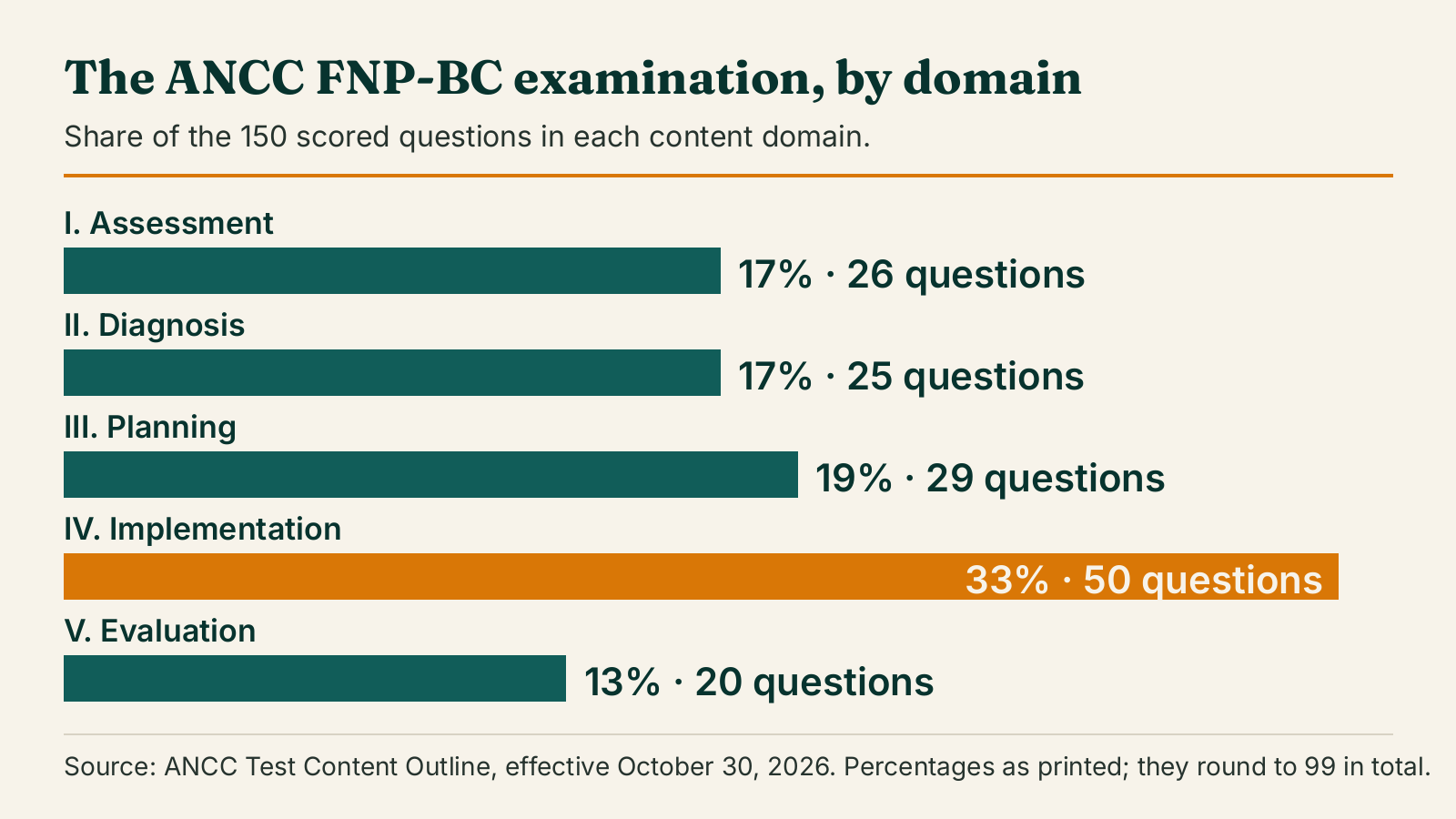
  • FNP Boards Study Plan. How Long to Study, Week by Week, and How to Tell If You Are Ready

    FNP Boards Study Plan. How Long to Study, Week by Week, and How to Tell If You Are Ready

    By Daniel Borkert, FNP-C
    Last reviewed October 24, 2026. Figures checked against the sources named below on October 24, 2026.

    I graduated from my FNP program in 2018 already working full time, on 12 hour shifts. Serious studying started right after graduation and ran four to eight weeks, a few hours at a time, on the days I was not working. I did not study on shift days. The plan below is built on that pattern. Work sets the shape of the week; the studying fits inside what is left.

    What filled those off days was mostly practice questions, lots and lots of them, some reading, and a review course I listened to in the car, which I had started during the last six months of school. If I were doing it again I would keep the same mix. What follows turns that run into a plan you can schedule, weighted against the current exam blueprints and grounded in the study research rather than prep company advertising. Where the plan gives you a number no study can give you, it says so.

    The short answer

    For a recent graduate studying a few hours on non-work days, my own runway was four to eight weeks, and this plan treats that range as workable, with the middle of it as the recommended aim. What matters more than the calendar is what fills it. The research on how people retain material rates exactly two techniques as high utility, practice testing and distributed practice, so the plan puts timed practice questions at the core, spread across every week, weighted to the blueprint of the exam you are taking. Readiness is a trend, not a score. Judge it by your last several timed blocks on questions you have never seen, never by one practice test; neither body publishes a conversion from a practice percentage to a passing score, and both caution against reading their own practice products as predictors.

    How long should I study for the FNP boards

    No primary source fixes an ideal study duration for FNP candidates. The timelines that rank for this question, twelve weeks from one provider, six to eight from another, two, four, and eight week versions from a third, are marketing pages describing courses. They show what companies sell, not how long you need.

    What can be said honestly runs on starting point and hours. A candidate who finished a program this spring starts with the material still warm, and the job is conversion, turning coursework into exam answers under time pressure. A candidate a year or more out of school, or working in a narrow clinical area since graduating, has rebuilding to do first, and should expect the long end of the range or beyond it. Then count your real capacity. My four to eight weeks held a few hours on each non-work day. A reader with two study days a week needs more weeks to hold the same total work. The plan below scales with phases and a weekly rhythm rather than a promise.

    One clock does run underneath the plan. Both certifying bodies give you a 120 day window to test once you are authorized, and both let you test before your degree is conferred once coursework and clinical hours are complete. So the application and the studying belong on the same calendar, with the paperwork started early enough that it never eats study weeks. The application itself, step by step for both bodies, is in the companion guide.

    A study plan built backward from test day

    Start from the date, not from a book. Pick a test day inside your authorization window, count the weeks back to today, and lay the phases down in that order. In a six week middle case, the first four weeks are coverage, new material across the whole blueprint, the fifth is consolidation, and the last runs the final week pattern below. Stretch to eight by giving coverage six weeks. Compress to four by running coverage for two weeks and consolidation for one, accepting thinner coverage and a harder working error log. A reader more than a year out of school should add a rebuild week at the front, on content review in the weakest domains, before timed blocks begin in earnest.

    Weight the coverage by the blueprint, because practice questions strengthen most what they actually cover. A meta-analysis of test enhanced learning found transfer to new questions real but modest, and weakest for material never tested at all, so a plan built on a few favorite systems leaves the rest of the exam to luck. The boards publish the weights. The AANP exam, administered by the Nurse Practitioners Certification Board, is scored across four domains, with rounded weights of Assess at 32 percent, Diagnose at 27 percent, Plan at 27 percent, and Evaluate at 15 percent, and its published age spread makes older adults the largest band at 30 percent of scored questions. The ANCC exam runs five domains, with Implementation heaviest at 29 percent under the current outline, rising to 33 percent under the new outline that takes effect October 30, 2026. If your test date falls after that change, weight Implementation at the new figure, and note that ANCC pauses testing around the changeover, so candidates test before October 18 or after October 30. If you have not chosen a certifying body yet, that choice changes the content mix and the sitting itself, 150 questions in 3 hours at the AANP board against 175 in 3.5 hours at ANCC, and the companion comparison works through it.

    Each body also sells an official rehearsal, a practice exam from the AANP board and a Readiness Test from ANCC. Both belong late in the plan, and their scores get a section of their own below.

    What to do each week

    The weekly rhythm is the plan. Mine was simple enough to survive a work schedule.

    On each study day, work a block of fresh practice questions, timed, in the exam’s own multiple choice format, because format matched practice transfers better. Attempt every question before you look at any answer; the benefit of testing is tied to the effort of retrieving. After the block, review the rationale for every question, including ones you got right for the wrong reasons, and write the misses into the error log. On the following study day, before new material, retest topics the log collected earlier in the plan. A topic is not finished when you first answer it correctly. In one experiment on this point, items that kept being tested after their first correct recall were retained at far higher rates a week later than items dropped once learned, while extra restudy of learned items added almost nothing.

    Week Phase The work
    1 and 2 Coverage New timed question blocks across every domain, weighted to the blueprint. Every miss goes in the error log.
    3 and 4 Coverage, with returns Keep covering. Begin each study day by retesting the topics your error log collected in the weeks before.
    5 Consolidation Mixed timed blocks under test conditions. By now the error log, not the table of contents, picks most of your topics.
    6 Final week One full length timed rehearsal early in the week. Log review. Volume tapers as test day approaches.

    Notes on this table are collected in the endnotes below.

    Spacing does quiet work inside this rhythm. The optimal gap between sessions grows with the time between now and the test, which is why the plan revisits topics across weeks rather than drilling them in one sitting. The literature hands down no single review interval. The rhythm above is this article’s recommendation, built on the direction of that evidence.

    Reading and listening have a place, as support. My course listening ran underneath everything else, and in the final week I read through the course workbook alongside the questions. What the research will not support is making passive review the core. In the standard review of learning techniques, rereading and highlighting are rated low utility, and in one experiment students who restudied felt more confident and then remembered less a week later than students who had tested themselves. Read and listen to fill the gaps your questions expose. Do not let them substitute for the questions.

    The error log, turning wrong answers into a study list

    My own version of this was modest. I found my weak areas through my practice questions, made note of them, and came back to them. It worked. The structured log below is this article’s system built on that habit, and it is what makes the weekly rotation above run on evidence instead of vibes.

    For every missed question, and every question you answered correctly while unsure, record six things while the rationale is still in front of you.

    The date and the set. Which block the question came from, so repeat entries for a topic can be counted.

    The topic. The system or condition, specific enough to schedule. Heart failure is a topic. Cardiology is a shelf.

    What the question tested. The decision the question actually turned on, in one line. Not the disease, the decision, such as which drug to stop first, or which finding sends this patient to the emergency department today.

    The keyed point. Why the correct answer is correct, in your own words, reconstructed rather than copied from the rationale.

    Why you missed it. One of four categories. You did not know the material. You misread the stem. You talked yourself out of a correct first answer. You ran out of time. The category matters more than the miss, because each points to a different fix, and they do not all call for more content study.

    A revisit date. When this topic comes back into a block, set by the rhythm in the previous section.

    Then use the log three ways. It builds your rotation, because the topics with the most entries get the most slots in the coming week’s blocks. It separates knowledge gaps from process errors, because a log full of misreads and changed answers is not asking for more content study; it is asking for a slower stem routine, and it will show you, in your own record, whether changing answers is costing you. And it sets the standard for fixed, because a topic counts as repaired only after you retest it on fresh questions. A topic you can explain but have not retested is one you have reread, and the difference between those two things is the whole argument of this article.

    A word of honesty about the log’s limits. One large meta-analysis found that feedback during practice tests added little measured benefit on its own, so the log does not earn its place as a ritual. It earns its place as a targeting device, telling you what to study next and whether the fix worked, which no score total gives you.

    Predictor scores and readiness

    This is the section candidates ask about in every forum thread, usually at midnight, usually holding one number. A practice score measures your performance on that set of questions, on that day, under those conditions. Either way, no published conversion turns the score into a real exam result. The AANP board publishes no numeric score scale at all. ANCC publishes its scale, a maximum of 500 with 350 or higher passing, and no practice percentage maps onto it, because a set’s difficulty and how many of its questions you had already seen can move the number without moving your readiness. A repeat attempt on seen questions can inflate a score, which is why the plan counts only fresh questions toward readiness.

    The certifying bodies say the quiet part themselves, about their own products. The AANP board’s practice exam page states that performance on the practice examination is not a predictor of whether a candidate will pass or fail, that its scores are reported as percentages and are not scaled like certification exams, and that the practice exams are not designed as an assessment of strengths and weaknesses or as a study guide. ANCC says of its Readiness Test that it does not guarantee a passing score and that you should not interpret your performance as an exact prediction of your certification exam performance. What that test does offer, by design, is a diagnostic report on strengths and weaknesses, delivered under real proctored conditions. Use both bodies’ products as rehearsals and diagnostics. Let neither one rule on you.

    So what should rule on you? The trend. Learners are poor judges of their own retention; in one experiment, students’ predictions of what they would remember were uncorrelated with what they actually remembered a week later. The record has to beat the feeling. Record every significant block, the date, the source, how many questions were fresh, timed or untimed, and the score, and read readiness off the last several entries. A rising or steady trend on fresh, timed, full format questions, across all the blueprint domains and not just your favorites, is the strongest signal available to you. Keep the base rates in view while you read it. In 2025, 81 percent of first time AANP candidates and 82 percent of first time ANCC candidates passed.

    For the record, I never took a predictor test. My own version was cruder. The questions kept coming and the weak areas kept shrinking. The system in this article is that same idea with paperwork.

    I failed a practice test, am I ready for boards

    A failed practice test is a data point with a loud voice. Before it talks you into moving your test date, read it the way you would read the error log, because the right response depends entirely on what kind of failure it was.

    Signals that point to more study are patterns, not scores. The same content area failing across fresh questions from more than one source. Misses whose log entries say did not know it, again and again, in domains the blueprint weights heavily. A timed block that falls apart in the second half, an endurance finding, and this plan treats endurance as trainable with full length rehearsals. If that is your picture and your date is close, spend the remaining weeks on the logged weaknesses in weight order, and judge the result by the trend afterward. Your window gives you room; the mechanics of scheduling and rescheduling sit inside it, and the companion application guide covers them.

    Signals that point to the test rather than to you are just as real. One low score on one short set. Scores that swing widely between similar sets taken days apart. Questions testing material outside the current blueprint, which happens with older banks. A set taken exhausted at the end of a shift. None of those is a readiness finding. All of them are calibration findings, and the correct response is a fresh set under test conditions, not a new test date.

    The rule is the readiness rule, offered as a recommendation rather than a finding. Never let one score on one day decide anything; decide on the trend across at least two or three sittings. A failed practice test inside a healthy trend is a study assignment. A flat or falling trend is a scheduling conversation, better had three weeks out than three days out.

    A failed practice test is a study problem. Failing the real exam is a different situation, with its own timelines and decisions, covered in what happens if you fail the FNP exam.

    Put your plan on one page

    Everything in this article fits on one page in a notebook. Copy this structure and fill it in. Your test date at the top, with the weeks counted backward beneath it and the phase laid over each week. Your study days each week, and the daily question target you set yourself, one you can actually hit on an off day. A score record with the date, the source, the number of fresh questions, timed or untimed, and the score. The error log running alongside it. And in the final week, the readiness check as five questions to answer honestly. Has my trend on fresh, timed blocks held across the last several sittings? Has every blueprint domain been covered, weighted by the outline? Have the repeat topics in my error log been retested on fresh questions? Have I sat one full length timed session under test conditions? For each domain, can I name my weakest topic and what I did about it?

    Then schedule the first block. If you want to see the shape of a timed block before your plan starts, a timed set of pharmacology practice questions with full rationales runs on the questions page.

    Get free FNP practice questions

    A plan starts with questions you have never seen. Start with 10 free board style practice questions, written for the outpatient clinic the way the boards test it, delivered by email along with a short sequence of study briefs over the following two weeks. They are the natural first entry in your score record.

    Frequently asked questions

    How many practice questions should I do a day?

    There is no sourced number, and any page that gives you one as a finding is inventing it. Set a target you can sustain on your study days, sized to the hours you actually have, and protect the rationale review and the error log entries inside the same sitting, because a block without review is half a block. My own volume was, in my words, lots and lots of practice questions, in the few hours an off day held. Choose consistency across four to eight weeks over a heroic daily count that collapses in week 2.

    Is rereading my notes and highlighting enough?

    No, and this is one of the better established findings in the learning literature. Practice testing and distributed practice are the two techniques rated high utility in the standard review; rereading and highlighting are rated low, and most students rely on them anyway. Read to fill a gap a question exposed. Then close the book and answer more questions.

    When should I take the official practice exam or the readiness test?

    Late enough that it rehearses the real thing, early enough that its diagnostic report can still change your plan. For most readers that is the consolidation week, under full test conditions, treated as data rather than as a verdict. The AANP board’s practice exams are $50, 50 questions in 60 minutes, taken once per purchase. ANCC’s Readiness Test is 60 questions in 75 minutes through Prometric. Both bodies state plainly that the score does not predict your result. Believe them, and use the reports for targeting.

    Should I move my test date if my practice scores are low?

    Not on one score. Decide on the trend across your last several timed blocks on fresh questions and on what your error log says the misses are; a flat or falling trend with knowledge gaps in heavily weighted domains, three or more weeks out, is a reason to use more of your window, and a single bad set is not.

    Endnotes

    Notes belonging to the table and figures above are collected here.

    Blueprint figures. Domain percentages are the certifying bodies’ own published weights. The AANP board’s handbook item counts govern its percentages; its web page displays Diagnose and Plan at 26.5 percent each, a rounding difference the handbook resolves. ANCC publishes its weights in its Test Content Outlines, current and effective October 30, 2026, and a plan for a test date after the change should use the newer outline. Age distribution figures are the AANP board’s published spread of scored questions.

    Sources for this page

    Dunlosky, Rawson, Marsh, Nathan, and Willingham, 2013, on the utility of ten learning techniques.

    Roediger and Karpicke, 2006, on test enhanced learning.

    Karpicke and Roediger, 2008, on repeated retrieval practice.

    Rowland, 2014, a meta-analysis of the testing effect.

    Adesope, Trevisan, and Sundararajan, 2017, a meta-analysis of practice testing.

    Pan and Rickard, 2018, on transfer of test enhanced learning.

    Cepeda, Vul, Rohrer, Wixted, and Pashler, 2008, on spacing and test delay.

    Green, Moeller, and Spak, 2018, BEME Guide 48, test enhanced learning in the health professions.

    Nurse Practitioners Certification Board, FNP Candidate Handbook (blueprint, exam format, testing window).

    Nurse Practitioners Certification Board, official practice exams.

    ANCC, Test Content Outlines for the FNP examination, 2022 outline and outline effective October 30, 2026.

    ANCC, Readiness Test.

    This plan runs on the Board & Bedside study system. The complete bundle in our shop pairs the 650-question bank and the flashcards with the 10-week planner that sequences the work.

    For clinician education only — not medical advice.
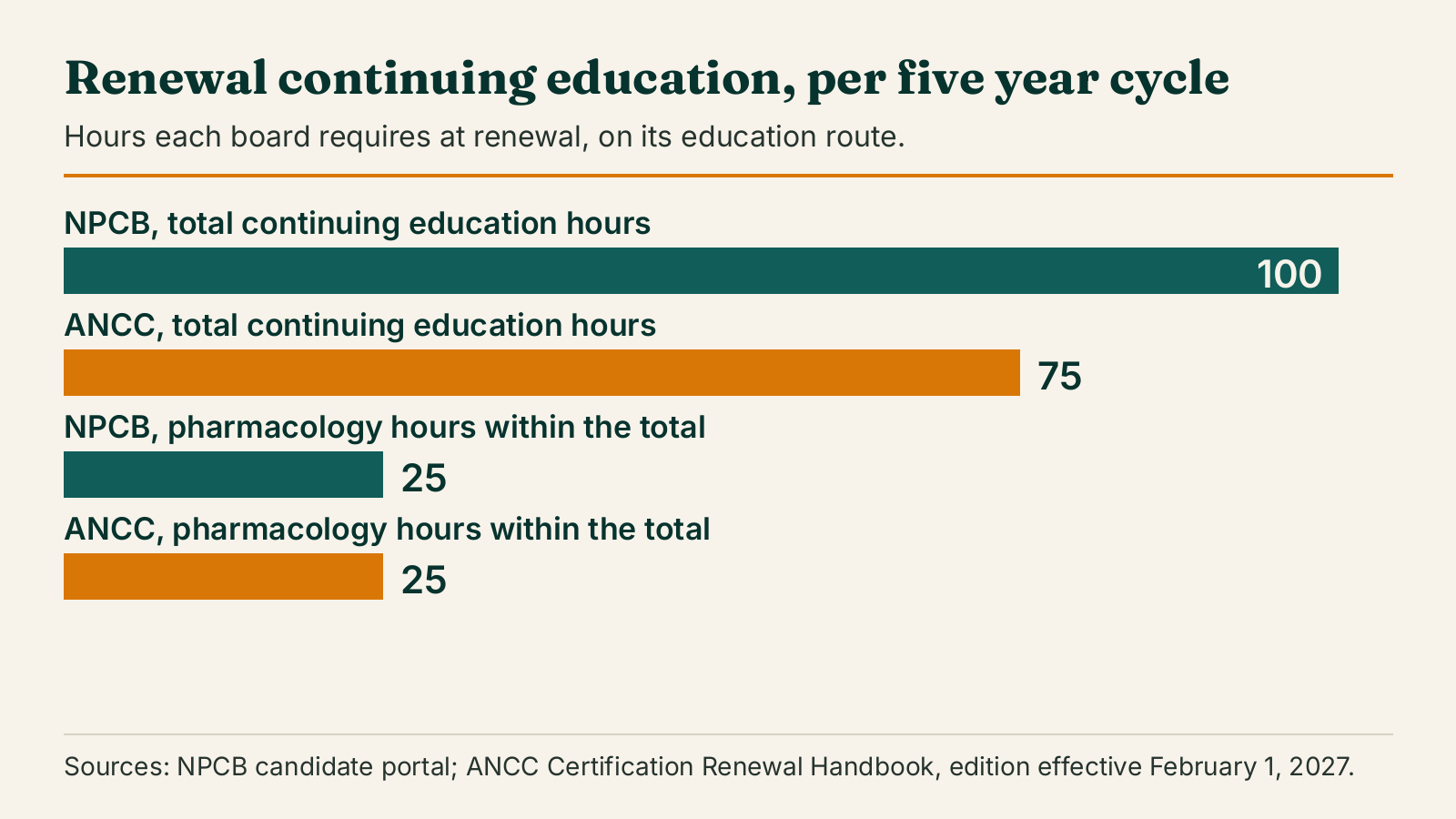
  • How to Apply for the AANP and ANCC FNP Exams, Step by Step

    How to Apply for the AANP and ANCC FNP Exams, Step by Step

    By Daniel Borkert, FNP-C
    Last reviewed October 24, 2026. Steps and figures checked against the sources named below on October 24, 2026.

    Applying for FNP certification is a document project with a clock attached, transcripts, forms, authorizations, and windows run by two certifying bodies with different paperwork habits. The AANP exam, administered by the Nurse Practitioners Certification Board, or NPCB, runs largely on your own attestation. ANCC runs a more formal process in which your school vouches for you before you test. Neither is hard. Both punish the candidate who starts late, because several steps wait on other people.

    My own application, in 2018, left two memories. Transcripts were involved, and the approval did not take long. The steps below show where the friction lives in each process, in the order you will meet it.

    The short answer

    Confirm the shared eligibility core first, an accredited FNP program, the three graduate core courses, at least 500 faculty supervised clinical hours, and a current RN license. Then the paths split. At the AANP board you create a profile, apply online with an unofficial transcript, pay $315 or $240 with membership, receive an authorization to test once your program completion date arrives, and schedule through your board account inside a 120 day window. At ANCC you apply online with your license, clinical hours documentation, and transcripts, you pay $395 or less with a membership discount, and you schedule with Prometric using your certification number inside your own 120 day window. Both bodies then release the credential only after you pass and your final official transcript, showing the degree conferred, is in their hands. If you have not yet decided which body, the companion comparison works through the choice itself.

    First, a timing warning for ANCC applicants

    Checked October 24, 2026. ANCC is replacing its FNP test content outline, and the changeover interrupts testing. The new outline takes effect October 30, 2026, after a 12 business day testing suspension. Candidates may test before October 18, 2026 or after October 30, 2026, and not in between. If you are reading this during the suspension, your ANCC date sits on or after October 30 by necessity, and you will sit the new outline. It reweights the exam, Implementation rising from 29 percent of scored questions to 33, Assessment falling from 19 to 17, and Evaluation from 15 to 13, while Diagnosis and Planning hold at 17 and 19. The change is to the exam’s content, not to the application process, and the AANP steps below run as written all fall.

    Step 1, confirm you are eligible

    The eligibility core is nearly identical at both bodies. You need a graduate FNP program, a master’s, post graduate certificate, or doctorate, from an accredited program, with the three graduate core courses taken as separate courses, advanced pathophysiology, advanced pharmacology, and advanced health assessment, plus at least 500 faculty supervised clinical hours in the FNP role (the AANP board specifies direct patient care hours), and a current, active RN license, which the AANP board requires at application and throughout your certification period.

    The accreditation wording differs slightly. The AANP board accepts programs accredited by a nursing accrediting organization recognized by the U.S. Department of Education or the Council for Higher Education Accreditation. ANCC names its accreditors, CCNE, ACEN, or the NLN Commission for Nursing Education Accreditation, accepts only the certificate program’s own accreditation for post graduate applicants, a rule tightened for graduations from January 1, 2026, and requires program content in health promotion and disease management, including prescribing.

    Two timing rules belong here. The AANP board lets you apply early, up to 6 months before completion for master’s and certificate candidates and 12 months for doctoral candidates, and you may test once coursework and clinical hours are complete, degree or not. ANCC sets the opposite boundary, a requirement to apply within five years of degree conferral.

    Step 2, gather your documents

    What each body wants in hand is where the two processes stop feeling alike.

    AANP (NPCB) ANCC
    To apply and test Your RN license details and an unofficial transcript showing coursework to date, with your name, university, and program role and population on it A copy of your RN license, documentation of your clinical hours, and unofficial transcripts
    School verification None. You attest that your application is accurate, and documents are requested only if you are audited A Validation of Education form from your program if you test before your degree is conferred, confirming coursework and clinical hours are complete
    To release your certification A final official transcript showing your degree awarded and date conferred, sent directly from your school. Post graduate applicants send the certificate transcript and their earlier MSN transcript A final official transcript showing the degree conferred. Your certification start date is the date ANCC receives it

    Notes on this table are collected in the endnotes below.

    The practical difference is who can slow you down. On the AANP side, the transcript you apply with is one you can download yourself, and the official copy matters only at the end. On the ANCC side, the Validation of Education form puts your program’s office inside your timeline if you test before graduation. Start transcript requests earlier than feels necessary.

    Step 3, apply and pay

    The AANP application is four moves, all online. Create or sign in to your online profile. Select the family nurse practitioner examination. Complete the application and upload the required documents. Submit payment, which finalizes it. The fee is $315, or $240 with AANP membership. The board processes applications in the order received once documentation and payment are complete, and publishes no standard processing time. My own approval in 2018 felt quick, but the board promises order, not speed.

    ANCC’s application is also online. Its published sequence runs, confirm eligibility and fees, gather the license copy, clinical hours documentation, and unofficial transcripts, apply, submit transcripts, and schedule once authorized. Fees are $395 for nonmembers, $295 for ANA members, $340 for AANP members, $290 for AANP student members, and $340 for GAPNA members. Discounts must be claimed within five business days of ANCC receiving the application and cannot be combined, so decide your membership before you apply. ANCC also sells speed, an expedited review for an additional non refundable fee that cuts review to three business days from receipt of payment for complete materials.

    Step 4, get your authorization to test

    Neither body lets you book a seat before your authorization to test arrives. Both issue an authorization to test, the ATT, and the 120 day testing window runs from it. The AANP board sends the ATT notification after your program completion date has been reached and your eligibility confirmed, and if the completion date lands on a non business day, the notification issues the next business day. ANCC’s sequence is parallel, 120 days from the ATT notice to make your appointment. The window is the real deadline of the application, and everything after lives inside it.

    Step 5, schedule with Prometric

    Both exams are computer based at Prometric testing centers, scheduled only after the ATT arrives, but you book through different doors. AANP candidates schedule through their board online account. ANCC candidates schedule at Prometric directly, at prometric.com/ANCC or by phone at 1.800.350.7076, using the certification number from their authorization.

    Life inside the window has published prices. On the AANP side, rescheduling and cancelling run through your board account under Prometric’s policies, and failing to appear, or cancelling within 24 hours of the appointment, can forfeit your fees. A missed exam or lapsed eligibility can be reset once per application for a $75 non refundable fee, requested within a year of the original application, approval not guaranteed, and a withdrawal before scheduling, while the window has not expired, recovers part of the fee minus a $120 processing charge. On the ANCC side, Prometric may charge to reschedule or cancel, cancelling less than two days out forfeits the fee, and the window extends once, as a re assignment, for $100.

    Step 6, prepare while you wait

    The weeks between authorization and test day are the highest value study time in the process. Both bodies test pharmacology and prescribing as core knowledge. A timed set of pharmacology practice questions is a fair simulation of the pressure, and it shows you which drug classes are soft while there is still time to fix them.

    Step 7, test day

    The sittings differ in size. The AANP exam is 150 multiple choice questions, 135 scored and 15 unscored pretest questions you cannot identify, in 3 hours. The ANCC exam is 175 questions, 150 scored and 25 pretest, with 3.5 hours to answer inside a session of about 4 hours that includes check in, instructions, and a practice session. ANCC describes its examinations as multiple choice format in its handbook, whatever prep marketing says about other item types.

    My strongest memory of the 2018 sitting is that the exam felt harder than I expected, and that the questions were not grouped by system or topic in any way I could feel. Treat both as normal. A mixed, front loaded feeling is the design of a broad certification exam, not a verdict on your performance.

    Step 8, results

    You do not wait in the dark at either body, but the sequences differ, and they are worth having exactly. The AANP board shows a preliminary pass or fail result immediately when you finish. Preliminary is the operative word. The result becomes official when the board has reviewed and released it, as an official score notification that also appears in your online profile. If you fail, a score report letter with more detail is emailed within 3 to 5 business days. My own memory of 2018 is of waiting about a week for results. Measured against the sequence the board publishes now, that wait most likely belongs to the official confirmation, because the process puts a preliminary result on the screen the day you test.

    ANCC routes results through the testing vendor. Candidates who test at a Prometric center can view their results online through the Prometric Report Validation Portal, which an email after the examination explains how to access. ANCC’s own faculty guidance describes student results as available immediately after testing, and ANCC itself receives the results within 24 to 48 hours. A failing candidate receives the scaled score, the fail status, and diagnostic feedback rated low, medium, or high in each content area, and ANCC does not release results by telephone, fax, or email.

    Step 9, certification issued

    Passing is not the last step. Both bodies hold the credential until the degree is proven on paper. At the AANP board, certification is issued when the final official transcript showing your degree awarded and date conferred arrives directly from your institution, and post graduate applicants owe two transcripts, the certificate program’s and the earlier MSN’s. The certification then runs five years, as FNP-C.

    At ANCC, certification is issued once a passing result is on file and the final official transcript showing the degree conferred has been received, and the certification start date is the date that transcript arrives. The certificate and pin follow about three weeks after all requirements are met. ANCC provides one free verification through your online account and does not send it to state boards or employers automatically.

    If you do not pass

    The retake terms differ enough to plan around. The AANP board allows up to three attempts per calendar year once your official score notification arrives, and retesting candidates must submit a minimum of 15 continuing education hours. ANCC requires a 60 calendar day wait, allows no more than three attempts in any 12 months, and requires the entire examination to be retaken. The companion comparison sets the two rule sets side by side with the renewal consequences.

    Get free FNP practice questions

    Your window is open and the date is set. Start the preparation with 10 free board style practice questions, delivered by email with a short sequence of study briefs over the following two weeks.

    Frequently asked questions

    How early can I apply for FNP certification?

    The AANP board accepts applications up to 6 months before program completion for master’s and post graduate certificate candidates, and up to 12 months before for doctoral candidates. ANCC likewise allows testing before conferral once coursework and clinical hours are complete, with a Validation of Education form from your program, and requires you to apply within five years of the degree being conferred.

    How long does approval take?

    Neither body publishes a standard timeline. The AANP board processes complete applications in the order received. ANCC publishes only its expedited option, three business days from receipt of payment for complete materials, for an additional fee. My own AANP approval in 2018 did not take long, but treat that as one candidate’s experience.

    What happens if my 120 day window expires?

    It is an expensive mistake in the process. At the AANP board, a missed exam or lapsed eligibility can be reset once per application for a $75 non refundable fee within a year of the original application, and approval is not guaranteed. At ANCC, the window can be extended once for a $100 re assignment fee, with the new window starting less than six months after the old one ended. Schedule early in the window, not at its end.

    When do I actually become certified after passing?

    When your final official transcript reaches the body, not when you pass. The AANP board requires the transcript sent directly from your institution, showing the degree awarded and date conferred, before certification can be issued. ANCC starts your certification on the date it receives that transcript, and the certificate and pin follow about three weeks later.

    Endnotes

    Notes belonging to the tables and steps above are collected here.

    Transcripts at ANCC. ANCC distinguishes a final official transcript, showing the degree conferred and sent directly from the university, from the official and unofficial transcripts that support testing before conferral. Transcripts go through an electronic transcript service, which ANCC prefers, or to its published validation address.

    The ANCC changeover. The suspension and outline figures in the timing warning are ANCC’s published terms as checked on October 24, 2026, and candidates testing on or after October 30, 2026 sit the new outline regardless of when they applied.

    Fees inside the fees. ANCC prices include a $140 non refundable administrative fee, and being approved for the wrong examination can carry a further $100 fee to change it. The AANP board’s $75 membership discount is honored if membership details arrive within 30 days of applying.

    Sources for this page

    Nurse Practitioners Certification Board (AANPCB), FNP Candidate Handbook, updated June 2026.

    Nurse Practitioners Certification Board, FAQ and certify page.

    American Nurses Credentialing Center, Family Nurse Practitioner certification page.

    American Nurses Credentialing Center, Certification Handbook.

    American Nurses Credentialing Center, FNP Test Content Outlines, 2022 and effective October 30, 2026.

    American Nurses Credentialing Center, scores and retest policy page and APRN Faculty Toolkit.

    Once your application is in, studying is the part you control. Our shop carries a 650-question bank, flashcards, and a timed mock exam for the ANCC and AANP FNP exams.

    For clinician education only — not medical advice.
  • ANCC vs AANP, Which FNP Certification Exam Should You Take?

    ANCC vs AANP, Which FNP Certification Exam Should You Take?

    By Daniel Borkert, FNP-C
    Last reviewed October 24, 2026. Figures checked against the sources named below on October 24, 2026.

    I took the AANP exam in 2018, about a month or two after I finished my FNP program, for the reasons students still give me. It cost less. I believed it was the shorter exam. I had heard it was the easier of the two, with the higher pass rate. And I liked the look of FNP-C better than FNP-BC. Most of my colleagues made the same choice, though some took the ANCC.

    Two of those reasons still hold up in the handbooks. Cost and length do. The pass rate story does not. In 2025, the most recent year both bodies have published, 81 percent of first time AANP candidates passed and 82 percent of first time ANCC candidates passed, one percentage point apart, which gives the easier exam argument nothing to stand on. What follows is the comparison I would want if I were choosing today, built from the two bodies’ own handbooks and fee tables, with my route through it marked as experience rather than evidence.

    One naming note. The AANP exam is administered by the American Academy of Nurse Practitioners Certification Board, which now does business as the Nurse Practitioners Certification Board, or NPCB.

    The short answer

    Both exams certify family nurse practitioners for five years, and both are given on computer at Prometric testing centers. In my experience the two credentials are accepted for the same licenses and the same jobs. My state license never depended on which body certified me, and no employer since has cared either. The real differences are narrower. The AANP exam is shorter, 150 questions in 3 hours against 175 in 3.5 hours, cheaper to take, and much cheaper to renew. ANCC publishes its passing score where the AANP board does not, and builds renewal around continuing education plus a choice of professional activities, where the AANP board’s standard renewal route requires 1,000 practice hours. Neither pass rate supports calling one exam easier. Choose on the sitting, the price, and which renewal structure fits the career you expect. When you are ready to apply, the companion guide walks through the application itself.

    The two exams at a glance

    AANP (NPCB) ANCC
    Credential you earn FNP-C FNP-BC
    Questions 150 total, 135 scored and 15 pretest 175 total, 150 scored and 25 pretest
    Time to answer 3 hours 3.5 hours, inside a 4 hour session
    First time pass rate, 2025 81 percent, 15,395 candidates 82 percent, 7,719 candidates
    Initial fee $315, or $240 with AANP membership $395, or $295 with ANA membership
    Renewal fee, by continuing education $195, or $120 with membership $375, or $275 with ANA membership
    Retake rules Up to 3 attempts per calendar year, with 15 continuing education hours submitted before retesting 60 day wait between attempts, up to 3 attempts in any 12 months
    Renewal requirement 1,000 practice hours and 100 continuing education hours, or pass the exam again 75 continuing education hours plus one of eight professional development categories

    Notes on this table are collected in the endnotes below.

    The pass rate story, checked

    The claim that one of these exams is the easier route survives because pass rates get quoted without years attached. Here are the years. The AANP board’s own statistics put its 2025 FNP first time pass rate at 81 percent, from 15,395 initial examinations, and its 2024 rate at 83 percent. ANCC’s published 2025 data put its FNP first time rate at 82 percent, with 6,358 passes from 7,719 first time candidates. One percentage point apart, with ANCC nominally ahead.

    What I had heard in school, that the AANP was easier and passed more of its candidates, was the perception of that era, and perceptions outlive the numbers that fed them. A pass rate is an average across thousands of candidates from hundreds of programs, and the distance between 81 and 82 percent is smaller than the distance between a prepared candidate and an unprepared one. If a classmate tells you one exam is the easy one, ask which year’s data they are quoting.

    The volumes do show one real difference, scale. The AANP board tested about twice as many FNP candidates in 2025 as ANCC did, and reports about 202,000 FNP certifications held against ANCC’s roughly 108,000, which matches my own cohort, where most of us went the AANP route. It says where the crowd is, not which exam treats a candidate better.

    Length and shape of the two exams

    The length difference is the one I remembered correctly. The AANP exam is 150 multiple choice questions, 135 scored and 15 unscored pretest questions mixed in so they cannot be told apart, in 3 hours. The ANCC exam is 175 questions, 150 scored and 25 pretest, with 3.5 hours to answer inside a session of about 4 hours that also covers check in, instructions, and a practice run. Twenty five more questions and thirty more minutes is a real difference in how a sitting feels at hour three, and a legitimate reason to prefer one exam, as long as nobody dresses it up as a difference in difficulty.

    The blueprints differ in shape too. The AANP board publishes four practice domains, Assess at 32 percent of scored questions, Diagnose at 27 percent, Plan at 27 percent, and Evaluate at 15 percent, and it also publishes the age spread of its questions, with older adults the largest age band at 30 percent of scored items. ANCC publishes five domains. Under the outline in force until late October 2026, Implementation is heaviest at 29 percent, then Assessment and Planning at 19 percent each, Diagnosis at 17, and Evaluation at 15. ANCC replaces that outline on October 30, 2026, with Implementation rising to 33 percent. Testing pauses for the changeover, so candidates test before October 18 or after October 30, dates the companion guide walks through.

    My own memory of the 2018 sitting is that the exam felt harder than I expected, and that it was not broken up by body systems or topics in any way I could feel. Expect the difficulty to feel front loaded and uneven. That is the format, not a sign you are failing.

    What each one costs, now and at renewal

    Price was my first reason in 2018, and it remains the AANP’s clearest advantage. The AANP exam costs $315, or $240 with AANP membership, which takes $75 off. ANCC’s sticker price is $395 for nonmembers, with a wider discount menu, $295 for ANA members, $340 for AANP members, $290 for AANP student members, and $340 for GAPNA members. Two details belong with those figures. ANCC’s prices include a $140 administrative fee that is not refundable, and its discounts cannot be combined. Even so, note the wrinkle. A student member of AANP can sit the ANCC for $290, so the price ordering is close enough to check your own memberships before assuming it.

    Renewal is where the gap widens. Both certifications run five years. Renewing the AANP certification by the continuing education route costs $195, or $120 with membership. Renewing ANCC costs $375, or $275 for ANA members. The cheaper exam is cheaper every five years, not just once, and the FAQ below does the fifteen year arithmetic plainly.

    Paperwork before you ever sit

    The application burden differs in a specific place, how much your school has to vouch for you before you test. The AANP board requires no Validation of Education form at all. You attest that your application is accurate, you apply with an unofficial transcript showing your coursework to date, and the board can ask for more only if you are audited. The final official transcript gates only the release of your certification after you pass.

    ANCC runs a more formal taxonomy. To test before your degree is conferred, your program must submit a Validation of Education form confirming your coursework and clinical hours are complete, alongside official or unofficial transcripts. ANCC distinguishes three kinds of transcript, the two that let you test early and the final official one showing the degree conferred, required before certification is issued. None of this is a reason to avoid ANCC. It is more coordination, with more parties who can slow it down. My own application memory is thin, which is itself the report. I remember transcripts being involved, and the approval not taking long. The process I went through was light enough to leave almost no trace eight years later.

    If you do not pass

    Retake rules are the difference nobody prices until they need them, and the two bodies run them on different clocks. The AANP board allows up to three attempts per calendar year, January to December, with no stated waiting period beyond receiving your official score notification and reapplying. There is a catch that took effect in January 2026. Retesting candidates must submit a minimum of 15 continuing education hours as part of returning. ANCC instead imposes time. You wait 60 calendar days from the date you last tested, you may test no more than three times in any 12 month period, and the whole examination is retaken, with no continuing education requirement attached.

    The feedback after a failure also differs. The AANP board publishes no numeric score scale and no passing score, so its candidates get a pass or fail and, after a fail, a score report letter with more detail, emailed within 3 to 5 business days. ANCC publishes its scale openly, scores run to a maximum of 500 with 350 or higher passing, and a failing candidate receives diagnostic feedback rated low, medium, or high in each content area. A candidate who wants to know exactly where they stand gets more from ANCC. A candidate who wants to sit again without a mandatory waiting period gets more from the AANP board.

    Renewal, the five year tail

    Certification is a subscription you pay in hours as much as in fees, and the two bodies structure the hours differently. The standard AANP route requires both halves within each five year cycle, a minimum of 1,000 practice hours as a nurse practitioner in your population focus, in roles that include direct patient care, administration, education, and research, and a minimum of 100 continuing education contact hours, 25 of them in advanced practice pharmacology. The alternative is to skip both and pass the exam again before your certification expires. There is no third door, and if your certification lapses, the published route back is to contact the board by email for an eligibility review under current requirements.

    ANCC requires fewer continuing education hours, 75 against the AANP board’s 100, and gives more ways to cover its second requirement. Every renewing certificant completes 75 continuing education contact hours, 25 in pharmacology, with at least 60 of the 75 from formally approved providers. On top of that, you complete one of eight professional development categories in full, which include more continuing education, academic credits, presentations, an evidence based practice or quality improvement project, publication or research, at least 120 preceptor hours, professional service, at least 1,000 practice hours in your specialty, or passing the exam. The 1,000 practice hours that are mandatory on the AANP side are one option of eight here. ANCC also allows no grace period after expiration. A late renewal becomes a reactivation, with a gap in your certification dates that cannot be backdated.

    My own renewal experience has been undramatic, which is the most useful thing I can report. I recertify every five years, the continuing education has come from credits I accumulate in ordinary practice, UpToDate credits in past cycles and OpenEvidence credits this coming one, and I have never found the process burdensome. What I would flag for a new graduate is the practice hours half of the AANP board’s renewal, because it is the half that can surprise you. A clinician who works part time for a stretch, or moves into a role with little counted practice, should check the 1,000 hour requirement against their plans before assuming renewal is a formality. On the ANCC side that same clinician has seven other categories to choose from. That flexibility is the strongest structural argument ANCC has, and it only becomes visible five years after the choice is made.

    How I would choose

    What I tell students is close to what I did. Pick the one you prefer, at the price you can get, on the date you want to test. Preference is not a lazy answer here, because in my experience the credentials are genuinely interchangeable to the people who license and hire you, and a preference you actually hold, for the shorter sitting, for the letters after your name, for the body your program knows best, is worth more than a borrowed belief about which exam is easier.

    Where I would push back on my own 2018 reasoning is only where the facts have moved. Do not choose on pass rates, because the current rates are 81 and 82 percent and prove nothing. Do choose with your eyes open about the differences that persist. The sitting is 30 minutes and 25 questions longer at ANCC. Renewal is cheaper and more rigid at the AANP board, more expensive and more flexible at ANCC. And the ANCC application involves your school formally, where the AANP application mostly involves you. All of it is knowable before you pay.

    Get free FNP practice questions

    Whichever exam you choose, the preparation is the same work. Start with 10 free board style practice questions, written for the outpatient clinic the way the boards test it, delivered by email along with a short sequence of study briefs over the following two weeks.

    Frequently asked questions

    Is the AANP or the ANCC exam easier?

    Neither, on the evidence either body publishes. The most recent first time pass rates are 81 percent for the AANP exam in 2025, from 15,395 candidates, and 82 percent for ANCC in 2025, from 7,719 candidates. One point apart is not a difficulty gap, and older figures quoted without a year are how the easier exam story survives. The sittings differ in length, which is a difference in endurance, not in standard.

    Do employers or state boards care which exam I take?

    In my experience, no. My state license did not depend on which body certified me, and no employer I have worked for has treated the two credentials differently. Both are the recognized national certifications for family nurse practitioners on five year cycles. What a state board cares about is that the certification is current, which is an argument for taking renewal seriously rather than for choosing one body over the other.

    Which certification costs less over fifteen years?

    The AANP, at published prices. The initial fee plus two renewals by the continuing education route at nonmember prices comes to $705 for the AANP board, $315 plus $195 plus $195. The same arithmetic at ANCC comes to $1,145, $395 plus $375 plus $375. Memberships narrow both figures and prices will change across fifteen years, so read it as the shape of the gap rather than a quote.

    What happens if I fail the first attempt?

    You reapply and sit again, on different terms. The AANP board allows three attempts per calendar year with no stated wait beyond your official score notification, plus at least 15 continuing education hours for retesting candidates. ANCC requires a 60 day wait and allows three attempts in any 12 months. ANCC also reports a scaled score with low, medium, or high feedback by content area, where the AANP board sends a detailed score report letter within 3 to 5 business days.

    Can I take the exam before I graduate?

    Yes, at both bodies, once your coursework and faculty supervised clinical hours are complete. The AANP board lets you apply up to 6 months before program completion, or 12 months for doctoral candidates, and releases your certification when the final official transcript arrives. ANCC requires a Validation of Education form from your program for pre graduation testing, and your certification starts when ANCC receives the final official transcript.

    Endnotes

    Notes belonging to the tables and figures above are collected here.

    Fees and memberships. The AANP member price reflects a $75 discount for AANP members, honored even if membership information reaches the board within 30 days of applying. ANCC renewal prices beyond the ANA member rate are $295 for AANP members and $320 for GAPNA members. ANCC discounts cannot be combined, and its prices include a non refundable $140 administrative fee.

    Blueprint figures. The AANP domain weights are the candidate handbook figures. The board’s exam web page shows Diagnose and Plan at 26.5 percent each, which this page does not use. ANCC weights are computed from the scored question counts in its test content outlines, 150 scored questions in both the outgoing and the incoming outline.

    Renewal currency. ANCC publishes a new renewal handbook taking effect for renewal applications submitted on or after February 1, 2027. The renewal requirements described here are the ones in force when this page was checked, in October 2026.

    Sources for this page

    Nurse Practitioners Certification Board (AANPCB), FNP Candidate Handbook, updated June 2026.

    Nurse Practitioners Certification Board, FNP Renewal Handbook, updated June 2026.

    Nurse Practitioners Certification Board, certify page and FAQ.

    Nurse Practitioners Certification Board, 2025 and 2024 Certification Statistics.

    American Nurses Credentialing Center, Family Nurse Practitioner certification page.

    American Nurses Credentialing Center, Certification Handbook.

    American Nurses Credentialing Center, Certification Renewal Handbook.

    American Nurses Credentialing Center, FNP Test Content Outlines, 2022 and effective October 30, 2026.

    American Nurses Credentialing Center, 2025 Certification Data.

    Whichever exam you choose, preparation is the part you control. Our shop carries a 650-question bank, flashcards, and a timed mock exam built for both exam blueprints.

    For clinician education only — not medical advice.
  • FNP Pharmacology Practice Questions for the Boards, With a Timed Quiz

    FNP Pharmacology Practice Questions for the Boards, With a Timed Quiz

    By Daniel Borkert, FNP-C
    Last reviewed October 23, 2026. Checked against the sources named below on October 23, 2026.

    Most pharmacology studying fails in a predictable way. Students drill drug names on flashcards until the names feel familiar, then sit for an exam that almost never asks what a drug is called. The boards ask what a prescriber does. A patient on lisinopril is coughing. A kidney result has slipped on a drug that was safe last year. A new antibiotic has quietly doubled the effect of a blood thinner. Every question below is one of those moments, taken from the Board & Bedside question bank and set in the outpatient clinic, where FNP prescribing actually happens.

    Each question comes with its answer, the mechanism underneath the answer, and a note on why each wrong option fails. That last part is where the learning is. A rationale that only defends the right answer teaches one fact. A rationale that dismantles the wrong answers teaches the pattern the next question will wear.

    The short answer

    This page holds 15 board-style pharmacology questions with full rationales, covering the prescribing decisions FNP candidates are actually tested on. Renin-angiotensin drugs and their monitoring, statins, heart failure therapy, anticoagulation and its interactions, diabetes and thyroid drugs, an antidepressant safety case, and outpatient antibiotics and their interactions. Every question is an outpatient primary care scenario. Read them straight through with the answers showing, or take them timed, 15 questions in 15 minutes, at the pace the boards run. The set is calibrated to be hard, on purpose, and a score on it is a readiness signal from one small timed set. It is not a predictor of passing, and this page will not pretend otherwise.

    If you want the facts organized before you test them, the companion cheat sheet lays out every class on this page in tables.

    Why these fifteen

    The bank these questions were drawn from holds hundreds of questions in total, and the rule for choosing this set was simple. Each question had to turn on a decision a prescriber makes, not a fact a student recites. Knowing what to monitor after starting a drug, not just naming the drug. Recognizing the toxicity, not just listing it. Removing the drug that caused the problem instead of the drug that is protecting the patient. Three of the fifteen end by sending the patient in for emergency evaluation, and that is deliberate too. Knowing which drug harms cannot be managed from the clinic is a pharmacology skill, and the boards test it.

    In my own practice, the classes I most often see prescribed badly are the antipsychotics and the antidepressants, along with the medications on the Beers criteria list that older adults are taking, such as NSAIDs.

    Want the sheet that goes with this quiz? Join the free student list. Your printable FNP pharmacology cheat sheet will be emailed to you, plus a short sequence of study emails over the following two weeks.

    Read them, or take them timed

    Two ways, and they teach different things.

    Read mode is the default below. Each question is followed by its answer and rationale, so the set works as a study session. Read the stem, commit to an answer before you look, then read all four rationale lines, including the ones for the options you never considered.

    Timed mode layers a clock on the same questions, 15 minutes for the set, answers held until the end, the way the boards feel.

    Take the timed pharmacology quiz

    The timed quiz needs JavaScript. If it does not load, the full set is in read mode below. The questions are never held hostage to the tool.

    Whichever mode you choose, the score language on this page stays honest. Fifteen questions cannot sort pass from fail. They can show you which class is soft, and that is what the score is for.

    Blood pressure and cholesterol

    Question 1

    A 58-year-old woman started on lisinopril 10 mg daily for hypertension develops a persistent dry cough after 3 weeks. She has no fever, wheezing, or URI symptoms. What is the most appropriate next step?

    • A. Switch lisinopril to losartan
    • B. Switch lisinopril to benazepril
    • C. Continue lisinopril and add dextromethorphan for the cough
    • D. Continue lisinopril and reassure her the cough will resolve on its own

    Answer: A

    ACE inhibitor-induced dry cough (from bradykinin accumulation) is managed by switching to an ARB, which blocks the angiotensin receptor without inhibiting bradykinin breakdown and rarely causes cough.

    Why the other options fail:

    • B. Benazepril is another ACE inhibitor and shares the bradykinin mechanism, so the cough would be expected to recur. The fix is to leave the class for an ARB, not to switch within it.
    • C. Cough suppressants do not address the bradykinin-mediated mechanism and the cough will persist.
    • D. ACE inhibitor cough typically persists as long as the drug is continued and warrants a switch, not reassurance.

    Test taking note. ACEi cough → ARB is a classic one-step question. Note the nuance: after ACE-inhibitor-induced angioedema, ARBs are used only with caution (many clinicians avoid them), but cough alone is never a reason to avoid an ARB.

    Question 2

    A 64-year-old man with hypertension and no CKD is started on lisinopril. His baseline labs are unremarkable. What laboratory monitoring is most important 2 to 4 weeks after initiation?

    • A. Liver function tests (aminotransferases and bilirubin)
    • B. Urine albumin-to-creatinine ratio (urine albumin excretion)
    • C. Complete blood count (hemoglobin and platelet count)
    • D. Basic metabolic panel (creatinine and potassium)

    Answer: D

    ACE inhibitors can raise potassium and creatinine by reducing aldosterone and intraglomerular pressure. Guidelines recommend checking a BMP within 2 to 4 weeks of initiation or dose escalation; a creatinine rise up to 30% above baseline is generally acceptable.

    Why the other options fail:

    • A. LFTs are not routine monitoring for an ACE inhibitor; the labs that matter here are creatinine and potassium.
    • B. Albuminuria tracking matters in hypertension care, but it does not catch the early creatinine and potassium shifts of the first weeks on an ACE inhibitor, which is the safety question here.
    • C. CBC is not affected by ACE inhibitor initiation.

    Test taking note. Any question about starting an ACEi or ARB: the answer is almost always 'check BMP for K+ and creatinine.' The 30% creatinine rise threshold is bonus points.

    Question 3

    A 57-year-old man with a baseline LDL-C of 148 mg/dL is started on atorvastatin 40 mg daily for primary prevention. According to the 2026 ACC/AHA dyslipidemia guideline, when should his lipid panel be rechecked to assess response and adherence?

    • A. 1 week after the first dose
    • B. 6 months after the first dose
    • C. 12 months after the first dose
    • D. 4 to 12 weeks after the first dose

    Answer: D

    The 2026 ACC/AHA dyslipidemia guideline recommends a lipid panel 4 to 12 weeks after statin initiation or dose adjustment to assess response and adherence, and every 6 to 12 months thereafter. The panel does not need to be fasting in most patients.

    Why the other options fail:

    • A. One week is too early to assess the full LDL-lowering effect.
    • B. Six months is the rhythm for later checks on stable therapy. Waiting that long for the first recheck leaves nonresponse and nonadherence undetected.
    • C. A full year misses the window to detect nonresponse or nonadherence early, and delays any adjustment the first panel would have prompted.

    Test taking note. Statin monitoring interval: 4 to 12 weeks after a change, then every 6 to 12 months. This is a pure memorization question, bank the interval.

    Heart failure

    Question 4

    A 64-year-old man with HFrEF takes lisinopril 20 mg daily. His clinician plans to switch him to sacubitril-valsartan. According to the 2022 AHA/ACC/HFSA heart failure guideline, what precaution is required?

    • A. Start sacubitril-valsartan the same day as the last lisinopril dose
    • B. Overlap both drugs for one week to avoid rebound
    • C. Hold the ACE inhibitor for 36 hours before the first ARNI dose
    • D. Start sacubitril-valsartan 12 hours after the last lisinopril dose

    Answer: C

    A 36-hour washout after the last ACE inhibitor dose is required before starting sacubitril-valsartan because combined ACE and neprilysin inhibition markedly increases angioedema risk. (No washout is needed when switching from an ARB.)

    Why the other options fail:

    • A. Same-day initiation without washout risks life-threatening angioedema.
    • B. Overlapping ACE inhibitor and ARNI therapy is contraindicated.
    • D. Twelve hours is still inside the washout window. The full 36 hours must pass after the last ACE inhibitor dose, whatever the dose timing.

    Test taking note. ACEi → ARNI = 36-hour washout (angioedema). ARB → ARNI = no washout. Boards love testing which switch needs the washout.

    Question 5

    A 73-year-old woman with HFrEF takes digoxin 0.125 mg daily. She develops nausea, visual changes, and new confusion. Her potassium is 2.9 mEq/L. What is the most likely explanation and appropriate action?

    • A. Emergent head CT to evaluate for stroke before changing any therapy
    • B. Hold digoxin and arrange immediate emergency evaluation
    • C. Attribute the symptoms to a viral illness and continue all medications
    • D. Increase the digoxin dose to compensate for the low potassium

    Answer: B

    Nausea, visual disturbances, and confusion are classic digoxin toxicity, and hypokalemia increases myocardial sensitivity to digoxin even at therapeutic levels. Hold digoxin and arrange immediate emergency evaluation with ECG, renal function, and electrolyte monitoring; outpatient electrolyte correction and a drug level alone are not sufficient with new confusion and visual symptoms.

    Why the other options fail:

    • A. Confusion does warrant urgent evaluation, but imaging alone misses the cause in front of you. The symptom cluster plus hypokalemia in a patient taking digoxin is toxicity until proven otherwise.
    • C. Visual changes and confusion do not fit a simple viral illness, and hypokalemia in a patient on digoxin must be addressed.
    • D. These are toxicity symptoms, made more likely by the low potassium. Raising the dose would deepen the toxicity.

    Test taking note. Digoxin toxicity triggers: hypokalemia, hypomagnesemia, renal dysfunction. Symptoms: nausea, vision changes (yellow-green halos), confusion, arrhythmias.

    Anticoagulation

    Question 6

    A 78-year-old man with atrial fibrillation takes warfarin 5 mg daily with previously stable INRs between 2.0 and 3.0. He was started on trimethoprim-sulfamethoxazole 4 days ago for a urinary tract infection. Today's INR is 4.8. He reports no bleeding, bruising, or falls. What is the most appropriate next step?

    • A. Hold warfarin, resume at a reduced dose once the INR returns to range, and recheck the INR in 2 to 5 days
    • B. Continue warfarin at the current dose of 5 mg daily, with no bleeding reported, and recheck the INR in 1 month
    • C. Stop warfarin permanently, start aspirin 81 mg daily alone for stroke prevention, and discontinue INR monitoring
    • D. Give oral vitamin K today, recheck the INR in 24 hours, and continue warfarin at the current dose

    Answer: A

    Trimethoprim-sulfamethoxazole inhibits CYP2C9, the enzyme that clears warfarin, raising the INR. The effect is fast, with prothrombin time rises documented between the second and sixth day of combined therapy. A supratherapeutic INR without bleeding is managed by holding one or more doses, resuming at a lower dose, and rechecking the INR in 2 to 5 days. Counsel on consistent vitamin K intake and checking for interactions before starting any new drug or antibiotic.

    Why the other options fail:

    • B. Continuing unchanged risks further INR rise and bleeding; a 1-month recheck is too infrequent during an active drug interaction.
    • C. Aspirin alone is inadequate stroke prophylaxis for atrial fibrillation, and stopping anticoagulation without a replacement plan is unsafe.
    • D. Vitamin K is not recommended for an asymptomatic INR in this range. It overshoots, complicates re-anticoagulation, and is reserved for bleeding or urgent reversal. Continuing the same dose also ignores the interaction still in effect.

    Test taking note. Supratherapeutic INR without bleeding: hold, reduce, recheck. Vitamin K is for bleeding or urgent reversal, not for an asymptomatic number.

    Question 7

    A 70-year-old woman with atrial fibrillation takes apixaban 5 mg twice daily. She started taking ibuprofen 400 mg daily for knee arthritis 2 weeks ago and now reports gum bleeding when brushing her teeth. Her blood pressure and labs are stable. What is the most appropriate counseling and management?

    • A. Hold apixaban for 3 days until the gum bleeding stops, and continue the ibuprofen for pain
    • B. Stop apixaban, switch to aspirin 81 mg daily for stroke prevention, and recheck her in 2 weeks
    • C. Stop the ibuprofen, switch to acetaminophen for pain, and continue apixaban while the bleeding stays minor and stable
    • D. Continue ibuprofen at the same dose, add a proton pump inhibitor for gastric protection, and continue apixaban

    Answer: C

    NSAIDs increase bleeding risk in patients on anticoagulants through platelet inhibition and mucosal injury, compounding the effect of apixaban. Stop the NSAID, substitute acetaminophen, and assess bleeding severity and stability; continue apixaban for minor self-limited bleeding, and arrange urgent evaluation for significant or persistent bleeding. Stopping anticoagulation in atrial fibrillation without cause exposes her to stroke risk.

    Why the other options fail:

    • A. Holding apixaban leaves her atrial fibrillation unprotected for days and does nothing about the drug that caused the bleeding. The precipitant is the ibuprofen, and it is the thing to remove.
    • B. Aspirin is weaker stroke prophylaxis for atrial fibrillation and carries its own bleeding risk. It swaps one problem for two.
    • D. A proton pump inhibitor only protects against gastric mucosal injury and does nothing for systemic bleeding risk from combined NSAID-anticoagulant use; the NSAID must be stopped.

    Test taking note. Any bleeding on a DOAC: first look for the added bleeder, NSAIDs, alcohol, new supplements. Remove the precipitant before touching the anticoagulant; stopping the DOAC is rarely the right first move.

    Diabetes and thyroid

    Question 8

    A 71-year-old man with type 2 diabetes takes metformin 1000 mg twice daily. His eGFR has declined from 52 to 38 mL/min/1.73m2. He has no acute illness. What is the most appropriate medication safety assessment?

    • A. Continue metformin at the current dose of 1000 mg twice daily with no change in monitoring
    • B. Stop metformin immediately; it is contraindicated below an eGFR of 60
    • C. Continue the current dose and recheck the eGFR in one year
    • D. Reduce metformin to a maximum of 1000 mg daily and monitor renal function closely

    Answer: D

    Metformin is contraindicated at eGFR <30 and should not be initiated at eGFR 30-45. When eGFR falls into the 30-45 range during therapy, FDA labeling directs a benefit-risk assessment; standard clinical practice is to reduce to a maximum of 1000 mg daily with close renal monitoring, due to lactic acidosis risk.

    Why the other options fail:

    • A. Metformin accumulates as renal function declines; continuing full dose at eGFR 38 increases lactic acidosis risk.
    • B. The contraindication threshold is eGFR <30, not 60; stopping outright at 38 forfeits a useful agent unnecessarily.
    • C. A year is far too long to leave full dose metformin unmonitored at an eGFR of 38. The dose reduction and closer follow-up happen now.

    Test taking note. Metformin renal rules: stop <30, don't start 30-45, max 1000 mg/day if already on it in the 30-45 range.

    Question 9

    A 68-year-old woman with type 2 diabetes and heart failure with reduced ejection fraction (EF 35%) has an A1C of 8.3% on metformin. Which medication addition is most appropriate?

    • A. Add a sulfonylurea
    • B. Add a DPP-4 inhibitor
    • C. Add pioglitazone
    • D. Add an SGLT2 inhibitor

    Answer: D

    SGLT2 inhibitors (dapagliflozin, empagliflozin) reduce heart failure hospitalization and cardiovascular death in patients with HFrEF with or without diabetes, and ADA Standards of Care recommend them for type 2 diabetes with heart failure independent of A1C.

    Why the other options fail:

    • A. Sulfonylureas offer no heart failure benefit and add hypoglycemia risk.
    • B. DPP-4 inhibitors are weight- and hypo-neutral but have no demonstrated heart failure outcome benefit (saxagliptin even increased HF hospitalization).
    • C. Pioglitazone causes fluid retention, is not recommended in symptomatic heart failure, and starting it in NYHA class III or IV heart failure is contraindicated.

    Test taking note. T2DM + heart failure = SGLT2 inhibitor (dapagliflozin/empagliflozin). Pioglitazone is not recommended in symptomatic heart failure, and starting it in NYHA class III or IV is contraindicated.

    Question 10

    A 52-year-old asymptomatic woman has TSH 7.8 mIU/L with a normal free T4 on two occasions. She is not pregnant and takes no interfering medications. What is the most appropriate next step?

    • A. Start levothyroxine 50 mcg daily now; treatment is recommended once the TSH passes 7 mIU/L
    • B. Reassure her and repeat thyroid testing only if symptoms develop
    • C. Start methimazole 10 mg daily to lower the TSH
    • D. Check anti-TPO antibodies and recheck the TSH in 2 to 3 months, deferring treatment for now

    Answer: D

    This is subclinical hypothyroidism (elevated TSH, normal free T4). Treatment should be considered when TSH exceeds 10 mIU/L. Below 10, the decision is individualized: symptoms, age, pregnancy plans, goiter, cardiovascular context, antibody status, and patient preference all inform it. Positive TPO antibodies predict progression to overt hypothyroidism but alone do not uniformly mandate treatment. Monitoring with repeat TSH and antibody assessment is appropriate when treatment is deferred.

    Why the other options fail:

    • A. The threshold at which treatment should be considered is a TSH above 10 mIU/L, not 7. At 7.8 in an asymptomatic patient, monitoring is the supported path.
    • B. Subclinical hypothyroidism can progress to overt disease, so follow-up is scheduled on a calendar, not left waiting for symptoms.
    • C. Methimazole treats hyperthyroidism and is contraindicated in hypothyroidism.

    Test taking note. Subclinical hypo: consider treatment at TSH >10; below that, an individualized decision (pregnancy, symptoms, goiter, CV risk, antibodies, patient preference). TPO positivity alone does not mandate treatment. Otherwise watch.

    Question 11

    A 38-year-old woman taking methimazole 20 mg daily for Graves disease for 6 weeks develops fever of 101.8F and a severe sore throat. What is the most appropriate action?

    • A. Reassure her; fever is a common and benign effect of methimazole
    • B. Stop methimazole immediately and obtain an urgent CBC
    • C. Reduce the methimazole dose by half
    • D. Add an antibiotic and continue methimazole

    Answer: B

    Fever and sore throat in a patient on methimazole can signal agranulocytosis (absolute neutrophil count <500), a rare but life-threatening adverse effect. The drug must be stopped immediately with urgent CBC; if confirmed, it must never be restarted and alternative definitive therapy (radioiodine or surgery) is needed.

    Why the other options fail:

    • A. These symptoms cannot be assumed benign in this context; they are agranulocytosis until a CBC proves otherwise, and missing it can be fatal.
    • C. Dose reduction does not mitigate agranulocytosis risk once suspected; the drug must be stopped.
    • D. Antibiotics do not address the underlying neutrophil failure, and continuing the drug is dangerous.

    Test taking note. Methimazole + fever/sore throat = agranulocytosis until proven otherwise: STOP drug, urgent CBC.

    Mood

    Question 12

    A 72-year-old woman has taken sertraline 100 mg daily for 3 months with good mood improvement. Her daughter reports new confusion and unsteadiness over the past week. Labs: Na+ 128 mEq/L (baseline 140), K+ 4.1, creatinine 0.9. She is euvolemic with no diuretic use. What is the best next step?

    • A. Hold sertraline and arrange urgent hospital evaluation for symptomatic hyponatremia
    • B. Start donepezil for new-onset dementia
    • C. Increase sertraline to 150 mg daily for residual symptoms
    • D. Reassure the family that a sodium of 128 requires no action in an older adult

    Answer: A

    SSRIs can cause SIADH with hyponatremia, most often in older adults and within the first weeks to months of therapy. New confusion with Na+ 128 mEq/L is clinically significant. Management is to confirm with a BMP and osmolality, hold the offending SSRI, correct sodium cautiously, and switch to a non-SSRI antidepressant (e.g., bupropion or mirtazapine) if ongoing treatment is needed. Confusion with Na+ 128 mEq/L is symptomatic hyponatremia requiring urgent hospital evaluation with monitored correction, not outpatient management.

    Why the other options fail:

    • B. Acute confusion with documented hyponatremia is a metabolic cause, not dementia; treating it as dementia misses a reversible emergency.
    • C. Increasing the SSRI will worsen SIADH-mediated hyponatremia.
    • D. Na+ 128 with confusion is not benign and requires evaluation and correction.

    Test taking note. Elderly + SSRI + new confusion/fall = check sodium; SSRIs cause SIADH. Treat the metabolic cause before labeling it dementia.

    Infection and inflammation

    Question 13

    A 26-year-old woman with no drug allergies has a positive rapid antigen test for group A Streptococcus. She is otherwise healthy. What is the most appropriate treatment?

    • A. Amoxicillin 500 mg twice daily for 10 days
    • B. Azithromycin 500 mg on day 1, then 250 mg daily for 4 days
    • C. Amoxicillin-clavulanate 875/125 mg twice daily for 10 days
    • D. Ibuprofen alone, since most pharyngitis resolves without antibiotics

    Answer: A

    Penicillin and amoxicillin remain the first-line treatments for confirmed group A streptococcal pharyngitis per IDSA guidance, Streptococcus pyogenes has never developed penicillin resistance. A 10-day course eradicates the organism and prevents acute rheumatic fever. Amoxicillin is preferred for its once- or twice-daily dosing and palatability.

    Why the other options fail:

    • B. Macrolides are reserved for patients with true penicillin allergy; they are not first-line, and rising macrolide resistance makes empiric azithromycin a poor default choice.
    • C. Amoxicillin-clavulanate adds unnecessary broad-spectrum coverage (and more gastrointestinal side effects) for an organism fully susceptible to plain amoxicillin.
    • D. Most pharyngitis is viral and needs no antibiotic, but a positive rapid antigen test confirms group A streptococcus, where antibiotics are required to prevent rheumatic fever. Supportive care alone is inadequate.

    Test taking note. Positive rapid strep in a non-allergic patient = penicillin or amoxicillin, full 10 days. Save azithromycin for true penicillin allergy, it is never the first-line pick.

    Question 14

    A 68-year-old man has a first episode of non-severe Clostridioides difficile infection with 5 watery stools per day. Labs: WBC 11,200, creatinine at baseline, no hypotension or megacolon. His insurance does not cover fidaxomicin, which he cannot afford out of pocket. What is the most practical first-line treatment?

    • A. Oral vancomycin 125 mg twice daily for 10 days
    • B. Metronidazole 500 mg three times daily for 10 days
    • C. Oral vancomycin 125 mg four times daily for 10 days
    • D. Loperamide as needed, with oral hydration and no antibiotic

    Answer: C

    The 2021 IDSA guideline prefers fidaxomicin for an initial episode because of lower recurrence rates, but its cost puts it out of reach for this patient. Oral vancomycin 125 mg four times daily for 10 days is the practical first-line therapy. Metronidazole is no longer recommended as first-line for any episode.

    Why the other options fail:

    • A. The drug is right but the regimen is not. Oral vancomycin treats C. difficile from inside the gut lumen and is dosed four times daily; twice daily dosing underdoses the infection.
    • B. Metronidazole was the old first line, but its cure rates run lower than vancomycin's, and current IDSA guidance reaches for it only for a non-severe first episode when vancomycin and fidaxomicin cannot be used. Here oral vancomycin is available, so the outdated default is the wrong pick.
    • D. Supportive care alone leaves the infection untreated, and antimotility agents such as loperamide are discouraged in acute C. difficile infection because they may precipitate toxic megacolon.

    Test taking note. C. diff first episode: fidaxomicin is guideline-preferred, but oral vancomycin 125 mg four times daily is the practical first-line because of cost. Metronidazole is out.

    Question 15

    A 68-year-old man with gout (eGFR 38 mL/min) takes colchicine 0.6 mg twice daily. Three days after starting clarithromycin for pneumonia, he develops severe watery diarrhea, diffuse myalgias, and weakness. Labs show new leukopenia. What is the most likely explanation?

    • A. An acute gout flare; increase the colchicine dose until the flare fully resolves
    • B. Clarithromycin-induced QT prolongation leading to arrhythmia
    • C. Colchicine toxicity from drug interaction and renal impairment
    • D. Allopurinol hypersensitivity syndrome with rash and organ injury

    Answer: C

    Clarithromycin inhibits CYP3A4 and P-glycoprotein, markedly raising colchicine levels, especially dangerous with eGFR 38, and its early toxicity signs are gastrointestinal distress (severe diarrhea), myalgias, and cytopenias. Stop colchicine immediately and arrange urgent emergency evaluation; avoid clarithromycin-colchicine coadministration in renal impairment.

    Why the other options fail:

    • A. More colchicine would worsen toxicity; the diarrhea-plus-myalgia pattern signals overdose, not undertreatment.
    • B. QT prolongation presents with syncope or arrhythmia, not severe diarrhea and myalgias.
    • D. Allopurinol hypersensitivity causes rash, eosinophilia, and organ injury, not this GI-muscular toxicity pattern, and he is not taking allopurinol.

    Test taking note. When a new symptom cluster follows a newly added drug, work the interaction first: identify the metabolic pathway (CYP3A4/P-gp here) and the organ that clears the original drug (kidney here).

    What this set is really testing

    Spread all fifteen out and the same four questions keep surfacing underneath them. What is the mechanism? The cough, the toxicity, and the interaction are all mechanisms wearing patient clothes. Which patients are at risk? The kidney patient on metformin, the older adult on the SSRI, the gout patient handed the wrong antibiotic partner. What monitoring does it need? The metabolic panel after the ACE inhibitor, the INR after the interacting antibiotic, the CBC the week a methimazole patient spikes a fever. And what does it interact with? Colchicine with clarithromycin, ibuprofen with apixaban, an antibiotic with warfarin.

    A candidate who studies pharmacology as those four questions stops memorizing drugs one at a time. The classes organize themselves, and a question about a drug never seen before can still be answered, because the class behavior is known.

    The board fact that mattered at the bedside in my practice is this one. Amlodipine can cause swelling.

    Study the set like a prescriber

    When a question goes wrong, name the failure before you move on. A mechanism miss means the class table needs another pass. A monitoring miss means the lab schedule was never learned as part of the drug. A disposition miss, managing in clinic what belonged in the emergency department, is the most expensive kind, on the exam and after it. Keeping a wrong-answer log, writing each miss and its pattern down, is what turns fifteen questions into a study plan.

    My rule of thumb, the one I reach for every week, is this. Start low and go slow.

    The rest of the bank

    These fifteen are the free sample of a larger set. The full bank holds 650 board style questions written to the same standard, outpatient scenarios, mechanism rationales, and a note on every wrong option, organized by system so a soft area can be drilled on its own.

    Frequently asked questions

    Are these questions harder than the boards?

    They are calibrated to be hard, and the page says so rather than dressing them up as typical. The bank was written to the shape of the real exam, outpatient scenarios that turn on a prescribing decision, so working these questions at speed is practice in the form the real questions take, even where the content is new. Hard and honest beats easy and flattering, because the exam does not grade on encouragement.

    What does my timed quiz score say about my readiness?

    Less than you want it to. Fifteen questions can flag a weak class, a slow pace, or a habit of changing right answers, and all three are worth knowing. They cannot estimate a pass probability, and any tool that converts a set this size into a readiness verdict is selling false precision.

    Is this a predictor exam?

    No. A predictor is a full length, blueprint weighted instrument with outcome data behind its cut scores, and this is a 15 question study set with a timer. It is built for learning and for an honest look at pace, nothing more.

    Why do some answers send the patient to the emergency department from a primary care question?

    Because that is the correct pharmacology answer for digoxin toxicity with confusion, for symptomatic hyponatremia on an SSRI, and for colchicine toxicity. Recognizing the limit of the clinic is part of prescribing safely, and the boards reward it.

    Sources for this page

    Questions drawn from the Board & Bedside question bank and refined for this page, with the original bank text, bank identifiers, and the claim by claim sourcing for every rationale kept in this page's production file. Clinical facts checked against American Family Physician topic reviews and guideline summaries, including its reviews of ACE inhibitor adverse effects, digoxin toxicity, hypothyroidism, and sodium disorders, and its summaries of the KDIGO diabetes in CKD guidance, the 2021 IDSA Clostridioides difficile update, and the group A streptococcal pharyngitis guideline. Guideline sources carried in the questions include the 2026 ACC/AHA dyslipidemia guideline, the 2022 AHA/ACC/HFSA heart failure guideline, and the ADA Standards of Care. FDA prescribing information on DailyMed was used for the labeled thresholds on sacubitril-valsartan, metformin, trimethoprim-sulfamethoxazole, and colchicine. Full claim by claim sourcing is kept with this page's production file and checked at every refresh.

    For clinician education only — not medical advice.
  • FNP Pharmacology Cheat Sheet for the Boards, Printable, With a First Minute Dump Sheet

    FNP Pharmacology Cheat Sheet for the Boards, Printable, With a First Minute Dump Sheet

    By Daniel Borkert, FNP-C
    Last reviewed October 23, 2026. Checked against the sources named below on October 23, 2026.

    Pharmacology is the section students say they fear most, and it is rarely the section that beats them on facts. It beats them on volume. Hundreds of drugs, one exam, and a study method that treats every drug as a separate fact to memorize. That method fails because the boards do not test hundreds of drugs. They test a few dozen classes, and inside each class they test the same four things, the mechanism of action, the patients at risk, the monitoring it needs, and the interactions that matter. Learn a class by those four questions and most of its drugs answer themselves.

    This sheet is built on that pattern. Every entry carries the mechanism in miniature, because a mechanism remembered is a dozen facts recovered under pressure. A fact with no mechanism under it is the first thing stress erases.

    The short answer

    This is a one sheet pharmacology reference for the FNP boards, organized by drug class and written for outpatient primary care prescribing, the setting the FNP exam tests. Each class gets its name pattern, its mechanism in one line, where it is used, the safety points and red flags the boards return to, and the monitoring that keeps it safe. At the top sits the dump sheet panel, the small set of numbers and antidotes worth writing on the exam scratch sheet in the first minute. The sheet is a compression of the pharmacology the boards actually test at FNP depth. It is a study tool, not a prescribing reference, and memorizing it alone is not a study plan. To test the facts on this sheet against patients, work the companion pharmacology practice questions and timed quiz.

    Want this sheet as a printable PDF? Join the free student list and the pharmacology cheat sheet will be emailed to you, plus a short sequence of study emails over the following two weeks.

    Your pharmacology dump sheet, what to write in the first minute

    Candidates get a scratch sheet at the exam. The first minute is free, and the best use of it is writing down the small set of numbers that pharmacology questions keep asking for, before the first question has a chance to crowd them out. Write these.

    Write this Why it earns its place
    INR 2.0 to 3.0 The warfarin target for atrial fibrillation and most venous thromboembolism (DVT and PE), the range half of anticoagulation questions are built on
    Metformin, stop under 30, do not start 30 to 45, cap 1,000 mg in between The eGFR rules, asked in some form on nearly every exam cycle
    36 hours The washout between the last ACE inhibitor dose and the first sacubitril-valsartan dose, skipped only when the switch is from an ARB
    4 to 12 weeks The lipid panel recheck after a statin starts or its dose changes, then every 6 to 12 months thereafter
    TSH over 10, consider treatment; under 10, decide Subclinical hypothyroidism in one line, treatment should be considered above 10 mIU/L and is individualized below it
    Urate under 6 The allopurinol target in gout, titrated from a low start
    Apixaban 2.5, two of three For stroke prevention in nonvalvular atrial fibrillation, the reduced dose needs two of age 80 or older, weight 60 kg or less, creatinine 1.5 mg/dL or higher
    Gout flare, colchicine 1.2 then 0.6 The low dose regimen for an acute flare, one dose and a half dose an hour later, as effective as the old high dose schedules with far less harm
    TSH recheck, 6 to 8 weeks The interval after any levothyroxine dose change before the level means anything
    Lithium, about 0.8 to 1.0 maintenance The maintenance target on the FDA label, with toxicity risk climbing above 1.5 mEq/L
    Naloxone, opioids. Vitamin K, warfarin. Digoxin immune fab, digoxin. N-acetylcysteine, acetaminophen. Protamine, heparin. Glucagon, beta blockers The antidote pairs, the fastest free points in pharmacology

    One warning belongs on the dump sheet itself. Flumazenil, the benzodiazepine reversal agent, is the antidote the boards use as a trap. Its label carries a boxed warning for seizures, most often in patients on long term benzodiazepines or with cyclic antidepressant poisoning, so in a patient with either risk it is withheld rather than given. If a question offers it as the easy reversal, read the patient again.

    Why the safety column is written the way it is

    Every class table below gives the safety points as much room as the uses, and that is deliberate. Board pharmacology questions are rarely “what does this drug do.” They are “this patient, on this drug, now has this problem,” and the problem is almost always in the safety column, the adverse effect with a mechanism, the interaction with a pathway, the lab nobody checked.

    Two checks carry most of that weight. Renal function is checked before a renally cleared drug is prescribed, whether it is a bisphosphonate, an SGLT2 inhibitor, or an anticoagulant. Warfarin gets a fresh INR check whenever an antibiotic that can move the INR is started beside it.

    Drug classes the boards keep coming back to

    Read the name pattern first. Drug stems are the cheapest points in pharmacology, because a stem names the class, and the class answers the mechanism question before you have finished reading the question stem. One refinement matters. The statin stem is properly -vastatin, and the -dipine stem belongs to the dihydropyridine calcium channel blockers only, amlodipine and nifedipine and their family. Diltiazem and verapamil are calcium channel blockers too, but they do not carry the stem and they act on the heart rate in a way the dihydropyridines do not.

    Blood pressure

    Class and stem Mechanism in miniature Where it is used Safety points and red flags Monitoring
    ACE inhibitors, -pril Block the conversion of angiotensin I to angiotensin II, and slow bradykinin breakdown, which is both part of the benefit and the cause of the cough First line for hypertension, and protective in diabetes with albuminuria and in heart failure Dry cough from bradykinin, switch to an ARB rather than treating the cough. Angioedema is the rare emergency. Raises potassium and creatinine. Never in pregnancy Basic metabolic panel 2 to 4 weeks after starting or raising the dose. A creatinine rise up to 30 percent from baseline is generally acceptable
    ARBs, -sartan Block the angiotensin II receptor directly, leaving bradykinin alone, which is why cough is rare The substitute when an ACE inhibitor is not tolerated, with the same kidney and heart indications Same potassium, creatinine, and pregnancy cautions as ACE inhibitors, without the cough. Do not combine with an ACE inhibitor Same basic metabolic panel schedule as ACE inhibitors
    Thiazide diuretics Block sodium reabsorption in the distal tubule, lowering volume and then vascular resistance First line for hypertension, often the drug added when one agent is not enough Low potassium and low sodium are the classic traps, along with raised uric acid in gout and raised glucose Basic metabolic panel, and uric acid where gout is in the picture
    Calcium channel blockers, -dipine Relax arterial smooth muscle by blocking calcium entry, the dihydropyridines acting on vessels far more than on the heart First line for hypertension, and a standard add on agent Dose-related ankle edema is the signature effect, more drug effect than fluid overload. Constipation belongs mostly to verapamil, outside this stem Blood pressure and a look at the ankles
    Beta blockers, -olol Block beta adrenergic receptors, slowing the heart and lowering renin release Not first line for uncomplicated hypertension on their own. Their home is after myocardial infarction, in heart failure, and in rate control Mask the warning symptoms of hypoglycemia, a real issue in diabetes. Bronchospasm risk in reactive airways. Never stop abruptly after long use Heart rate and blood pressure, glucose awareness in diabetes

    Lipids

    Class and stem Mechanism in miniature Where it is used Safety points and red flags Monitoring
    Statins, -vastatin Block HMG-CoA reductase, the rate limiting step in cholesterol production, which makes the liver pull more LDL out of the blood The foundation of lipid treatment and ASCVD risk reduction Muscle symptoms are the common complaint. High intensity means atorvastatin 40 to 80 mg or rosuvastatin 20 to 40 mg, lowering LDL by about half or more. Moderate intensity lowers it by about 30 to 49 percent Lipid panel 4 to 12 weeks after starting or changing dose, then every 6 to 12 months
    Ezetimibe and PCSK9 agents Ezetimibe blocks cholesterol absorption in the gut. PCSK9 agents keep more LDL receptors alive on the liver cell surface Added when LDL-C stays above goal on a maximally tolerated statin. The 2026 guideline goals are under 100 mg/dL for borderline and intermediate risk primary prevention, under 70 for high risk primary prevention and most established ASCVD, and under 55 for very high risk ASCVD. The add on, ezetimibe, a PCSK9 agent, or bempedoic acid, is chosen by the size of the remaining gap Both are notably well tolerated next to the drugs they follow, which is why they are the add ons rather than the foundation Lipid panel on the same schedule as the statin

    Diabetes

    Class and stem Mechanism in miniature Where it is used Safety points and red flags Monitoring
    Metformin Lowers hepatic glucose production and improves insulin sensitivity, without driving insulin secretion, which is why it does not cause hypoglycemia on its own First line for type 2 diabetes in most patients The kidney rules are the testable core. Contraindicated below an eGFR of 30. Starting it between 30 and 45 is not recommended. A patient already on it in that band is capped at about 1000 mg a day with close monitoring. Hold it in acute illness that threatens the kidneys, because the feared harm is lactic acidosis eGFR at least yearly and more often as it falls, vitamin B12 over time
    Sulfonylureas Force the pancreatic beta cell to release insulin whether glucose is high or not, which explains both the benefit and the harm Older low cost agents, used less as safer options have spread Hypoglycemia and weight gain are the class price. Glyburide, with its long half life, carries the highest hypoglycemia risk and is a poor fit for older adults A1C, and honest questions about hypoglycemia episodes
    SGLT2 inhibitors, -gliflozin Block glucose reabsorption in the proximal tubule, so glucose leaves in the urine, along with a modest sodium and volume effect Type 2 diabetes, and independently in heart failure and chronic kidney disease, where the outcome benefits are the reason they are prescribed Genital yeast infections are the common harm, from the glucose rich urine. Euglycemic ketoacidosis is the rare dangerous one, serious illness on a normal glucose reading. Pioglitazone is the contrast drug here, a different class entirely. It causes fluid retention, is not recommended in symptomatic heart failure, and starting it in NYHA class III or IV heart failure is contraindicated eGFR and volume status, foot and skin checks in kidney disease
    GLP-1 receptor agonists, -glutide Mimic the incretin hormone, raising insulin only when glucose is high, slowing gastric emptying, and reducing appetite Type 2 diabetes, especially with cardiovascular disease or where weight loss is a goal Nausea and vomiting are the common effects. Contraindicated with a personal or family history of medullary thyroid cancer or MEN 2. The slowed stomach matters before surgery and in gastroparesis A1C and weight, gastrointestinal tolerance
    DPP-4 inhibitors, -gliptin Slow the breakdown of the body’s own incretins, a gentler version of the GLP-1 idea A well tolerated option where hypoglycemia must be avoided Weight neutral and hypoglycemia free on their own, with no heart failure outcome benefit. Saxagliptin is the exception that increased heart failure hospitalizations in its outcomes trial A1C, kidney dose adjustments for most of the class

    Blood thinners and the heart failure core

    Class Mechanism in miniature Where it is used Safety points and red flags Monitoring
    Warfarin Blocks the recycling of vitamin K, so the liver cannot activate clotting factors II, VII, IX, and X Atrial fibrillation and venous thromboembolism where a DOAC is not suitable, and mechanical heart valves, where it is the only option Nearly everything interacts with it, antibiotics, diet changes, and new supplements among them. The target INR for atrial fibrillation is 2.0 to 3.0. A high INR without bleeding is managed by holding doses, not by reflex reversal INR on schedule, and an interaction check before any new drug is started beside it
    DOACs, apixaban the prototype Directly inhibit factor Xa, a single point in the clotting cascade, which is why the dose is fixed rather than titrated to a blood level First choice for most atrial fibrillation and venous thromboembolism Bleeding risk climbs when an NSAID is added, and the first fix for minor bleeding is removing the NSAID, not stopping the anticoagulant. The reduced apixaban dose, 2.5 mg twice daily, applies to stroke prevention in nonvalvular atrial fibrillation and needs two of the three dose reduction criteria on the dump sheet Kidney function and hemoglobin, and a medication list review at every visit
    The heart failure four pillars Four classes, each blocking a different arm of the neurohormonal response that drives heart failure progression Patients with symptomatic heart failure with reduced ejection fraction should be offered all four ARNI or ACE inhibitor or ARB, an evidence based beta blocker, metoprolol succinate, carvedilol, or bisoprolol, a mineralocorticoid receptor antagonist, and an SGLT2 inhibitor. The ARNI switch carries the 36 hour ACE inhibitor washout from the dump sheet Potassium and creatinine whenever the renin angiotensin arm or the MRA changes
    Digoxin Raises the force of contraction and slows conduction through the AV node, an old drug with a narrow window An add on in heart failure and a rate control option, well behind the four pillars Toxicity is nausea, visual changes, and confusion, and low potassium makes the heart sensitive to it even at normal levels. Digoxin immune fab is the antidote for serious toxicity Level, potassium, magnesium, and kidney function

    Antibiotics, the outpatient set

    Drug Mechanism in miniature Where it is used Safety points and red flags Monitoring
    Amoxicillin and penicillins Block bacterial cell wall synthesis, bactericidal First line for group A streptococcal pharyngitis, a full 10 day course, because Streptococcus pyogenes has never developed penicillin resistance. Macrolides are the reserve for true penicillin allergy, never the default Allergy history is the work. A vague childhood rash and a true anaphylaxis history lead to different drugs Clinical response in 48 to 72 hours
    Doxycycline Blocks bacterial protein synthesis at the 30S ribosome Community respiratory infections, tick borne illness, acne, and atypical coverage Photosensitivity and pill esophagitis are its signatures. Take it upright with a full glass of water and food Sun protection counseling is part of the prescription
    TMP-SMX Blocks two steps of bacterial folate synthesis in sequence Urinary tract infection and skin infection where local resistance allows Raises potassium, trimethoprim behaves a little like a potassium-sparing diuretic, and it raises the INR in patients on warfarin. It also raises digoxin levels, especially in older adults Potassium and creatinine on longer courses, INR when warfarin is aboard
    Nitrofurantoin Damages bacterial DNA and ribosomes by several routes at once Uncomplicated cystitis only It never reaches kidney tissue levels, so it does not treat pyelonephritis, and it is avoided when the eGFR falls below 30 Urine culture where the picture is not simple
    Fluoroquinolones Block bacterial DNA gyrase and topoisomerase, broad and powerful Reserved agents in outpatient practice, not first line for simple infections The FDA boxed warning covers tendon rupture and tendonitis. Aortic aneurysm and dissection risk sits in the label’s warnings as well. Add QT prolongation and blood sugar swings The monitoring is restraint, use them where the benefit earns the risk
    Oral vancomycin and fidaxomicin Poorly absorbed from the gut, which is the point, they act inside the colon Clostridioides difficile infection. Fidaxomicin is the guideline preferred first agent for a first episode, oral vancomycin 125 mg four times daily for 10 days is the practical standard where fidaxomicin is out of reach. Metronidazole is no longer first line for any episode Antimotility drugs such as loperamide are avoided in acute infection, they can set up toxic megacolon Stool frequency and hydration, recurrence watch for weeks after

    Thyroid, mood, gout, steroids, and lithium

    Class Mechanism in miniature Where it is used Safety points and red flags Monitoring
    Levothyroxine Replaces the thyroid hormone the gland no longer makes Hypothyroidism, overt and the subclinical cases that meet the treat threshold Absorption is fragile. Empty stomach, 30 to 60 minutes before eating, and about 4 hours away from iron and calcium. Recheck the TSH 6 to 8 weeks after any dose change, earlier readings mislead TSH on the 6 to 8 week cycle until stable, then yearly
    Methimazole Blocks new thyroid hormone synthesis Graves disease and other hyperthyroidism Fever or a severe sore throat on methimazole is agranulocytosis until proven otherwise. Stop the drug at once and get an urgent CBC. After confirmed agranulocytosis the drug is never restarted Baseline CBC and liver tests, and the fever warning given to every patient in plain words
    SSRIs and their neighbors Raise serotonin signaling, the SSRI arm directly, bupropion by norepinephrine and dopamine, mirtazapine by blocking the receptors that cause its sedation and appetite effects Depression and anxiety, first line in primary care Older adults can develop SIADH and hyponatremia, new confusion on an SSRI earns a sodium check before it earns a dementia label. Serotonin syndrome is the combination risk, triptans, MAO inhibitors, and linezolid among the partners. Paroxetine and venlafaxine punish abrupt stops with discontinuation symptoms. Bupropion lowers the seizure threshold and is contraindicated in eating disorders. Mirtazapine sedates and adds weight, sometimes exactly what a frail patient needs Sodium in older adults after starting, mood and PHQ-9 trend, a bipolar screen before the first prescription
    Allopurinol and colchicine Allopurinol blocks xanthine oxidase, lowering uric acid production. Colchicine disrupts the microtubules neutrophils need to swarm a joint Allopurinol is the long term gout control. Colchicine is the early flare drug at the low dose on the dump sheet Start allopurinol low, 100 mg a day or less, lower in kidney disease, and titrate every few weeks to a urate under 6. Screen for HLA-B*58:01 before starting in patients of Southeast Asian or African American descent, where the severe skin reaction risk concentrates. Colchicine interacts with clarithromycin, which blocks its CYP3A4 and P-glycoprotein exit routes, and the interaction in a patient with kidney disease can be lethal Urate to target, kidney function, and an interaction check before any macrolide is prescribed beside colchicine
    Glucocorticoids Suppress inflammation and the immune response broadly, and suppress the body’s own cortisol axis while they do it Flares of inflammatory disease, severe allergic and pulmonary episodes, replacement in adrenal failure Courses beyond about 3 to 4 weeks can suppress the HPA axis and should not be stopped abruptly. The patient who stops a long course abruptly and then gets sick can land in adrenal crisis, refractory shock in a patient who cannot mount a cortisol response. Raise glucose, pressure, and infection risk while aboard Taper plan written into the prescription, glucose and pressure on longer courses
    Lithium Narrows the swing of mood signaling by mechanisms still argued about, cleared almost entirely by the kidney Bipolar maintenance, a psychiatry partnered drug that primary care monitors constantly The window is narrow, about 0.8 to 1.0 mEq/L for maintenance on the FDA label, with toxicity climbing above 1.5. Guideline maintenance targets run lower than the label, down to 0.6 mEq/L, so the 0.6 to 1.2 mEq/L band taught for the boards joins that floor to the acute ceiling rather than contradicting the label. Baseline before starting is a BMP, a TSH, and a pregnancy test. NSAIDs and thiazide diuretics raise its level, and dehydration is the usual trigger of toxicity, coarse tremor, confusion, and unsteady gait Level, BMP, and TSH on schedule, and a level recheck whenever an interacting drug starts or stops

    Deprescribing, the quiet theme under half these questions

    Read the tables again and a pattern shows. A large share of board pharmacology is not about starting drugs. It is about the drug that should never have been combined, the dose that should have followed the kidney down, the agent that should have been stopped before the new one started. The exam tests the medication list as much as the diagnosis.

    My own process starts with the patient. I look at where the patient is, and at their prognosis, then weigh the risks, benefits, and alternatives of each medication, including the interactions between them. I always want to try to reduce the number of medications when I can. The primary factor, though, is shared decision making with the patient. Sometimes I cannot in good conscience continue prescribing a medication, but I usually try to reach a shared decision with the patient first.

    Mnemonics and memory hooks, used honestly

    Many readers arrive here from a search for pharmacology mnemonics, so this section answers that search straight. A mnemonic is a recall aid laid on top of a mechanism, and it works only in that order. A student who can recite a clever phrase for the anticholinergic toxidrome but cannot say what atropine does at a muscarinic receptor owns the decoration and not the knowledge. The exam writes questions that punish exactly that gap.

    Used in the right order, hooks help. Three kinds earn their place on this sheet.

    First, the rules that are already short enough to memorize as rules. Two of three for the apixaban dose. Thirty six hours for the ARNI washout. Four to twelve weeks for the statin recheck. These are not mnemonics, they are the dump sheet, and they pay out on every exam.

    Second, the classic toxidrome rhyme for anticholinergic poisoning, blind as a bat, dry as a bone, red as a beet, mad as a hatter, hot as a hare. It survives because each phrase is a receptor fact in costume, blocked muscarinic receptors in the eye, the glands, the skin vessels, the brain, and the sweat glands.

    Third, class stems, the built in mnemonics the drug names already carry. A stem is a hook that can never be forgotten at the moment it is needed, because the question itself supplies it.

    Frequently asked questions

    What should go on an FNP pharmacology dump sheet?

    The numbers a candidate cannot afford to derive under time pressure. The warfarin INR range, the metformin kidney rules, the 36 hour ARNI washout, the statin recheck interval, the subclinical hypothyroid treatment threshold, the gout urate target, the apixaban two of three rule, the low dose colchicine regimen, the levothyroxine recheck interval, the lithium maintenance range, and the antidote pairs. The panel at the top of this page is the list, written the way it should be written in the first minute of the exam.

    Are mnemonics enough for pharmacology on the boards?

    No. They are a recall aid on top of mechanism, useful for lists and toxidromes, and useless for the questions the boards actually ask, which put a patient on a drug and ask what happens next. Those questions are answered by the mechanism, the safety column, and the monitoring, which is why every entry on this sheet carries its mechanism in miniature.

    Is this sheet a substitute for practice questions?

    No, and the order matters. Facts first, then questions, because questions are where facts get tested against a patient.

    Sources for this page

    American Family Physician topic reviews and guideline summaries, including its hypertension treatment review, its cholesterol guideline summaries, with the lipid entries on this sheet refreshed against the 2026 ACC/AHA dyslipidemia guideline, its type 2 diabetes noninsulin pharmacotherapy review, its practice guideline summary on heart failure, its pyelonephritis and urinary tract infection reviews, its hypothyroidism review, its depression pharmacologic treatment review, and its gout reviews, used as the primary clinical resource for the class facts. FDA prescribing information on DailyMed for metformin, sulfamethoxazole-trimethoprim, flumazenil, lithium, apixaban, and amlodipine, for the labeled dosing thresholds, ranges, and boxed warnings. The 2021 IDSA guidance on Clostridioides difficile as summarized in the clinical reviews above. Full claim by claim sourcing is kept with this page’s production file and checked at every refresh.

    Want more pharmacology questions like these, with a full rationale for every answer? They live inside the 650-question FNP bank in our shop.

    For clinician education only — not medical advice.