By Daniel Borkert, FNP-C
Last reviewed November 2, 2026. Claims checked against the sources named below on November 2, 2026.
The question usually comes from a patient reading my badge or my profile. What does FNP-C mean?
My answer takes one breath. I’m a family nurse practitioner. It means I can see the full range, full spectrum of ages and people.
Notice what is missing from that answer. No certifying board. No examination. No letters decoded. A patient is asking who will take care of them, and whether I am the right clinician for their child, their parent, or themselves. The population is the answer they need.
Students ask the same four letters a harder question. They want to know what the C stands for, how it differs from the BC on other clinicians’ names, and whether picking one over the other follows them into hiring and pay.
This page answers the student’s question. It turns out the complete answer is nearly as short as the patient’s one. The last letter marks which board certified the nurse practitioner. Both credentials certify the same role and the same population. The license itself still comes from the state, whichever board’s letter follows the name.
In this guide
- The short answer
- Two credentials, two boards
- What the letters certify
- What I tell patients, and what I tell students
- Choosing a board is choosing an exam
- The employer preference story
- The five year tail
- Writing the letters after your name
- Frequently asked questions
- Change log and corrections
- Sources for this page
The short answer
- FNP is family nurse practitioner, the nurse practitioner role built on family and individual care across the whole lifespan, from prenatal and newborn care through older adults.
- The letter at the end marks the certifying board. FNP-C comes from the AANPCB, which now goes by NPCB. FNP-BC comes from the ANCC.
- Both boards test the same role and the same population. Their examinations differ in size and structure, and their renewal rules differ in detail, so the choice between them is a fit decision, not a ranking.
- Both credentials run on a five year cycle. Both FNP examinations sit on the National Council of State Boards of Nursing list of approved APRN licensure certification exams. Neither credential is a license. Your license, and your scope of practice, come from your state.
Two credentials, two boards
FNP-C is the credential of the American Academy of Nurse Practitioners Certification Board. Candidates who meet its requirements and pass its Family Nurse Practitioner certification examination hold it, and they hold it only while their certification stays active.
In 2026 the board began operating under the brand NPCB, short for Nurse Practitioners Certification Board, at aanpcert.org. Readers will meet both names in the wild, on older pages, in program materials, and in every forum thread on this subject. AANPCB and NPCB are the same organization.
Read the letters the way the board builds them. Its general credential, NP-C, expands in the board’s own words to Nurse Practitioner-Certified, and NP-C is the board’s registered trademark. FNP-C is that credential in the family population. Family nurse practitioner, certified by this board.
One misunderstanding is worth clearing up here. The certification board is not part of AANP, the professional association. The board was established by the American Academy of Nurse Practitioners in the early 1990s and became separately incorporated in 1999. It is an independent nonprofit affiliated with AANP. Membership in AANP is not required to certify, and the association does not issue the credential.
FNP-BC is the credential of the American Nurses Credentialing Center, the ANCC. The ANCC awards it to candidates who meet its eligibility requirements and pass its Family Nurse Practitioner board certification examination. The ANCC renders the letters in its own text as Family Nurse Practitioner-Board Certified, and the BC ending is the marker students see on the other half of the profession’s name badges.
The ANCC sits inside a larger house. It is a subsidiary of the American Nurses Association, and it certifies nurses across many roles and specialties, of which the FNP is one. Both certification programs are accredited by the Accreditation Board for Specialty Nursing Certification and the National Commission for Certifying Agencies.
What the letters certify
Both credentials certify the same role and population. NPCB describes its examination as testing clinical knowledge in family and individual care across the lifespan. ANCC builds its examination outline from a role delineation study of the knowledge and skills the family nurse practitioner role requires.
The road to either exam runs through the same checkpoints, though each board words its rules in its own terms, and each board’s own handbook is the version that governs an application. Both boards ask for a current RN license. Each asks for a graduate level family nurse practitioner program. The ANCC names a master’s, postgraduate certificate, or DNP in the population from a program accredited by CCNE, ACEN, or CNEA. NPCB names a graduate, postgraduate, or doctoral program accredited by a nursing accrediting organization recognized by the U.S. Department of Education or the Council for Higher Education Accreditation.
Both name a floor of 500 faculty supervised clinical hours in the program. The ANCC states that floor in its eligibility rules, and NPCB states the same floor in its current candidate handbook.
Both also name the same three courses. Each board’s eligibility text requires the APRN core coursework, the core for the advanced practice registered nurse, in three separate graduate level courses, covering advanced pathophysiology, advanced pharmacology, and advanced health assessment. NPCB calls the third course advanced physical assessment. Students know the three courses by a shorter name of their own. They call them the 3 Ps.
Both programs also sit inside the same national framework. The ANCC states that its certification aligns with the Consensus Model for APRN Regulation, and NPCB’s candidate handbook states that its eligibility requirements are aligned with the same model.
Certification is not the same step as licensure, and the difference matters. Certification is a national credential granted by a private board after an examination. It does not, on its own, authorize anyone to practice. The state licenses the nurse practitioner and the state sets the scope of practice. The exam at the end of the program and the license from the state board are two separate gates, and a new graduate passes through both.
Timing confuses people, so here are the mechanics. At both boards, you can test before your degree is formally conferred, once every course and every clinical hour is complete. NPCB lets MSN and postgraduate certificate students apply up to six months before program completion, and DNP students up to twelve months before.
The credential itself waits on the transcript at both boards, in each board’s own words. NPCB’s handbook requires a final official transcript showing the degree awarded and the date conferred before certification can be issued. The ANCC holds the examination results and issues certification only after every eligibility requirement is met and the final, degree conferred official transcript arrives.
The application mechanics for both boards, documents, windows, and fees, are a process of their own. They are laid out step by step in the step by step application guide for the AANP and ANCC exams.
An FNP is also one type among several. The guide to the types of nurse practitioners sets out the other population foci, from pediatrics to psychiatric mental health, and where each one practices.
What I tell patients, and what I tell students
I hold the FNP-C, certified in 2018, and the letters sit after my name on every note I sign. Almost nobody in a clinic room has ever asked me to decode them.
When a patient asks what FNP-C means, I give the answer from the top of this page. “I’m a family nurse practitioner. It means I can see the full range, full spectrum of ages and people.” That is the whole explanation. It stays on the population I see, and it does not decode the letters.
A student gets a longer answer, because a student is asking about the certification itself. Here is what I tell them. The C is just how my certifying board has decided to differentiate themselves from the other certifying board, which is BC. There is not really any difference as far as practice day to day.
That is my position. The letter tells you which board’s exam the clinician passed. It says nothing about how I practice, on a Tuesday or any other day.
Choosing a board is choosing an exam
The examinations are the most visible difference between the two credentials, and the practical place to start. The renewal rules differ in detail, and each board words its eligibility in its own terms, but on the day the choice is made, the test is what sits in front of the student. The comparison this section offers is fit, which examination suits how you think.
NPCB describes its own exam as clinical only. It runs 150 multiple choice questions, 135 of them scored, in three hours. The content covers patients across the lifespan in four knowledge areas, health assessment, pathophysiology, therapeutics, and evidence informed practice. The board states that there is no theory, research methodology, or nursing process content on it.
The ANCC examination is a larger instrument. It runs 175 questions, 150 of them scored, in three and a half hours, offered by computer year round inside a 120 day testing window.
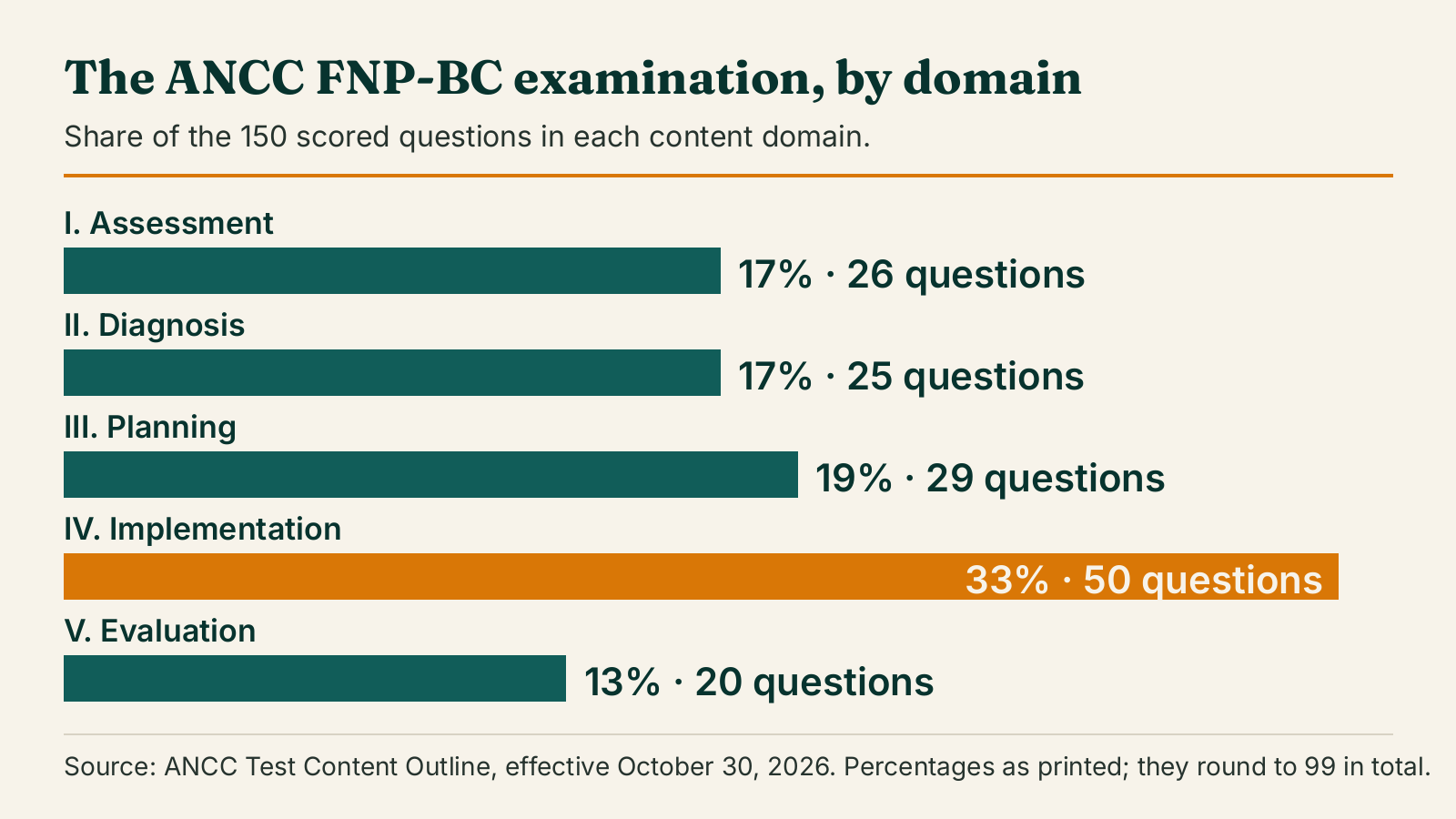
Students have a word for the ANCC material that sits outside the patient case, and the word is fluff. ANCC’s own test content outline, effective October 30, 2026, shows what the word points at, and where it sits. The examination is built in five domains, Assessment, Diagnosis, Planning, Implementation, and Evaluation, and the outline carries no separate professional role section. The legal and ethical material sits inside the clinical domains. Implementation, the largest domain at a third of the scored questions, includes legal and ethical implications for healthcare, regulatory guidelines such as reportable diseases and abuse reporting, and the scope and standards for advanced practice registered nurses. Evaluation includes ethical and legal principles for patients, populations, and systems. Treat the word as a warning rather than a description. That material is tested, so it is not optional, and a study plan that treats it as decoration leaves scored questions unprepared.
Neither credential outranks the other. Both FNP examinations appear on the National Council of State Boards of Nursing list of approved APRN licensure certification organizations and exams, the list state boards build licensure on. NPCB states that its credential is recognized by every state board of nursing and accepted by Medicare, Medicaid, the Veterans Administration, and private insurers.
Blueprints, question styles, fees, and renewal rules are compared side by side in the full comparison of the ANCC and AANP exams and boards.
The employer preference story
One claim circulates through comparison pages, staffing firm blogs, and student forums, and it deserves a direct answer. The claim is that hospitals, academic centers, and Magnet designated hospitals prefer FNP-BC, while clinics and primary care prefer FNP-C.
The claim is folklore. Nothing in the sources behind this page establishes a general employer preference for either letter. In the peer threads and student discussions read for this page, no one reported being hired, rejected, paid differently, or credentialed differently because of the letter after their name. What the primary sources state is acceptance, not preference. Both FNP examinations appear on the National Council of State Boards of Nursing list of approved APRN licensure certification exams, and NPCB states that its credential is recognized by every state board of nursing.
One older version of the story names the Veterans Administration. This page could not verify that history in any primary source, and it does not repeat it as fact. What can be verified today is NPCB’s own statement. NPCB’s site lists the Veterans Administration among the payers that accept the FNP-C, alongside Medicare and Medicaid.
One narrow caveat is worth keeping, and it is a checking instruction rather than evidence of a preference. Anyone headed to a specific federal or military system should read that employer’s own credentialing language before choosing. Check the applicable state board and payer requirements as well.
The five year tail
Whichever board certifies you, the credential runs on a five year cycle. Five years after the examination, the letters come due.
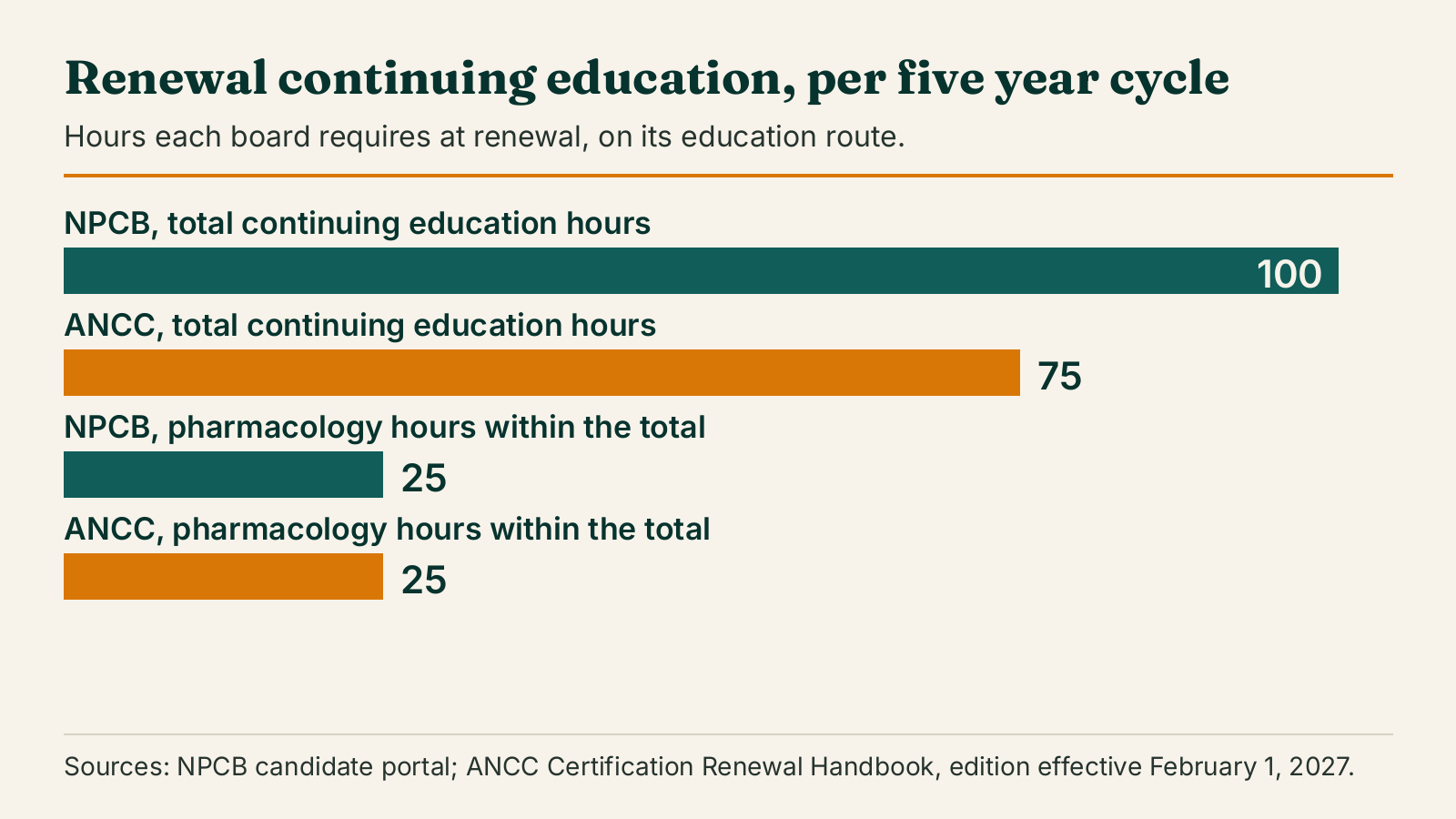
Renewal at NPCB takes one of two routes. The first is practice and education, a minimum of 1,000 practice hours in your population focus plus 100 hours of advanced continuing education, at least 25 of them in advanced pharmacology, on a current RN license. The second route is renewal by examination, sitting the test again.
Renewal at the ANCC is built from continuing education and professional development. Its headline requirement is 75 continuing education hours inside the five year cycle, at least 25 of them in pharmacology for APRN certificants, plus one professional development pathway, on an active RN license. Those figures come from ANCC’s Certification Renewal Handbook edition effective February 1, 2027. Handbook editions change, so read the edition in force when your own renewal comes due.
The full walk through both boards’ renewal rules, categories, and deadlines is the certification renewal and CE guide.
One rule governs the letters themselves in the meantime. You may use your credential only while your certification is active. Let it expire, and you may not use the letters or present yourself as certified until you hold the credential again. The five year date is not paperwork decoration. It is the boundary of the credential itself.
Writing the letters after your name
Students also ask how the letters should be arranged, and the ANCC publishes an accepted order. It sets out highest degree first, then licensure, then the certification, then honorary recognitions and fellowships. The certification sits in the third position, and the ANCC’s own example puts FNP-BC there, after the degree and the RN or APRN license. FNP-C is written in the same position when the certificant’s board is NPCB.
Frequently asked questions
What does FNP-C mean?
FNP-C names a family nurse practitioner certified by the American Academy of Nurse Practitioners Certification Board, the board that now goes by NPCB. The FNP is the population, family and individual care across the lifespan. The C is the board’s certification marker, from its general credential NP-C, which the board expands as Nurse Practitioner-Certified.
What does FNP-BC mean?
FNP-BC names a family nurse practitioner certified by the American Nurses Credentialing Center, the ANCC. The ANCC expands the letters in its own text as Family Nurse Practitioner-Board Certified. The BC ending marks the ANCC the same way the C ending marks NPCB.
Who grants each credential?
NPCB grants FNP-C. Its full name is the American Academy of Nurse Practitioners Certification Board, it operates under the NPCB brand as of 2026, and it is an independent nonprofit affiliated with AANP, not part of the association. The ANCC grants FNP-BC. The ANCC is a subsidiary of the American Nurses Association.
Does it matter which one I choose?
Not in the ways students fear. The two credentials certify the same role and the same population, both examinations sit on the national list of approved APRN licensure certification exams, and the letter has never changed how I practice day to day. Your own license still comes from your state, and an individual employer’s requirements are that employer’s. What does differ is the examination, its size, its scheduling, and where its outline places the legal and ethical material, plus the renewal rules that follow the credential. Choose the test that fits how you think.
Do hospitals or employers prefer one credential over the other?
No general preference shows up in the sources behind this page, whatever the comparison pages say. Both FNP examinations appear on the National Council of State Boards of Nursing list of approved APRN licensure certification exams. NPCB states that its credential is recognized by every state board of nursing and accepted by Medicare, Medicaid, the Veterans Administration, and private insurers. The one check worth making is a specific employer, above all a federal or military system. Read that employer’s credentialing language if you are headed to one named system, and check your state board and payer requirements as well.
Is certification the same as a license?
No. Certification is the national credential a board grants after its examination. Licensure is the state’s permission to practice, and the state also sets your scope of practice. A new family nurse practitioner needs both, the certification at the end of the program and the license from the state board of nursing.
Can I take the exam before my degree is conferred?
Yes, at both boards, once all of your coursework and faculty supervised clinical hours are complete. NPCB lets master’s and postgraduate certificate students apply up to six months before program completion, and DNP students up to twelve months before. The credential itself waits on the final transcript at both boards. NPCB’s handbook requires a final official transcript showing the degree awarded and the date conferred before certification can be issued. The ANCC holds the examination results and issues certification only after every eligibility requirement is met and the final, degree conferred official transcript arrives.
Which exam is easier?
No sourced basis exists for calling one examination easier, and neither board ranks the other’s. No pass rates appear here, because the comparison cannot be sourced fairly. The ANCC displays a pass rate for its 2025 data on its own page. No NPCB pass rate was verified from an NPCB primary page, so this page does not set one board’s figure against the other board’s silence. The more useful question is which format suits you, a shorter clinical only examination, or a longer one whose outline weaves legal, ethical, and regulatory material through its clinical domains.
How should I write my credentials?
In the order the ANCC publishes, highest degree, then licensure, then certification, then honors. A family nurse practitioner certified by the ANCC signs with FNP-BC in the certification position, and one certified by NPCB signs with FNP-C in the same position.
Change log and corrections
First published November 2, 2026. Updates and corrections to this page are recorded in this section with their dates.
Sources for this page
NPCB (American Academy of Nurse Practitioners Certification Board), FNP Candidate Handbook. Eligibility, the three separate APRN core courses, the 500 clinical hour floor, the current and active licensure requirement, application timing, the final official transcript required before certification can be issued, the five year certification period, and the rules on using the credential.
NPCB, About NPCB. The NP-C expansion and trademark, and the board’s history and independence.
NPCB, FNP certification page. The board’s description of its examination as clinical only, its question counts and timing, and its statement of recognition by state boards, Medicare, Medicaid, the Veterans Administration, and private insurers.
NPCB candidate portal, certifications and recertification. The lifespan scope of the FNP examination and the two renewal routes with their hour and CE figures.
AANP, AANP and NPCB, your membership association or your certification board. NPCB eligibility in the board’s general terms and the distinction between the association and the board.
American Nurses Credentialing Center, Family Nurse Practitioner certification. The FNP-BC credential and its expansion, eligibility including the 500 clinical hours and the three APRN core courses, the examination’s size and window, the testing before conferral rules, and the five year validity.
American Nurses Credentialing Center, Family Nurse Practitioner Board Certification Examination, Test Content Outline, effective October 30, 2026. The five scored domains and their weights, and the legal, ethical, and regulatory content the outline places inside the Implementation and Evaluation domains.
American Nurses Credentialing Center, Certification Renewal Handbook, edition effective February 1, 2027. The 75 continuing education hours, the 25 pharmacology hours for APRN certificants, and the professional development requirement.
American Nurses Credentialing Center, APRN Faculty Toolkit. The recommended order for displaying credentials.
American Nurses Credentialing Center, About ANCC. The ANCC as a subsidiary of the American Nurses Association.
National Council of State Boards of Nursing, Approved APRN Licensure Certification Organizations and Exams, updated September 2025. Both the AANPCB and the ANCC family nurse practitioner examinations appear on the national list of approved APRN licensure certification exams.
Community listening, batch 16, November 2026. Firsthand threads and educator content read for the questions students actually ask, the vocabulary they use, and the employer preference claim this page corrects. Patterns are paraphrased and attributed by venue in the research file. The material is qualitative and limited, and Reddit was not sampled. No anecdote is used as article material. Community material shaped the questions and the vocabulary, and the employer section reports only what the reviewed threads did and did not contain.
For clinician education only — not medical advice.
Leave a Reply