
By Daniel Borkert, FNP-C
Last reviewed October 31, 2026. Claims checked against the sources named below on October 31, 2026.
I wanted to do a residency. I think I even applied for one in the Seattle area. There were so few of them, and none was required, so I went straight into practice instead.
I would have benefited from one, and I probably would have taken an offer if one had come. A structured year would have significantly accelerated my competency and my confidence. Instead I built the support a residency would have handed me out of informal mentors and a reference subscription, across years rather than months.
This page is the guide I could not find then. It sets out what NP residency and fellowship programs are, what the outcomes evidence shows and where that evidence runs out, what the year costs in pay, and the structure questions that separate a training program from a cheap pair of hands. It ends with the route most new NPs actually take, because most never get a program at all. Building the same support yourself, through mentorship, inside an ordinary first job.
In this guide
The short answer
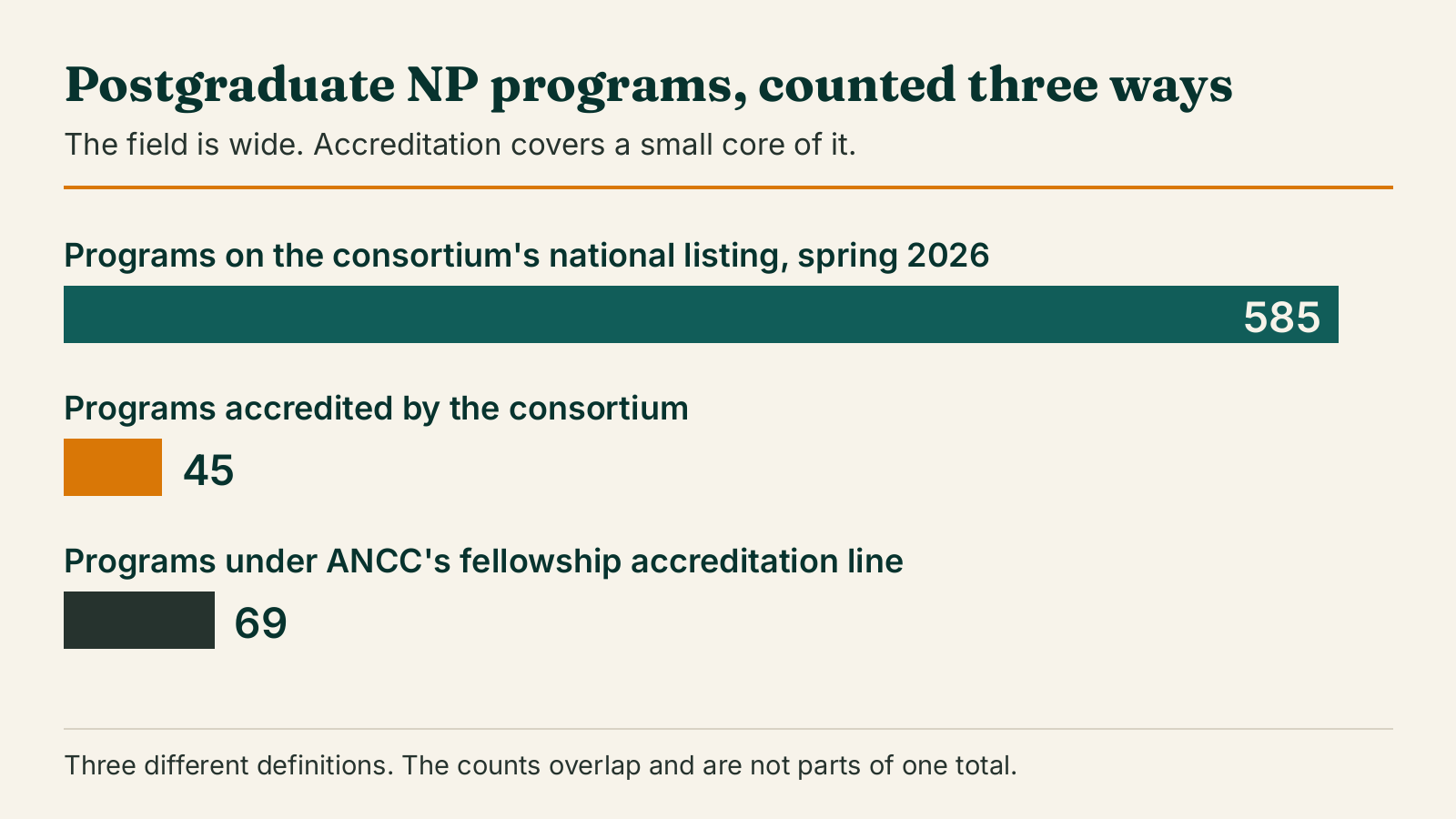
- A residency or fellowship is a 12 month postgraduate training program for new NPs. It is not required for practice. Programs themselves are not rare: the national listing counted 585 NP, PA and joint programs in spring 2026 and over 600 by June, with specialty programs alone spanning more than 100 specialties. Accreditation is the rare part. The consortium behind the original programs accredits 45 of them, with 1,291 alumni in total, and cohorts are small, so most new NPs still transition without one.
- The outcomes evidence points the right way and is thin. An integrative review of 11 studies found confidence and preparedness as the major theme among participants, and says in the same breath that data on these programs’ efficacy is still scarce.
- The decision is structural, not reputational. Judge a program by its hours, its backup, its teaching time, and its mentorship, and judge a first job by the same list. Where no program exists, those features can be negotiated and built inside an ordinary job.
What a residency or fellowship year is
A residency or fellowship, in the NP world, is a year of postgraduate training that sits between graduation and ordinary practice. The programs in the research behind this page run about 12 months. You are employed, you carry patients, and the year is structured around your newness on purpose. Precepted clinics, scheduled teaching, named mentors, and a patient load that is meant to grow rather than arrive full size on the first day.
The two names draw no consistent line. The review literature and the accrediting consortium treat residencies and fellowships together, as one category of postgraduate program, and individual programs use the labels differently. Read the structure of any given program rather than its name. That advice runs through this whole page.
Programs live inside employers. The largest evaluated example in this page’s research is the Veterans Affairs primary care residency, assessed across five sites. Others sit in community health systems, and in programs built for rural and medically underserved communities.
A national consortium, the Consortium for Advanced Practice Providers, accredits postgraduate programs for NPs, PAs, and joint programs, and the American Nurses Credentialing Center accredits advanced practice fellowships under its own line, so accredited programs carry different marks and most programs carry none. Accreditation is one of the few quality signals a new graduate can check from outside.
Scale decides who this page is for, and the scale depends on what gets counted. The consortium counts 192 trainees in its accredited programs for 2025 to 2026, and across every accredited program it oversees, total alumni number 1,291. That is the recorded output of the consortium’s accredited programs, and it is not the whole field.
The same consortium keeps a national listing of postgraduate programs whether or not anyone accredits them, and the listing grows as programs are found. It counted 585 NP, PA and joint programs nationwide in the spring of 2026 and over 600 by that June. A 2025 journal description of the same field, written by Community Health Center and consortium authors, put it at about 550 NP and joint programs across 48 states as of March 2025. A count of NP programs alone has not been updated since an environmental scan found 68 in 2017, so this page does not print a current one.
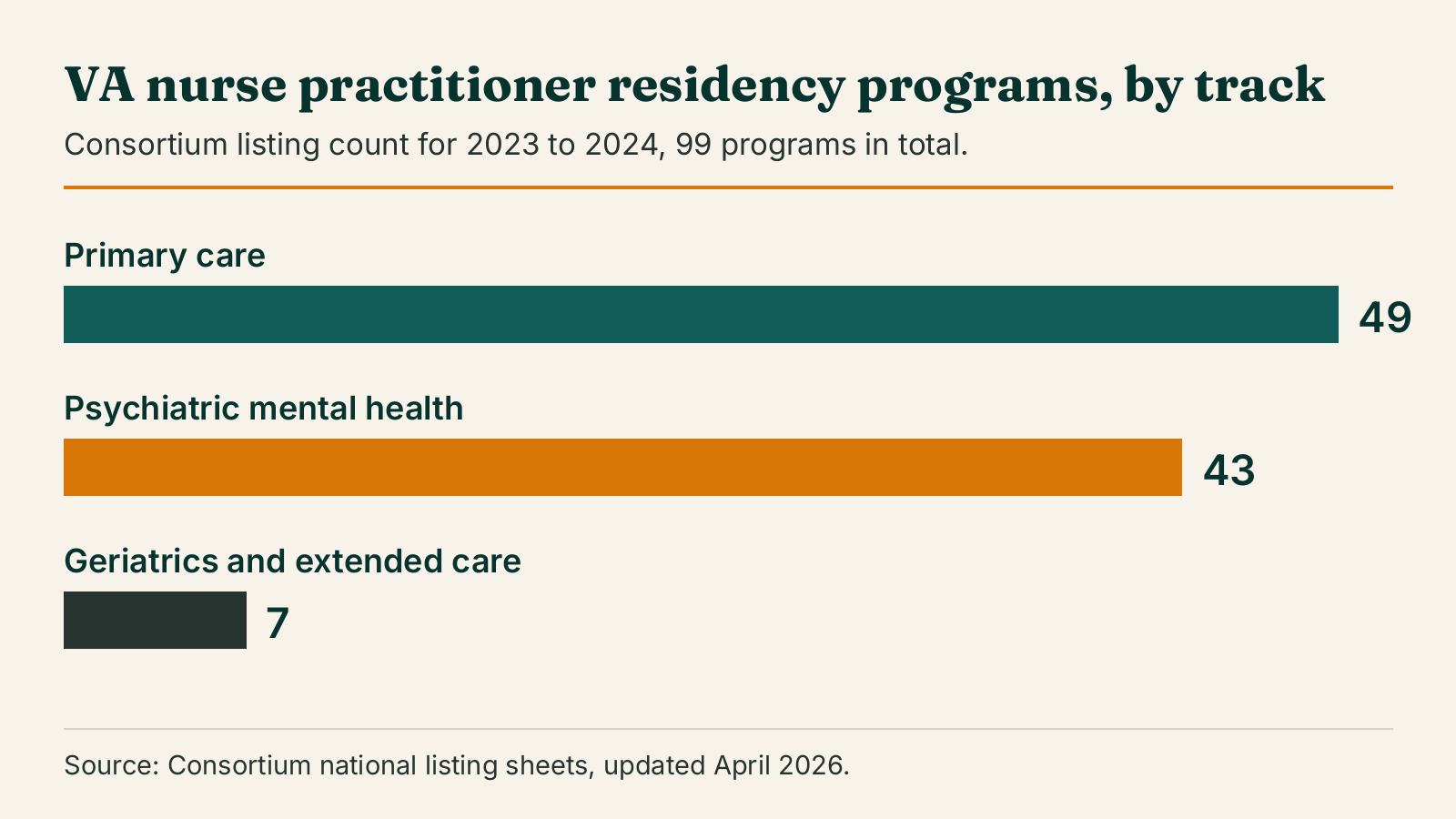
The VA is the largest single system inside the field, and its NP residencies run in three tracks, primary care, mental health, and geriatrics and extended care. The consortium’s listing counted 99 VA residency programs across those tracks in 2023 to 2024, 49 in primary care, 43 in psychiatric mental health, and 7 in geriatrics and extended care.
However the field is counted, cohorts stay small, a handful of seats at a site, in set cities and set specialties, and most new NPs still transition without a residency. The supported year is the exception. The unsupported one is the norm this page has to serve.
None of it is required, and I am the ordinary case. The programs were few, licensure did not ask for one, and I started work. An organized objection in the profession’s residency debate holds that NPs are competent at graduation and that making programs mandatory would build financial barriers into the profession’s entry. This page takes no side in that argument, because the outcomes evidence in the next section cannot settle it. What the evidence can do is help a new graduate judge the offers actually on the table.
For some new graduates the program question arrives from the other direction. Job postings ask for experience the new graduate cannot yet have, and the question underneath the applications, asked in exactly those terms in new graduate communities, is how anyone is supposed to get experience when nobody gives them the first opportunity. Creator content aimed at that frustration points to fellowship programs as one bridge across it. The catch is part of why programs get considered by people who never set out wanting one.
There is no book to hand you, either. The print shelf for new NPs carries transition guides, role textbooks with mentoring chapters, and a scholarly literature on mentoring. It contains no book length guide to choosing a residency or fellowship at all. The decision gets articles, program pages, and debate, and no book. That gap is part of why this page exists.
The programs themselves, a landscape
Named examples make the range concrete. Every program in the table below was checked against its own program page for this page in October 2026. The list is representative, not a ranking and not an endorsement, and programs open, close, and change their terms between application cycles, so treat it as a map of what exists, then read the current page of any program you pursue.
The length column gives the training period. A program can also attach an employment commitment after it, Community Health Center’s residency among them, and the terms live on the program’s own page. The table does not report accreditation. Where a program holds accreditation it belongs to that named program and track, and it is checked on the program’s own page, not inferred from this table.
| Specialty | Program | Who it takes | Length |
|---|---|---|---|
| Primary care | Community Health Center Inc. NP Residency, Middletown, Connecticut | FNPs; sister tracks take PMHNP, adult gerontology and pediatric NPs | 12 months |
| Primary care | VA Puget Sound Primary Care NP Residency, Seattle, Washington | AGNP or FNP | 12 months |
| Primary care | Sea Mar APP Residency, Seattle area, Washington | FNPs; its psychiatric program takes PMHNPs; PAs admitted since 2025 | 12 months |
| Primary care | HealthPoint NP Residency, Renton, Washington | FNPs | 2 year contract; year 1 is the residency |
| Critical care | Mayo Clinic NP/PA Critical Care Fellowship, Rochester, Minnesota | NPs and PAs | 12 months |
| Critical care | Emory Critical Care Center APP Fellowship, Atlanta, Georgia | Acute care NPs and PAs only | 12 months |
| Critical care | Duke Critical Care Fellowship for APPs, Durham, North Carolina | Acute care NPs and PAs | 12 months |
| Critical care | Virginia Mason Franciscan Health Critical Care APP Fellowship, Tacoma, Washington | Acute care NPs and PAs; FNPs with ICU RN experience considered | 12 months |
| Critical care | UCSF Surgical and Critical Care APP Fellowship, San Francisco, California | AGACNPs and PAs | 12 months |
| Hospital medicine | Johns Hopkins NP/PA Fellowship in Hospital Medicine, Baltimore, Maryland | NPs and PAs | 12 months |
| Emergency medicine | UCSF Emergency Medicine APP Fellowship, San Francisco, California | Adult and family NPs, and PAs | 12 months |
| Oncology | MD Anderson Post Graduate Fellowship in Oncology Nursing, Houston, Texas | Adult, adult gerontology, acute care and family NPs; NPs only | 12 months |
| Oncology | Fred Hutch and UW Medical Center APP Oncology Fellowship, Seattle, Washington | NPs and PAs | 12 months |
| Oncology | OHSU APP Hematology and Oncology Fellowship, Portland, Oregon | Family, adult, adult gerontology acute care, adult gerontology primary care, and acute care NPs, and PAs | Not stated on its page |
| Cardiology | Emory APP Fellowship in Cardiac Critical Care Medicine, Atlanta, Georgia | Acute care NPs and PAs | One year |
| Surgery | Duke Abdominal Transplant Fellowship for APPs, Durham, North Carolina | Acute care NPs and PAs | 12 months |
| Surgery | Mayo Clinic NP/PA General Surgery Fellowship, Rochester, Minnesota | NPs and PAs | 12 months |
| Pediatrics | Seattle Children’s APP Fellowship, Seattle, Washington | APPs; its page does not break out NP certifications or PA eligibility | One year |
| Mental health | Vanderbilt PMHNP Fellowship, Child and Adolescent Psychiatry, Nashville, Tennessee | PMHNPs only | 12 months |
| Mental health | OHSU Psychiatric APP Fellowship, Portland, Oregon | PMHNPs and PAs | Three 17 week rotations |
| Mental health | VA Puget Sound Mental Health NP Residency, Seattle and American Lake, Washington | PMHNPs only | One year |
| Geriatrics | VA Houston Geriatrics and Extended Care NP Residency, Houston, Texas | FNP, AGPCNP and AGACNP | 12 months |
A few patterns are worth seeing whole. The big academic centers mostly run joint NP and PA fellowships, and their NP door is usually a specific certification. Critical care is the largest academic cluster, and programs like Emory’s take acute care NPs only. Stanford’s fellowship runs six tracks, from cancer care and cardiac electrophysiology to orthopedic and cardiothoracic surgery, plus an administration track for experienced APPs. Dartmouth Hitchcock lists six tracks of its own, including hospice and palliative care and otolaryngology, alongside primary care.
Primary care residencies sit mostly somewhere else, in community health centers and the VA, and their door is usually the family NP certification. Oncology splits both ways. MD Anderson’s fellowship takes NPs only, in adult, adult gerontology, acute care, and family certifications, while the Fred Hutch fellowship in Seattle and the OHSU fellowship in Portland take NPs and PAs together.
Readers in the Pacific Northwest meet a local version of the same map. Seattle alone holds the Fred Hutch oncology fellowship, the VA Puget Sound primary care residency, with its mental health residency shared with American Lake, Seattle Children’s general and psychiatric fellowships, a University of Washington psychiatric fellowship, and Sea Mar’s primary care and psychiatric programs across its sites. Tacoma has Virginia Mason Franciscan Health’s critical care fellowship, and Renton has HealthPoint’s FNP residency under a two year contract. Portland has OHSU’s three fellowships, in hematology and oncology, psychiatry, and dermatology.
Two honest gaps belong on the map as well. Geriatrics training for NPs is mostly a VA offering; one joint NP and PA geriatrics fellowship outside the VA was verified for this page, and no NP only geriatrics program outside the VA was found. And pediatrics runs thinner than the academic names suggest. Seattle Children’s general fellowship is the verified example here, and its page does not break out which NP certifications it takes, which is itself a first question to ask any program.
What the outcomes evidence shows
Start with the whole field at once. In 2024, Kevin McDonough published an integrative review of postgraduate NP fellowship and residency outcomes. It found 11 articles worth including. Eight were quasi experimental and three were cross sectional, designs that describe how a cohort changed without isolating the program as the cause. The major theme across them was increased confidence and preparedness to practice among participants. The minor themes were increased job satisfaction, reduced turnover, and decreased intent to quit.
Two limits travel with that finding everywhere this page uses it. The outcomes are dominated by what participants report about themselves, so confidence and preparedness here are mostly self assessed. And the review states its own limit directly. The data on the efficacy and benefits of these programs is still scarce. A guide that quotes the theme and drops the scarcity is misquoting the review.
The strongest single program account is the Veterans Affairs evaluation. Across five sites, residents rated themselves, and their mentors rated them, across a 12 month primary care residency. Both sets of ratings improved significantly in all seven competency domains, and at 12 months the mentors rated the residents able to practice without supervision in every domain.
That is one large system’s account of its own program, built on self ratings and mentor ratings rather than independent measurement. It shows what a structured year can look like from inside. It does not measure residencies in general, and it should not be quoted as if it does.
A smaller account adds what residents themselves say they took away. In a qualitative study of 15 NPs who completed a residency inside one Canadian health authority, participants reported that the program’s structured mentorship influenced their decision to join that employer, and that exposure across specialties and clinical environments enhanced their clinical skills and confidence. Fifteen people, one employer, self reported experience. It is a window into what a program feels like from inside, and it names the two features residents keep naming in this literature. A mentor who is actually there, and breadth you cannot schedule for yourself.
The accreditor’s own numbers belong in a different mental drawer from the studies. The consortium reports its 2025 outcomes across accredited programs as an average completion rate of 88 percent and an average job placement rate of 89 percent.
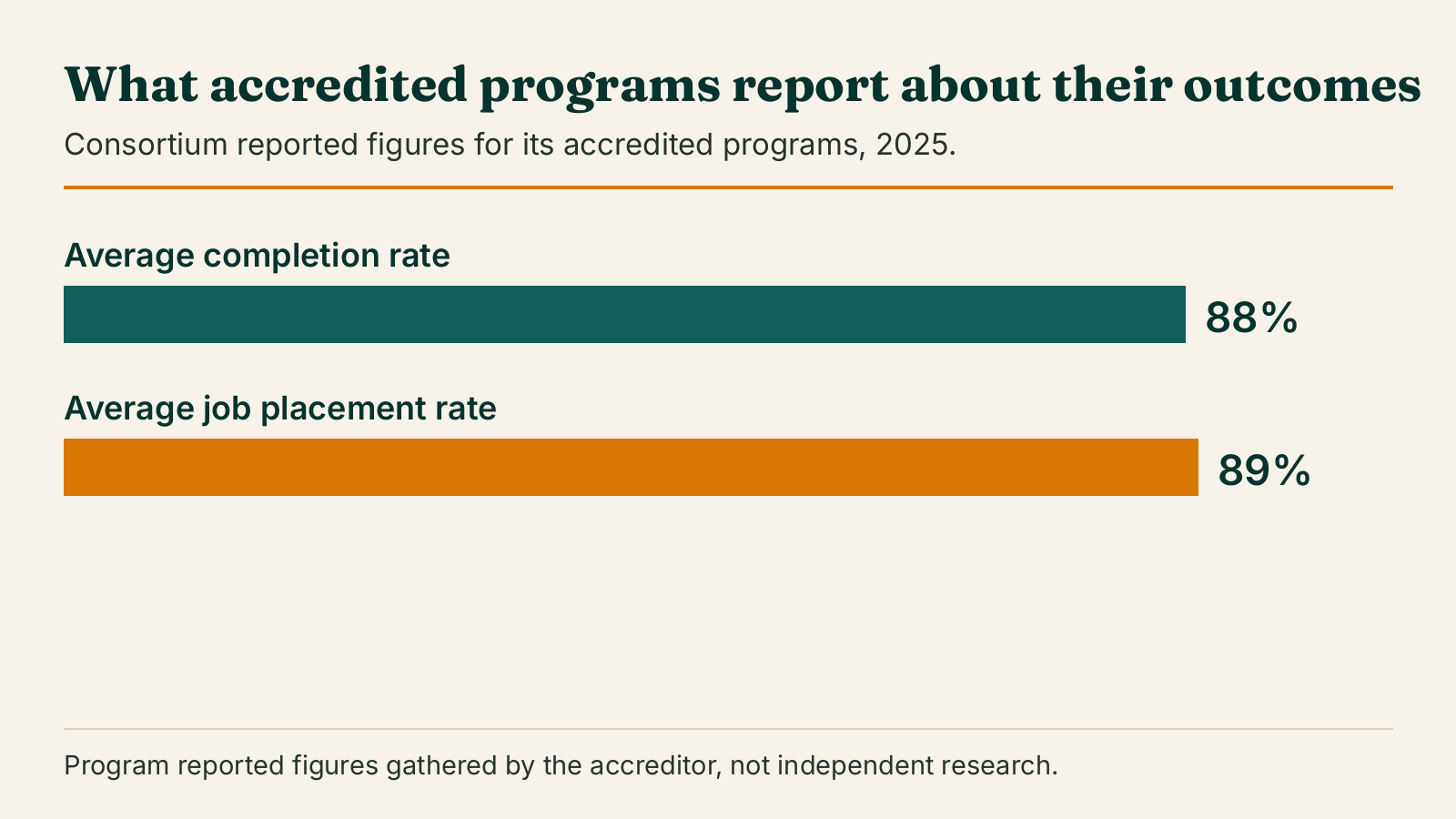
Those are program reported figures gathered by the body that accredits the programs, not independent research, and the same page says the evidence base continues to grow and that additional research is needed. Completion and placement also measure a program’s pipeline rather than what the year did for the clinician. Hold them as signs that accredited programs finish most of the people they start and place most of the people they finish, and as nothing more than that.
Add it up and the honest statement is narrow. Structured postgraduate years are associated, in early and mostly self reported evidence, with new NPs who feel readier and who stay longer. Nobody has yet run the study that would let this page say more than that, and any program brochure saying more is ahead of its evidence.
The pay trade
A program year is a trainee year, and the trade at the center of every residency decision is a year of full practice earnings given up against a year of structure received. Most programs publish no pay figure, and this page will not invent one. What can be priced is the shape of the trade, and what the structure on offer is worth against the specific difference in front of you.
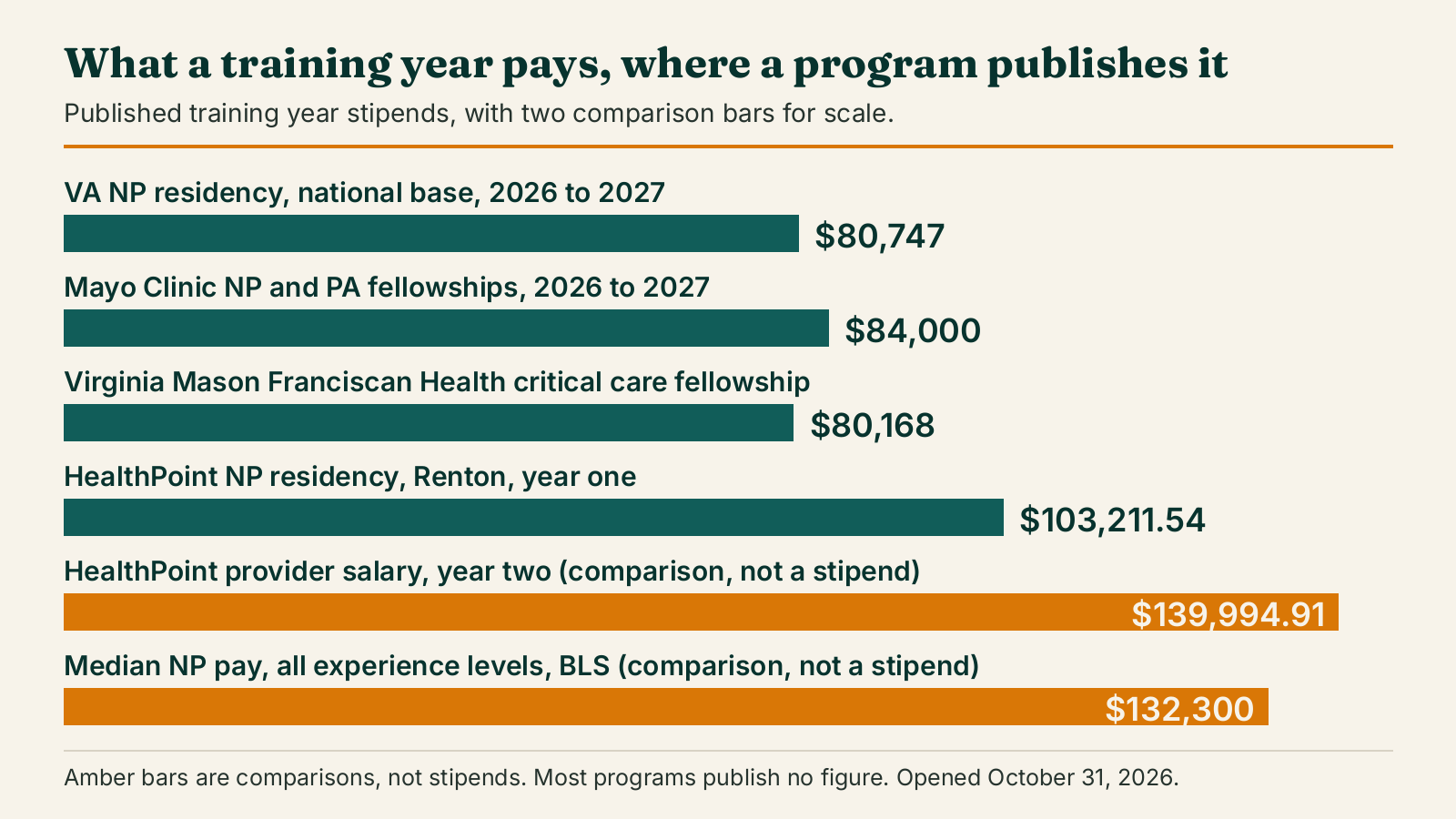
Where programs publish, the figures cluster. The VA pays residents under a national system, locality adjusted above an $80,747 base for 2026 to 2027; San Francisco publishes $101,954. Mayo Clinic fellowships pay $84,000 for 2026 to 2027, and Virginia Mason Franciscan Health’s critical care fellowship pays $80,168, with a two year return of service. The one national dataset is a survey, not a census: Kidd and colleagues’ 2024 survey drew 129 disclosures, most paid between $65,000 and $85,000, the most common band $76,000 to $86,000, self reported, in bands.
One employer publishes both sides of its own trade. HealthPoint, in Renton, pays $103,211.54 for the residency year and $139,994.91 for a second year full time provider, a gap of $36,783. Beyond that pair, no exact gap can be computed; no published series tracks new graduate first job earnings. This site’s nurse practitioner salary guide makes the companion point. The Bureau of Labor Statistics publishes no wage split by experience, and its percentiles describe the whole workforce, not a career ladder, so no band in them is a new graduate rate; its median annual wage, across all experience levels, is $132,300. A training year trades against full practice earnings; the reader’s own offer is the only exact second term.
My own position, from the far side of a first year spent without that structure, is not neutral. I think most new graduates should do a residency or fellowship, or seriously consider one. The acceleration is the point. The competency and confidence I built across years of ordinary practice is what a structured year exists to compress into twelve months.
On pay, a difference is fair. A trainee who is being taught, precepted, and carried at a growing load is not yet producing what a full practice NP produces, and a training salary below a practice salary prices that honestly. What I would add is the employer’s side of the ledger. Large companies and organizations should consider investing in these programs as feeders into their own healthcare system.
The counterweight is personal arithmetic, and it is real. A year at a training rate is a genuine sum forgone, against loan payments and a life that does not pause while you train. Nobody can run that arithmetic for you. The next section is how to tell whether the structure on offer is worth your number.
The community argues the same trade in its own terms. Creator advice to new graduates repeats one instruction in several voices. Pick the job that will teach you, because the first two years are a steep learning curve, and a well paying job that teaches nothing is the expensive one.
One practicing NP’s recurring advice segment ranks the things to look for in a first job as mentorship first, orientation and training second, and patient volume third, with salary named as the thing new graduates lead with and should not. That ranking is the pay trade answered as a support question.
Judging a program, the structure questions
The durable warning in the new graduate community is that some fellowships are cheap labor under a training label, and that a famous name is no guarantee of a teaching environment. Treated as an accusation, that warning is unanswerable. Treated as a checklist, it is the most useful passage on this page. When I am asked what a new graduate should check before trading a year of pay for a fellowship, my answer is a list of structure questions. Ask every one of them, of any program, and notice which ones the program cannot answer.
- Maximum hours. Is there a stated ceiling on the working week, and does the program keep it?
- Call. Is call part of the year, how much of it is there, and from how early?
- Backup support. When a case runs past you, who backs you up, and is that backup a named person or an assumption?
- Classroom hours. Is scheduled teaching time built into the week, and is it protected from clinical pull?
- Learning materials. Are books and online references provided, or are you buying your own tools?
- A mentorship program. Is a mentor assigned as part of the design, and are the mentors prepared for the role? One small evaluation of 19 fellows in a rural training program, self reported and single site, credited its structured support in participant feedback and still named a need for better mentor preparedness. A program can advertise mentorship and underbuild it. Ask how its mentors are chosen and supported.
- Cohort groups. Do you train alongside peers at your own stage, or alone inside a department of experienced clinicians?
- Rotations through specialties. Does the year deliberately move you across services and settings, or keep you in one?
- Procedure opportunities. Are procedures taught and supervised, or only observed?
- Leadership development. Does the program build anything beyond the clinical year, in quality work, teaching, or committee experience?
The same list reads a workplace, not only a program, and one study explains why the backup and mentorship questions carry the weight they do. In Amy Edmondson’s field study of 51 work teams, a team’s shared belief that it is safe to take interpersonal risks, asking questions, seeking feedback, and discussing errors, was associated with exactly that learning behavior.
Three cautions belong with it. The setting was manufacturing teams rather than clinical ones, the findings are associations rather than proof of cause, and the belief is a property of a team, not a trait a new graduate can be told to have. Read with those cautions, the study still tells an applicant what to listen for in an interview. A workplace that treats questions as weakness is telling you how your first year will go.
The same screening runs through the new graduate community in a shorter form. New NP creators trade red flag and green flag lists for first jobs, and the pairs map onto the questions above. No orientation against structured onboarding. No mentor against strong mentorship. A full patient load on day one against a gradual ramp up. Rushed into independent practice against support when you need it. A list that short is a poster rather than an evaluation, but it tells you which failures the community has learned to price first.
No program, build the support yourself
Most readers of this page will take this section’s route, because most new NPs have no program to take. The consortium’s accredited programs count 1,291 alumni in total, and the wider field’s cohorts stay small and local. Everyone else assembled a first year some other way. Here is the way, built from the same evidence and from my own year.
The research recommendation is formal mentorship. In the Ontario study of 23 first year NP graduates, mentorship by a colleague had a positive effect on the transition into the new role, and the authors recommend that all newly hired NP graduates would benefit from formal mentorship when beginning practice, preferably with experienced NPs or physician colleagues.
That is a qualitative finding from one study, and nothing in this page’s research measures how large the effect is. What it establishes is direction. The supported transitions went better, and the unsupported ones named the lack of orientation, mentorship, and infrastructure as the difficulty.
Ask for it by name when you sign. A new graduate can request an assigned mentor as a term of the job rather than a favor after it, and the study above is the reason the request is reasonable rather than presumptuous.
The community’s hardest version of the same advice is a refusal. In a job thread in this page’s research, a newly graduated NP declined an offer after a shadowing week in which she would have seen about 11 patients a day with no training on the record system or the clinic workflow, critical results and after hours prescribing expected, under a restrictive two year contract. The 38 comments under the post overwhelmingly validated the refusal and traded similar stories.
The lesson that thread teaches is the one this section is built on. Read an offer for its support, including the contract that would lock you into an unsupported job, before you read it for its salary.
What I actually had was the informal version, and it worked. My mentors were peer NPs and PAs and physicians around me. None of it was assigned, scheduled, or written into my job. I had to reach out for help most of the time. The support existed, but I had to go and get it, question by question.
What made a mentor a mentor was not seniority. They said they were available, and then they actually responded when I texted, called, or asked. Availability stated, then honored. That is the test to apply to anyone who offers to be yours, and the standard to hold your own reaching out to. Ask early, ask specifically, and keep asking.
The permission to ask has to survive contact with real workplaces, and the community is blunt about both halves of that. Its most repeated piece of affirmative advice is to stop apologizing for asking questions, and the warning that travels with it is the old one, that nurses eat their young.
What mentors say the questions mostly are is plainer than new graduates fear. A clinical training director whose job is onboarding new NPs, interviewed on the Real World NP channel, reports that the number one question her newest clinicians bring her is not a knowledge question at all. It is, is this okay, am I normal. In the first months the asking is mostly calibration and permission, which is exactly the kind a workplace can make cheap or expensive.
The asking itself has a mentality underneath it, and it is the subject of the companion piece to this one, imposter syndrome as a new nurse practitioner. The doubt that makes a question feel like exposure is documented, named, and survivable, and the short version of that whole page is this. Asking and checking are part of the role, not evidence against you.
I also had a mentor that was not a person. I treated UpToDate as a mentor, and honestly it was probably my primary one. It answered at the moment of the question, as often as I asked, without judgment. Today I would lean on UpToDate and OpenEvidence in addition to colleagues. A new NP building support from nothing should secure the reference first. Get an evidence based guideline service, and you have hired the one mentor who is available on day one, at 2 a.m., for the simplest question you own.
A mentor is doing more than answering, and the theory underneath this page says why. In Bandura’s self efficacy theory, one of the channels through which people judge their own capability is watching models, especially models they see as similar to themselves, and that channel carries its greatest weight when the work is new and your own performed successes are still few.
Watching a clinician a year or two ahead of you handle the day you are dreading is evidence, not comfort. It is one of the inputs confidence is actually built from, which is a reason to choose mentors near enough to your stage that their steadiness reads as reachable.
The print shelf agrees that finding a mentor is a project rather than a hope. The NP role textbook, Stewart and DeNisco’s Role Development for the Nurse Practitioner, carries a dedicated mentoring chapter. Aktan’s Fast Facts for the New Nurse Practitioner gives the search for a mentor a two chapter part, with criteria for what to look for. Grossman’s Mentoring in Nursing is the scholarly treatment of mentoring models, written mostly for the mentor’s side of the table.
None of that is outcome evidence. It is the profession’s written consensus that the search deserves method, and method is what a new graduate without a program needs most.
Then ask for the residency features by name, inside the ordinary job. One NP creator’s line states the strategy whole: your first job is your residency. Many first jobs carry a ramp in some form. Mine gave me a month to ramp up, which was something, and not much. Protected time is rarer, and nobody protected mine. What I had was mentorship advice on how to manufacture it.
Set a schedule and set boundaries. Do the paperwork in the hours when patients are resting or busy with other services, and find the sweet spot in the day when the real work can actually be done. A ramp and protected hours are negotiable before you sign, while the negotiation is still open, and they are worth more than most of what gets negotiated instead.
The accounts of good ordinary starts describe the same features from the receiving end. One new NP describing her orientation at a community health center tells of a week shadowing a physician, then a reduced schedule that grew over months until she carried a full caseload around the one year mark, and a preceptor who took her under her wing and answered all her questions.
Her summary of the year is that new graduates need a support system and at least one person they can call on. That is the ask this section keeps repeating, one trusted person, arriving here from someone describing a job that got it right.
One support a program hands you that a solo new NP has to build deliberately is peers. The strongest intervention evidence anywhere in this page’s research is about exactly that, and it comes from another profession, so read its flags before its finding.
In a pilot randomized trial, 101 female resident physicians at one university volunteered for a six month web based group coaching program. Against training as usual, the coaching group showed significantly reduced emotional exhaustion, significantly reduced impostor syndrome scores, and significantly increased self compassion across the six months.
The flags are these. A pilot trial, a single institution, physician trainees rather than nurse practitioners, all women, all volunteers, and outcomes measured on self report scales. It is not NP evidence, and this page does not present it as any. What it is, is the only randomized evidence in reach showing that structured group coaching among peers at your stage measurably moves the first year experience, in the same direction everything else on this page points.
A cohort does not need a program office. It needs a recurring time, and people at your stage who will say the true thing.
The honest summary
Here is what this page can and cannot honestly tell you. Residencies and fellowships are real and structured, and most new NPs will never train in one. The evidence that they help is early, mostly self reported, and described by its own reviewers as scarce, and it all points the same way. Supported first years go better than unsupported ones.
The support is the active ingredient, not the label on the year, and support can be built where no program exists. That is what most new NPs will have to do. It is what I did, without knowing at the time that I was assembling, piece by piece, the thing I had applied for. Judge every offer, program or job, by the structure questions. Then get the reference, find the people, and ask them everything.
Practice Brief signup. This page is part of a short series of practice guides for nurse practitioners beyond the boards. The Practice Brief is the email list that carries them.
Frequently asked questions
Is a residency required to practice as a nurse practitioner?
No. A residency is not a licensure requirement, and the large majority of practicing NPs never completed one, which the consortium’s accredited programs’ own alumni total of 1,291 makes concrete. The programs are voluntary postgraduate training. A debate about making them mandatory exists in the profession, with an organized counterposition holding that NPs are competent at graduation and that mandates would build financial barriers into entry. The evidence on this page does not show the outcome superiority that would settle that argument, and this page does not pretend otherwise.
What is the difference between an NP residency and a fellowship?
In the sources this page rests on, there is no consistent line. The integrative review of program outcomes and the accrediting consortium both treat residencies and fellowships as one category of postgraduate training, and individual programs use the two labels differently. Some of the variation is local habit rather than design. Judge any specific program by its structure, its hours, backup, teaching time, and mentorship, and not by which word sits in its name.
Does a residency actually make new NPs more confident?
Participants say so, and the measurement underneath them is thin. The integrative review of 11 studies found increased confidence and preparedness as the major theme among program participants, and the outcomes in that literature are mostly self assessed. The same review says the data on these programs’ efficacy is still scarce. The fair statement is that new NPs who complete structured programs report feeling readier, that mentors in the largest evaluated program rated its residents ready for unsupervised practice at twelve months, and that no stronger design has yet tested the claim.
There is no program anywhere near me. What do I do instead?
Take the default route, which is most NPs’ route, and build the support deliberately. Secure an evidence based guideline service first, because it is the one mentor available from day one. Find informal mentors, peer NPs, PAs, and physicians, who say they are available and then actually respond, and reach out to them early and often. Ask for an assigned mentor, a ramp period, and protected time as terms of the job before you sign. And build a peer cohort at your own stage, because structured peer support is the one intervention in this page’s research with randomized evidence behind it, in another profession’s trainees. The sections above work through each of those in turn.
Change log and corrections
This page carries a public change log. Every correction, addition, and re-verification is recorded here with its date and the source it was checked against.
| Date | Section | What changed | Checked against |
|---|---|---|---|
| October 31, 2026 | First publication | The page published with its statements drawn from the sources named below, each checked on October 29, 2026, with the program landscape checked on October 31, 2026. | The sources named in the Sources section |
| October 31, 2026 | The pay trade | Pay data and a stipend chart added; the salary guide linked; one sentence corrected. | VA facility pages; program pages; Kidd et al, Cureus 2024. Checked October 31, 2026 |
| October 31, 2026 | The pay trade | Stipend chart: NP pay bar added. | BLS OEWS, May 2025. Checked October 31, 2026 |
| October 31, 2026 | The pay trade | Stipend chart: comparison bar changed from the BLS mean to the BLS median, $132,300, to match the salary guide. | BLS OEWS, May 2025. Checked October 31, 2026 |
Corrections: to report a suspected error, email daniel@boardandbedside.com naming the section and the source you believe is current. A reported error is checked against its source before any change is made, and the outcome is recorded here either way.
Sources for this page
McDonough KE. Outcomes of Postgraduate Fellowships and Residencies for Nurse Practitioners, An Integrative Review. Journal of Professional Nursing 2024;53:95-103. Eleven articles, eight quasi experimental and three cross sectional, for confidence and preparedness as the major theme among program participants and the minor themes of job satisfaction, turnover, and intent to quit. Used here only with the review’s own statement that data on these programs’ efficacy is still scarce.
Rugen KW et al. Evaluation of Veterans Affairs Primary Care Nurse Practitioner Residency, Achievement of Competencies. Nursing Outlook 2018;66(1):25-34. The five site VA residency evaluation, for the improvement in resident self ratings and mentor ratings across all seven competency domains and the twelve month unsupervised practice ratings. A single system’s evaluation, based on self and mentor ratings rather than independent measurement.
Crowe S and de Sequera M. Understanding the Residency Experience of Nurse Practitioners in Fraser Health, A Qualitative Study. Canadian Journal of Nursing Research 2026;58(1):58-65, published online in 2025. Fifteen residency graduates in one Canadian health authority, for structured mentorship as a reason participants joined the employer and exposure across specialties as a source of skill and confidence. Small, qualitative, single employer, self reported.
Consortium for Advanced Practice Providers (National Nurse Practitioner Residency and Fellowship Training Consortium). Benefits and Outcomes page, opened October 29, 2026. The accreditor’s reported 2025 outcomes, an average completion rate of 88 percent and an average job placement rate of 89 percent, with 192 trainees in accredited programs for 2025 to 2026 and 1,291 total alumni. Accreditor reported program data, not independent research, used with the page’s own statement that the evidence base continues to grow and additional research is needed.
Consortium for Advanced Practice Providers. FAQ page, Spring 2026 Newsletter, and national program listing sheets updated April 2026, opened October 31, 2026. The scale framing’s wider field rests on these. The FAQ page, marked updated October 15, 2026, states that over 600 APP postgraduate training programs existed as of June 2026. The Spring 2026 Newsletter counts 45 programs accredited by the consortium and 585 postgraduate NP, PA, and joint programs on its national listing. The listing sheets state that 48 states have NP and NP/PA programs, give the VA’s 2023 to 2024 residency counts by track, 49 primary care, 43 psychiatric mental health, and 7 geriatric and extended care, and count 36 states with specialty programs offering training in over 100 specialties. The listing counts NP, PA and joint programs together and grows as programs are found, so its figures are a moving listing and not a census.
American Nurses Credentialing Center. Accreditation program counts page, opened October 31, 2026. The page counts 69 programs in 139 sites under its Advanced Practice Provider Fellowship Accreditation line. Its larger Practice Transition Accreditation Program count, 344 programs, transitions registered nurses into new practice settings and is not an NP count, and it is not used here as one.
Angers J et al. Innovations in Health Professions Training to Address the Health Workforce Needs, Nurse Practitioner Residency and Fellowship Programs. Journal of Primary Care and Community Health 2025. The scale framing’s journal description of the field, about 550 NP and joint NP/PA postgraduate residency and fellowship programs in 48 states as of March 2025, with 20 percent located in health centers. The authors are Community Health Center and Weitzman Institute staff with the consortium’s executive director as a co-author, and the count tracks the consortium’s listing rather than an independent census.
Martsolf GR et al. Postgraduate Nurse Practitioner Residency and Fellowship Programs. The Journal for Nurse Practitioners 2017. The last NP only count this page’s research found, 68 active programs, 31 residency and 37 fellowship, from an environmental scan. It dates from before the growth of specialty fellowships at academic centers and is used as a dated baseline, not a current total.
Program pages, opened October 31, 2026. Every program named in the landscape table and text was checked against its own institution’s pages: Community Health Center Inc, VA Puget Sound, Sea Mar Community Health Centers, HealthPoint, Mayo Clinic, Emory, Duke, Virginia Mason Franciscan Health, the University of California San Francisco, Johns Hopkins, MD Anderson, Fred Hutch Cancer Center, Oregon Health and Science University, Seattle Children’s, Vanderbilt, VA Houston, the VA Office of Academic Affiliations, Dartmouth Hitchcock, Stanford Health Care, the University of Washington, and the Levine Cancer Institute Center for Advanced Practice. Accepted NP certifications, tracks, and lengths are stated as those pages state them, and where a page does not state a field, the landscape says so. Programs change their terms between application cycles, and naming a program here is not an endorsement. The University of Washington psychiatric fellowship was verified from the university’s department pages, no standalone program page being found.
Kidd VD, Horstmann JL, Felder S, Bamrick K. An Analysis of Trainee Salaries Offered in Nurse Practitioner and Physician Assistant/Associate Postgraduate Residency and Fellowship Programs in the United States. Cureus 2024;16(7):e64434. A survey of program directors (336 invited, 151 responding, 129 disclosing). Self reported and banded, not exact; two authors are Consortium accreditation staff.
US Department of Veterans Affairs. NP resident stipends, set nationally by the Office of Academic Affiliations, locality adjusted, from VA facility pages. The San Francisco residency page publishes $101,954. The VA programs named on this page publish no figure.
US Bureau of Labor Statistics. Occupational Employment and Wage Statistics, May 2025 release, nurse practitioners. Median annual wage $132,300 across all experience levels; BLS publishes no wage split by experience.
Ketel C et al. Advancing Nurse Practitioner Proficiency and Confidence, An Evaluation of Postgraduate Training in Rural and Medically Underserved Communities. Journal of the American Association of Nurse Practitioners 2024;(9):512-522. Nineteen fellows in a single rural program, read in this research through a journal index record rather than at the publisher. Used here only for its qualitative finding that participants credited the program’s structured support while naming a need for better mentor preparedness. Very small sample, self reported measures.
Sullivan-Bentz M et al. Supporting Primary Health Care Nurse Practitioners’ Transition to Practice. Canadian Family Physician 2010;56(11):1176-1182. A qualitative study of 23 first year NP graduates and 21 coparticipants, for the positive effect of colleague mentorship on the transition, the difficulty named where orientation, mentorship, and infrastructure were lacking, and the recommendation of formal mentorship for every new graduate. Single province, primary health care setting, and no measured effect size exists in it.
Fainstad T et al. Effect of a Novel Online Group-Coaching Program to Reduce Burnout in Female Resident Physicians, A Randomized Clinical Trial. JAMA Network Open 2022;5(5):e2210752. A pilot randomized trial of 101 female resident physicians at one institution, for the effect of six months of structured group coaching on emotional exhaustion, impostor syndrome scores, and self compassion. Physician evidence from a pilot trial, not NP evidence, and used here as nothing more.
Edmondson A. Psychological Safety and Learning Behavior in Work Teams. Administrative Science Quarterly 1999;44(2):350-383. A field study of 51 manufacturing work teams, for the association between a team’s shared belief that interpersonal risk is safe and learning behavior such as asking questions and discussing errors. Correlational and team level, used with those cautions.
Bandura A. Self-efficacy theory, as stated in Artino AR Jr, Academic Self-Efficacy, Perspectives on Medical Education 2012, and Gale J et al 2021, used here in relayed form through those two agreeing sources; Bandura’s own texts were not opened in this research. For the sources of self judgment, including watching similar models, and the greater weight of that channel when a task is new.
Stewart JG and DeNisco SM, editors. Role Development for the Nurse Practitioner. Jones and Bartlett Learning, third edition 2023. The NP role textbook, carrying a dedicated mentoring chapter. Cited as professional consensus and landscape, not as outcome evidence.
Aktan NM. Fast Facts for the New Nurse Practitioner, What You Really Need to Know in a Nutshell. Springer Publishing Company, second edition 2015. The NP transition guide whose part on finding a mentor sets out criteria for what to look for. Practitioner and educator guidance, cited as landscape, not as evidence.
Grossman SC. Mentoring in Nursing, A Dynamic and Collaborative Process. Springer Publishing Company, second edition 2012. The scholarly text on mentoring models and evaluation, addressed mainly to the mentor’s side of the relationship. Cited for what mentoring is and how it is structured, not as outcome evidence for new NPs.
Community listening, October 2026. First person accounts by new nurses and nurse practitioners in public online communities and creator content on Reddit, YouTube, Instagram, Facebook, and TikTok, used only as testimony, attributed as such where it appears. The warning that some fellowships are cheap labor under a training label, and the positions in the residency debate, including the objection attributed to the NP Roundtable, reached this research through that community and debate content and are used in relayed form. Private groups were not read. Figures circulating in community posts were not verified and are not used.
Every statement on this page is drawn from the sources in this list, each checked on the date shown, and the sourcing is rechecked at every refresh.
For clinician education only — not medical advice.
Leave a Reply