
By Daniel Borkert, FNP-C
Last reviewed October 22, 2026. Figures checked against the sources named below on October 22, 2026.
The highest paid nurse practitioners in America work in two places few students picture when they choose a specialty: a neonatal intensive care unit, and a psychiatric unit. Neonatal and psychiatric mental health nurse practitioners sit at the top of every current compilation this page checked, in one order or the other depending on the source, and both sit at or near the top of the field. Acute care and emergency practice form the next tier. Family practice, the largest specialty in the profession, sits near the middle of the pay distribution it anchors, and in the ranking basis compilation the primary care specialties cluster within about $4,000 of each other at the median. The second compilation spreads the comparable primary care figures wider, about $7,000.
What follows is the ranking with its method stated, the figures dated, and the tradeoffs written by a practicing nurse practitioner rather than copied from a job board. Headline, state, and hourly figures live in the companion salary guide, and this page links there rather than restating them.
In this guide
- How this ranking was built
- The ranking
- A scope note before the details
- Neonatal nurse practitioner
- Psychiatric mental health nurse practitioner
- Acute care nurse practitioner
- Emergency nurse practitioner
- Pediatric acute care nurse practitioner
- The primary care baseline, family, adult gerontology, women’s health, and pediatric
- Subspecialty roles inside the employer survey
- Pay set against the rest of the decision
- What the training costs
- What this ranking cannot tell you
- If you are choosing, and if you are already practicing
- Get the ranking in your inbox
- Frequently asked questions
- Sources for this page
How this ranking was built
Method matters more on this page than on most, because the Bureau of Labor Statistics does not publish pay by nurse practitioner specialty. BLS reports one wage line for all nurse practitioners, a median of $132,300 in the May 2025 OEWS release, and every specialty figure anywhere comes from compensation surveys. Surveys differ in who answers, whether they count base salary or total cash compensation, and how current they are. A ranking that hides that is decoration.
This ranking is ordered by the first source family below, and the other two are shown beside it so the reader can see where sources agree and where they argue.
- Source family one, the ranking basis. National medians from compensation surveys including data compiled by CompHealth, published 2025 to 2026. These are reported medians for full time practice by population focus specialty.
- Source family two, the cross check. A second compilation of reported survey medians, published by NP Hub in its 2026 update of this same page type. Shown because it orders the top two the other way, which is itself information.
- Source family three, the employer survey. SullivanCotter 2026 Advanced Practice Provider Compensation and Productivity Survey, data effective January 1, 2026, drawn from 892 organizations and more than 160,900 advanced practice providers, as reported by Becker’s Hospital Review in September 2026. This survey reports median total cash compensation, meaning base salary plus annual incentives and excluding premium pay such as shift differentials and call pay. Total cash figures run higher than base salary medians for the same work, and the survey’s roles are employed positions in reporting organizations, described at subspecialty level rather than by population focus. It is used here as a cross check on employed, hospital based pay, never blended with the survey medians.
No figure from any family has been averaged with another. Where a specialty cannot be matched cleanly across families, the table says so.
One disclosure about the ranking basis itself. Its publisher’s summary table and its own deeper specialty sections disagree by a few thousand dollars on a few specialties, family practice by $4,000 and acute care by $5,000. This page uses the summary table figures throughout, consistently, and shows the second compilation beside them so readers can see the range of what is reported.
The ranking
Reported medians by specialty, with data dates in the column heads. This table is the citable summary of this page, and it is rebuilt at every annual refresh.
| Rank | Specialty | CompHealth median, 2025 to 2026 | Second compilation median, 2026 |
|---|---|---|---|
| 1 | Neonatal NP | $150,000 | $140,000 |
| 2 | Psychiatric mental health NP | $145,000 | $150,000 |
| 3 | Acute care NP | $135,000 | $138,000 |
| 3 | Emergency NP | $135,000 | $137,000 |
| Not ranked | Pediatric acute care NP | — | $130,000 |
| 5 | Family NP, the baseline | $122,000 | $121,000 |
| 6 | Adult gerontology NP | $120,000 | $122,000 |
| 6 | Women’s health NP | $120,000 | $128,000 |
| 8 | Pediatric NP, primary care | $118,000 | — |
Table notes and the employer survey cross-check are in the notes at the bottom of this page.
One row is flagged rather than ranked. The ranking basis compilation does not separate acute care pediatrics from primary care pediatrics, so the pediatric acute care row carries the second compilation’s median, flagged as such, in the position that figure earns.
Read the employer survey column with its basis in mind. Its family medicine figure of $147,396 looks like a contradiction of the $122,000 survey median until the basis is stated. Total cash compensation counts incentives, the respondents are organizations rather than individuals, and employed hospital system roles pay differently from the full market the other compilations sample. The column is evidence about employed pay at large organizations. It is not a second estimate of the same median, and this page never treats it as one.
Two structural facts survive every source. The spread from the top of the ranking to the family practice baseline is roughly $28,000 to $29,000 at the median. Measured instead against the lowest paid primary care specialty, pediatric primary care, the spread is about $32,000. Either way, real money and not a fortune. And the top of the ranking is occupied by specialties built on shortage plus acuity, psychiatric care and neonatal intensive care, which is the pattern the rest of this page explains specialty by specialty.
A scope note before the details
Certified registered nurse anesthetists earn a median of $236,590, BLS, May 2025, far above anything on this page. CRNA is a separate advanced practice role with its own degree path and its own certification, not a nurse practitioner specialty, and it is not ranked here. Any list that places it at the top of an NP ranking is answering a different question. The same applies to nurse midwives, a separate role with a May 2025 median of $134,040 per BLS. This ranking covers nurse practitioner population focus specialties only.
Neonatal nurse practitioner
Reported median $150,000 in the ranking basis compilation and $140,000 in the second compilation, with the employer survey’s neonatal-perinatal role at $168,032 in total cash compensation. Whichever source a reader trusts, neonatal practice sits at or near the top, and the reasons are structural. Neonatal nurse practitioners work in level III and level IV neonatal intensive care units, attend high risk deliveries, and manage some of the most fragile patients in medicine, including premature infants on ventilators. The workforce is small, the training pipeline is narrow, and a NICU cannot staff around a vacancy the way a clinic can.
The route in is the most experience gated on this page. Neonatal programs are graduate degrees with certification through the National Certification Corporation, and most require registered nurse experience in a NICU before admission, commonly around two years. That gate is part of why the pay holds. The supply of qualified applicants cannot expand quickly, because the prerequisite experience itself takes years to accumulate.
The tradeoffs are the mirror of the pay. The work is hospital based and shift based, with nights, weekends, and holidays as a permanent feature rather than a season. The emotional load is real and specific, caring for infants who may not survive, alongside families in the worst weeks of their lives. And the specialty is geographically narrow. NICUs concentrate in larger hospitals and cities, so the high median is attached to a limited map of places a neonatal nurse practitioner can live and work.
Psychiatric mental health nurse practitioner
Reported median $145,000 in the ranking basis compilation and $150,000 in the second compilation, which places it first. The employer survey puts psychiatry at $156,472 for general psychiatry, $154,998 inpatient, and $152,482 outpatient, in total cash compensation. On any basis, psychiatric mental health is either the highest paid specialty in the profession or tied for that position. The explanation the survey sources and employers point to is shortage. The United States does not train enough psychiatric prescribers, and the PMHNP, whose route in is measured in years rather than the decade psychiatry requires, is the fastest route the system has to add prescribers at scale, which employers and telehealth platforms have bid up accordingly. That is an interpretation of the pay figures, consistent with them, and it is stated here as one.
Certification is through the American Nurses Credentialing Center, across the lifespan. The practice shapes vary more than in any other specialty on this page, from inpatient units to outpatient clinics to fully remote telepsychiatry, and the pay varies with them. Telehealth lowered the geographic barrier to high paying contracts, which is part of why this specialty’s reported range is so wide in every compilation.
The tradeoff the forums keep circling is saturation, and it deserves a plain answer. Entry level telehealth roles in saturated metropolitan markets are more competitive than they were several years ago, because PMHNP program enrollment grew fast in response to exactly the pay figures on this page. That is a market entry problem in specific segments, and it is worth being precise about what the data on this page can say about it. The figures here are cross-sectional medians, one snapshot per source. They cannot show whether the specialty’s ceiling has moved or whether its entry level floor has softened, because no source on this page tracks the same measure over time. What they do show is that the medians still sit at the top of the profession while entry level competition has visibly increased in some segments.
Experienced PMHNPs, child and adolescent work, addiction settings, and underserved regions remain shortage markets by every account this page found.
Acute care nurse practitioner
Reported median $135,000 in the ranking basis compilation and $138,000 in the second compilation as adult gerontology acute care. The employer survey’s closest roles are medical critical care at $150,229 in total cash compensation and hospitalist nocturnist work at $157,604, second among the survey figures cited on this page only to neonatal-perinatal medicine at $168,032, which shows what nights are worth in employed acute care.
Acute care nurse practitioners, certified through ANCC or AACN in the adult gerontology acute care role, work in intensive care units, hospitalist services, emergency and trauma services, and specialty teams such as cardiology and surgery. Certification is population and acuity specific, and most programs expect or require registered nurse experience in acute or critical care settings before admission. The premium over primary care, roughly $13,000 to $17,000 at the median depending on source, is payment for acuity, for procedures, and for a schedule that includes nights, weekends, and call.
The tradeoff is sustainability, and practitioners price it differently across a career. Acute care at thirty and acute care at fifty are different jobs on the same body. Many clinicians treat the acute care premium as compensation for a season of practice and plan a later move toward specialty clinic or primary care work, accepting the pay step down as the cost of a schedule they can keep. A ranking cannot make that decision, but it should not hide that the decision exists.
Emergency nurse practitioner
Reported median $135,000 in the ranking basis compilation and $137,000 in the second compilation, with emergency medicine at $149,905 in total cash compensation in the employer survey. Emergency nurse practitioners work in emergency departments and urgent care settings, managing undifferentiated patients across the lifespan, and the role is usually built on family nurse practitioner certification plus emergency specific certification through AANPCB’s ENP credential, which requires documented emergency practice experience, or on an acute care certification for adult focused departments.
The pay logic is similar to acute care, shift based work, nights and weekends, procedural breadth, and a chronic staffing shortage in emergency departments that cannot close their doors. The tradeoff is the nature of the work itself, high variance, high interruption, and a patient stream that includes the most acute presentations and the least appropriate visits in the same hour. Emergency practice also concentrates in hospital markets, though urgent care widens the map somewhat.
Pediatric acute care nurse practitioner
Reported at $130,000 in the second compilation, the ranking basis compilation does not separate acute care pediatrics from primary care pediatrics, and the employer survey puts pediatrics critical care at $150,500 in total cash compensation. Certification is through the Pediatric Nursing Certification Board.
This is a small specialty based in children’s hospitals, practicing in pediatric intensive care and acute care services. It shares the acute care pattern, high acuity, hospital schedule, pay above the pediatric primary care baseline, and it is included here so that the pediatric figures below are not misread. The $118,000 pediatric figure in the ranking is the primary care role.
The primary care baseline, family, adult gerontology, women’s health, and pediatric
A ranking of the highest paid specialties needs its baseline drawn honestly, because most nurse practitioners work in primary care and most readers of this page are choosing between a primary care route and a specialty route, not between neonatal and psychiatry.
Family nurse practitioner, reported median $122,000 and $121,000 in the two compilations. The FNP is the largest specialty in the profession and the most flexible credential in it, certified through AANPCB or ANCC, spanning the lifespan in clinics, urgent care, retail health, community health, and increasingly in specialty practices that hire for breadth.
Its median sits below the national all-NP median of $132,300, and the mix is the likely explanation rather than anything about family practice itself. The national figure is the median of the whole nurse practitioner workforce, a mix in which family practice is the largest single group but far from the only one, and the pooled median reflects that entire mix rather than any one specialty’s market. What the FNP median does not capture is optionality. No other certification opens as many doors, in as many places, with as much freedom to change setting later.
Adult gerontology primary care, reported median $120,000 and $122,000. The AGPCNP cares for adolescents through the oldest adults, in primary care clinics, geriatrics practices, and post-acute and long term care settings. Its demand story is demographic and strong, an aging population with complex chronic disease, and its pay sits with the other primary care roles because it competes for many of the same positions as the FNP.
Women’s health, reported median $120,000 and $128,000. The widest disagreement between the two compilations in the primary care group, and a reminder that survey medians for smaller specialties move with sample composition. WHNPs, certified through the National Certification Corporation, provide gynecologic, reproductive, and obstetric adjacent care in clinics and specialty practices. The employer survey’s nearest role, gynecology only practice within obstetrics and gynecology, reports $147,574 in total cash compensation, which reflects employed specialty practice rather than the broad market.
Pediatric primary care, reported median $118,000. The lowest figure in the ranking and the section where this page most wants to prevent a misreading. Pediatric primary care pay sits at the bottom of the NP pay table. The structural explanation usually offered, and the one consistent with what is visible across medicine, is that pediatric reimbursement runs lower than adult reimbursement, and pediatricians likewise sit near the bottom of physician pay tables. This page offers that as the commonly cited explanation, not as a finding of its own sources.
It is not a signal about demand or value. Shortages in pediatric practice are widely reported, and a clinician who wants this work is choosing a population, not making a financial error. Certification is through the Pediatric Nursing Certification Board.
Subspecialty roles inside the employer survey
Population focus is only one way to cut the data. The employer survey, which describes employed roles at reporting organizations, shows where total cash compensation concentrates at subspecialty level, and several of its figures are worth a reader’s attention. Cardiothoracic surgery roles report $156,495 and cardiovascular surgery $152,407. Dermatology reports $153,713. Invasive and interventional cardiology reports $150,553, and hematology and oncology $149,947.
These are not separate certifications. They are what happens when a nurse practitioner, usually with an acute care or family certification and substantial experience, embeds in a high acuity specialty service. The lesson cuts against a common assumption. The highest employed pay in the profession attaches less to the letters after a name than to the service line a clinician works in and the scarcity of people who can do that work.
Pay set against the rest of the decision
| Specialty | Reported median, ranking basis | Certification route | Typical setting | The tradeoff in one line |
|---|---|---|---|---|
| Neonatal | $150,000 | NCC, graduate program with NICU experience commonly required first | Level III and IV NICU | Highest pay, narrowest map, nights for a career |
| Psychiatric mental health | $145,000 | ANCC, across the lifespan | Clinics, inpatient units, telehealth | Shortage pay with a more contested entry level floor |
| Acute care | $135,000 | ANCC or AACN, acute care experience commonly expected | ICU, hospitalist, specialty services | Acuity premium paid in schedule and call |
| Emergency | $135,000 | FNP base plus ENP credential, or acute care route | Emergency departments, urgent care | Breadth and pace, shift work throughout |
| Pediatric acute care | $130,000 (second compilation) | PNCB | Children’s hospitals, PICU | Hospital acuity premium over pediatric primary care |
| Family | $122,000 | AANPCB or ANCC | Primary care everywhere | The most options, a mid table median |
| Adult gerontology primary care | $120,000 | AANPCB or ANCC | Adult primary care, post-acute | Demographic demand, primary care pay |
| Women’s health | $120,000 | NCC | Gyn and reproductive health clinics | A focused scope, survey figures that disagree |
| Pediatric primary care | $118,000 | PNCB | Pediatric practices | The population is the reason, pay is structural |
The ranking basis compilation does not separate acute care pediatrics from primary care pediatrics, so this row carries the second compilation’s median and is flagged as such, consistent with its section above.
Three questions worth more than the ranking
For most readers, these do more work than the ranking itself.
- 1. How long is the route? Count any registered nurse experience a program requires before it will admit you. A specialty that pays $15,000 more and takes two additional years to enter has a payback period, not just a premium.
- 2. What does the work do to your schedule and your body across twenty years? The acute care premium is partly a payment for nights, and nights get more expensive with age.
- 3. How narrow is the map? A specialty practiced in forty hospitals within driving distance is a different asset from one practiced in four hundred clinics.
Demand runs underneath all of it. BLS projects nurse practitioner employment overall to grow 41 percent from 2025 to 2035, and while BLS does not project by specialty, the shortage drivers named across the survey sources are consistent, psychiatric prescribers, neonatal and critical care staffing, and primary care access. A high median in a shrinking niche would be a warning, and this ranking cannot issue that warning in either direction. The projection covers the profession as a whole, not any specialty, so it says nothing here about whether a given specialty’s own demand is growing or shrinking.
What the training costs
The first of the three questions asks how long the route is. This section asks the same question in dollars, because the two answers multiply. A specialty that takes two extra years to enter charges twice, once in tuition and once in years spent earning the lower salary while the premium waits.
Tuition first, and this time priced from the programs themselves. The estimates below are built from the schools U.S. News & World Report ranks at the top of nursing, its leading master’s and DNP programs and its leading online master’s programs.
For each program, this page took the per credit tuition the school itself publishes, for the academic year the school states, and multiplied it by the program’s published credit total. Public university figures use the resident rate where a school charges one, and fees are excluded unless a school folds them into its per credit charge.
Two California programs, UCLA and UCSF, publish annual charges rather than a per credit rate, so their totals are the published annual figure multiplied by the program’s length in years, and the UCSF annual figure includes its student health insurance premium, which is part of why it sits high in its range. Eight places across the three ranked lists could not be priced this way, because the school publishes no per credit rate or no credit total. Michigan, which charges by the term, is one of them. Those programs are left out rather than estimated.
| Route | Estimated total tuition |
|---|---|
| Master’s, top ranked programs | $33,500 to $140,200 |
| BSN to DNP, top ranked programs | $58,800 to $220,400 |
| Online master’s, top ranked programs | $18,400 to $114,900 |
| Post-graduate certificate | $16,000 to $29,000 |
Notes for this table are at the bottom of this page.
A note on the totals. Each is an estimate built on the school’s own published basis, and those bases differ in what they fold in. Some schools fold mandatory fees into the per credit charge and some do not, one annual total includes a student health insurance premium, and the rates come from the academic years the schools state. The method paragraphs above govern how each total was built, and the ranges should be read as school priced estimates rather than as quotes on an identical basis.
The spread inside each row is the finding. The least expensive top ranked master’s on this list, at the University of Alabama at Birmingham, costs about a quarter of the most expensive, at NYU, and the two schools sit in the same U.S. News top ten. A ranked list tells a reader almost nothing about price until the schools’ own rates are laid beside it.
The route most relevant to this ranking is the last row. A practicing nurse practitioner changing specialty rarely buys a second degree. The usual purchase is a post-graduate certificate stacked on the graduate degree already held, and psychiatric mental health is the most common target. Published totals for 24 credit certificates make the scale plain. The University of Missouri lists an estimated $16,351 for its online psychiatric mental health certificate, and St. Catherine University lists $28,800 in total tuition for the same credential at private rates.
One regional check, because most readers price the programs near home alongside the ranked ones. In the Seattle area, the family nurse practitioner route is now a DNP at all three universities. The University of Washington charges $1,097 per quarter credit for its DNP under its fee-based model, and its published family nurse practitioner curriculum runs to 96 quarter credits, which puts tuition at about $105,300.
Seattle University charges $1,002 per quarter credit for 2026-27, and its own published estimate for the RN to DNP runs $106,212 to $120,240. Seattle Pacific, where I trained, publishes a BSN to DNP of 100 quarter credits, and at the most recent per credit rate the university has published for nursing, $899 per quarter credit in 2022-23, tuition for that degree comes to about $89,900.
The comparison with my own history puts the change in perspective. The family nurse practitioner degree the same school sells today is a longer doctorate that, priced at that last published nursing rate, comes to close to $90,000. My own degree there cost roughly half that, as the dated example below details.
One dated example from my own history sits inside those ranges. My MSN at Seattle Pacific University, a private program I attended from 2016 to 2018, cost roughly $50,000 in total. I carried about $20,000 of it in student loans and paid the loans off within a year of starting work. Those are 2016 to 2018 prices, not current ones. The ranges above carry the present day picture, and tuition has moved since.
What students carry out of these programs is debt rather than tuition receipts. The fullest national picture is the American Association of Colleges of Nursing survey of graduate nursing students, published in 2017 from responses by 2,235 students at 328 schools. Sixty-nine percent had taken out federal loans, and 74 percent of nurse practitioner students had.
The median debt students expected to hold at graduation fell between $40,000 and $54,999. That figure covers all graduate nursing students, nurse practitioners among them, not nurse practitioners alone, and about one in six expected to owe more than $100,000. No newer national survey has replaced it, and it is dated on this page the same way every other figure is. Two cautions belong with it. The figures are from 2017, and tuition has climbed steeply since, as the program totals above show, so the amounts students borrow today are likely higher than these medians. And the most recent large study measures something different. A 2026 University of Michigan study of nearly 10,000 licensed nurses found that advanced practice nurses still carrying loans hold a median balance of about $66,000, with nearly three in ten of them owing more than $100,000. That is a current balance among practicing clinicians who still hold loans, not debt at graduation, so the two figures sit side by side as context. Neither proves what a student borrowing today will owe.
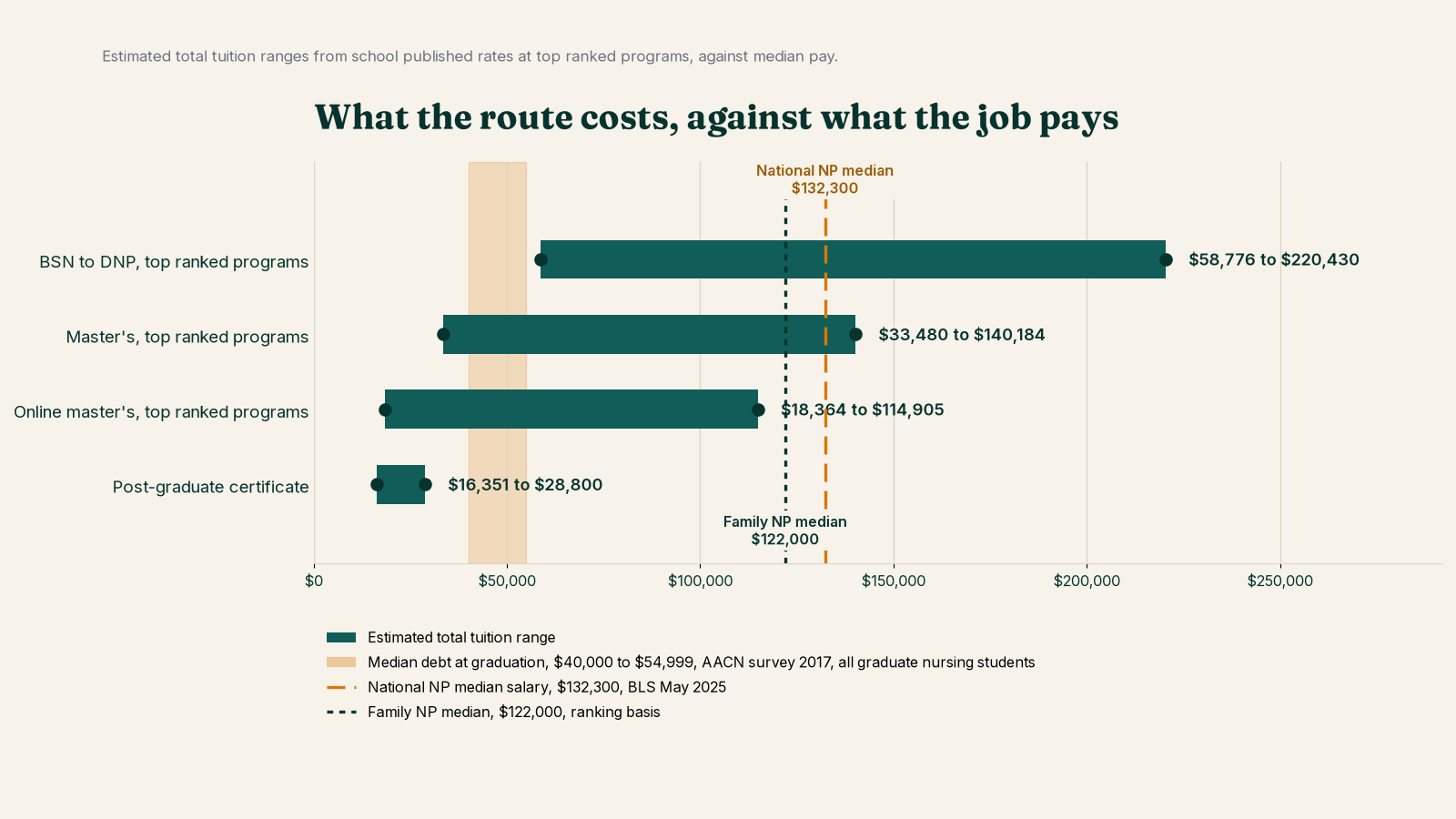
Against the ranking’s gaps, the mid-career switch is the one piece of arithmetic that consistently surprises. The move from family practice to psychiatric mental health is a move from a $122,000 median to a $145,000 median, a gap of $23,000 a year. Set against certificate tuition of $16,351 to $28,800, the tuition alone is recovered in roughly nine to fifteen months of the gap.
The assumptions are stated so the reader can discount them properly. The gap is counted at the median from the first day, loan interest and taxes are ignored, and only tuition is priced. A switcher starts at the new specialty’s floor rather than its median, and certificate clinical hours can displace paid work. The honest payback runs longer than the arithmetic one, and the tuition arithmetic on its own seldom settles the choice. The time priced costs on the other side of the ledger are the heavier side of it.
The remaining costs are the ones no tuition bill collects, and this page has named them already. Neonatal programs commonly require about two years of registered nurse experience in a NICU before admission, and acute care programs expect or require acute or critical care experience, so the most gated specialties charge their first price in years at registered nurse pay before tuition begins.
The second charge comes after graduation, in the years spent at a new specialty’s floor while seniority rebuilds, when the gap actually earned is smaller than the median gap in the ranking. Both charges are priced in time rather than dollars, and neither appears on any program’s tuition page.
What this ranking cannot tell you
Rankings earn trust by stating their limits, and this one has four that matter.
It cannot price your market. Every figure here is national. A specialty’s national median and its median in your state can differ by more than the entire spread of this table, which is why the state question in the FAQ below is answered the way it is.
It cannot fully separate base pay from total pay. The ranking basis counts reported medians from surveys of individuals, the employer survey counts total cash compensation at organizations, and real offers add differentials, call pay, and bonuses on top of either. Two clinicians in the same specialty at the same hospital can be paid on visibly different structures.
It cannot see small specialties clearly. Survey samples for neonatal, pediatric acute care, and women’s health practice are smaller than for family practice, so their medians move more between editions. The women’s health disagreement between the two compilations on this page, $120,000 against $128,000, is that effect in the open. The same boundary covers post-acute care and rehabilitation, or physiatry, practice. These are settings rather than specialties, staffed mainly by family and adult gerontology clinicians and priced by their setting’s economics rather than by specialty, with the setting pay story told in the salary guide.
And it cannot measure the parts of a job that decide whether the pay was worth it. Panel size, call burden, staffing ratios, autonomy, and the quality of the team around you decide most of job satisfaction in practice, and none of them appears in any salary table. The ranking answers the money question honestly so that the other questions get a fair hearing.
If you are choosing, and if you are already practicing
If you are a nursing student or an RN choosing a program, the ranking is the start of the decision, not the decision. The companion guide walks through choosing a specialty on fit, setting, and training route as well as pay. If you are a practicing nurse practitioner reading this against your own pay, the salary guide has the state and distribution tables that locate a specific offer.
And if your question is whether a specialty change is worth it mid career, price the whole move, the program cost, the experience gate, the years at a new specialty’s floor while you rebuild seniority, against the median gap, which for most moves is $13,000 to $30,000 a year once you arrive.
Get the ranking in your inbox
This ranking is rebuilt every year when the new survey data lands, because a ranking is only worth reading while its data dates are current. Start with the companion one-pager, NP Pay by State, the state means and medians behind every specialty figure on this page, on a single sheet. Join the Practice Brief list and the one-pager comes to your inbox, and the rebuilt ranking, with its new data dates, follows at each refresh, alongside the new practice and career guides as they publish.
Frequently asked questions
Which nurse practitioner specialty makes the most money?
Neonatal and psychiatric mental health, in one order or the other depending on the source. Reported medians put neonatal at $150,000 and psychiatric mental health at $145,000 in one current compilation and the reverse, $140,000 and $150,000, in another. Both sit at or near the top in either compilation, which is the consistent finding across both.
Why do sources disagree about the top specialty?
Because BLS does not publish specialty pay, so every figure is a survey figure, and surveys differ in respondents, in whether they count base salary or total cash compensation, and in date. This page shows its sources side by side instead of picking the one that makes the cleanest headline.
Is psychiatric mental health saturated?
At the entry level, in saturated metropolitan telehealth segments, competition has clearly increased as program enrollment grew. The specialty’s medians remain at the top of the profession, and experienced, child and adolescent, addiction, and rural practice remain shortage markets. Both things are true at once.
Does specialty or state matter more?
State, at the extremes. The gap between the highest and lowest paying state means is larger than the gap between the top specialty median and the primary care baseline, and a family nurse practitioner in California can out-earn a neonatal nurse practitioner in a low paying state. Specialty is the lever you choose once. State is the lever that prices everything else.
Are these figures what a new graduate will be offered?
No. Survey medians describe the middle of the whole specialty, including experienced clinicians, so a specialty median is the wrong yardstick for a first offer. New graduates should benchmark an offer against the distribution in the salary guide instead, which shows the full range of what the market pays and where a first offer can be located inside it.
Table notes and cross-check
Acute care NP: in the second compilation, its figure is given as adult gerontology acute care.
Adult gerontology NP: in the second compilation, its figure is given as adult gerontology primary care.
Pediatric acute care NP is not separated in the ranking basis, so the ranking basis gives it no median of its own; the $130,000 shown for it in the table comes from the second compilation.
Pediatric NP, primary care, is not separated from acute care pediatrics in the second compilation, so it has no second compilation median.
Employer survey cross-check, SullivanCotter 2026, median total cash compensation, closest matching role:
- Neonatal, $168,032 (pediatrics neonatal-perinatal medicine)
- Psychiatric mental health, $156,472 (psychiatry, general)
- Acute care, $150,229 (medical critical care)
- Emergency, $149,905 (emergency medicine)
- Pediatric acute care, $150,500 (pediatrics critical care, which is the acute care pediatric role, not primary care)
- Family, $147,396 (family medicine)
- Adult gerontology, $149,039 (internal medicine, nearest employed role)
- Women’s health, $147,574 (obstetrics and gynecology, gynecology only, nearest employed role)
- Pediatric primary care: no cross-check figure. The employer survey reports no pediatric primary care role; its only pediatric role is pediatrics critical care, which belongs to pediatric acute care above.
Training cost table notes
1. Master’s, top ranked programs: 7 programs priced from school published rates and credit totals.
2. BSN to DNP, top ranked programs: 7 programs priced the same way; Duke publishes 73 to 94 credits by specialty, which sets the top of the range.
3. Online master’s, top ranked programs: 9 programs priced the same way, at resident or flat online rates as each school publishes them.
4. Post-graduate certificate: Published program totals, named in the text below.
Sources for this page
US Bureau of Labor Statistics, OEWS May 2025 release and Occupational Outlook Handbook, for the all-NP median of $132,300, the nurse anesthetist median of $236,590, and the nurse midwife median of $134,040. Compensation surveys including data compiled by CompHealth, 2025 to 2026, for the ranking basis medians. NP Hub, highest paid nurse practitioner salaries, 2026 update, for the second compilation of reported medians. SullivanCotter, 2026 Advanced Practice Provider Compensation and Productivity Survey, data effective January 1, 2026, as reported by Becker’s Hospital Review, September 2026, for median total cash compensation by employed role. The tuition pages, catalogs, and cost schedules of the ranked schools named in this page’s production file, with program selection from the U.S. News & World Report rankings of master’s, DNP, and online master’s programs in nursing, for the training cost table. American Association of Colleges of Nursing, survey of graduate nursing student debt, published 2017, for the borrowing figures. Full claim by claim sourcing is kept with this page’s production file and checked at every refresh.
Board & Bedside also makes FNP board prep for students and new graduates. The question bank, flashcards, and mock exam are in our shop.
Leave a Reply