Board & BedsideCLINICAL KNOWLEDGE FOR THE REAL WORLD

Category: Career

NP career and practice guidance from Board & Bedside: salary, specialties, contracts and practice authority.

  • Types of Nurse Practitioners. Specialties, Settings, and How to Choose

    Types of Nurse Practitioners. Specialties, Settings, and How to Choose

    By Daniel Borkert, FNP-C
    Last reviewed October 27, 2026. Claims checked against the sources named below on October 27, 2026.

    Choosing a nurse practitioner specialty looks like choosing a department. Cardiology sounds different from primary care, post-acute care sounds different from a clinic, and psychiatry sounds different from pediatrics. Those differences are real, but they are not all the same kind of difference. One choice is the population you train for. Another is the setting you take a job in. A third is a narrower specialty built after the credential. Treating them as one list is where many students start in the wrong place.

    I chose family practice because it offered the most flexibility. At the time, I expected to work in an outpatient primary care clinic. Instead, I built my career in post-acute care, working as a contracted primary care provider in nursing facilities. The credential did not change. The setting did, and the setting changed the work.

    That is the decision this guide takes apart. Start with the patients your education and certification prepare you to serve. Then look at the setting and the team around the job. Only after that should pay and prestige get a vote, and pay has its own dated pages on this site so the figures are not copied into a third place.

    The short answer

    • Broadest range of patients and future settings: family practice.
    • Certain that adults and older adults are your population: adult-gerontology, with an early choice between primary care and acute care.
    • Mental health as the clinical work itself, not an interest inside general practice: psychiatric-mental health.
    • Children as the reason you are becoming an NP: pediatrics, with depth a lifespan credential does not try to match.
    • A focused scope in gynecologic, reproductive, and gender-related care: women’s health.

    Then reverse the order before you commit. Ask where you want to spend an ordinary workday, who will mentor you, how much support the role carries, and what the schedule does to your life. My own answer, after years in practice, is that setting matters more than the specialty label to how the work feels. Mentors, support, and work culture are part of the setting, not extras around it.

    Specialty, population focus, and setting are different choices

    The APRN Consensus Model gives the cleanest map. A certified nurse practitioner is one of four advanced practice registered nurse roles. NP education and certification are organized around six population foci:

    • Family and individual care across the lifespan
    • Adult-gerontology
    • Pediatrics
    • Neonatal
    • Women’s health and gender-related health
    • Psychiatric-mental health

    Your education, certification, and licensure have to line up in the same role and population focus. That alignment is the legal and educational spine of the choice. A specialty can be added within or alongside a population focus, but a nurse practitioner is not licensed solely in a narrow specialty. Specialty education can sit inside the NP program or come later as post-graduate education, and specialty competence is assessed by professional organizations rather than issued as a separate board license.

    Setting is a third thing. NP scope is not made setting-specific by the Consensus Model. It follows the population focus and the needs of the patient. The same family nurse practitioner may work in a clinic, an urgent care center, a school, a nursing facility, or a specialty practice. The work will not feel the same in those places, even though the credential is the same.

    This is why department names can mislead a student. Cardiology, oncology, orthopedics, and hospital medicine describe services and settings where NPs work. They are not the first population decision in the same way that family, pediatrics, or psychiatric-mental health is. A clinician usually reaches them through a compatible population focus and experience in that service.

    The numbers show how concentrated the entry pipeline is. In AANP’s table of new NP graduations by certification exam for 2023 to 2024, family accounted for 51.3 percent. Adult-gerontology primary care accounted for 5.5 percent, pediatric primary care for 2.4 percent, and women’s health for 1.4 percent, while non-primary-care certifications, including acute care, neonatal, and psychiatric-mental health, made up a combined 33.6 percent. AANP also reports about 461,000 licensed NPs in the United States, about 87 percent of them educated and prepared in programs that focus on primary care. Family practice is not just one option among equals. It is the profession’s main doorway.

    The main NP routes at a glance

    Route Patients at the center Common settings Certification route The decision in one line
    Family NP Children, adults, and older adults across the lifespan Primary care clinics, urgent care, community health, schools, post-acute care, specialty practices AANP Certification Board or ANCC Choose breadth when you want the most future movement
    Adult-gerontology primary care NP Adolescents through the oldest adults, with adult care at the center Adult primary care, geriatrics, post-acute and long-term care, specialty clinics AANP Certification Board or ANCC Choose adult depth without preparing for child care
    Adult-gerontology acute care NP Adults and older adults with acute, complex, or unstable problems Hospitals, intensive care, hospitalist and specialty services ANCC or AACN Certification Corporation Choose hospital acuity and its schedule knowingly
    Psychiatric-mental health NP Children, adults, and older adults with mental health needs Outpatient mental health, inpatient units, integrated care, telehealth ANCC or the AANP Certification Board Choose it when mental health is the work, not a side interest
    Pediatric primary care NP Infants, children, adolescents, and young adults within pediatric practice Pediatric offices, school-based health, community clinics Pediatric Nursing Certification Board Choose depth in child health over lifespan breadth
    Pediatric acute care NP Children with acute, complex, or chronic unstable problems Children’s hospitals and pediatric acute care services Pediatric Nursing Certification Board Choose pediatric depth plus hospital acuity
    Women’s health NP Patients seeking gynecologic, reproductive, and gender-related care Women’s health clinics, reproductive health, gynecology practices National Certification Corporation Choose a focused scope rather than a general panel

    Neonatal practice is also a recognized population focus. It belongs on any complete map of NP types, and its pay and hospital role are covered in the specialty ranking. It is not given a comparison section here because the route is unusually experience-gated and hospital-specific, and a short paragraph would flatten the choice.

    Family nurse practitioner

    The family nurse practitioner, or FNP, is prepared to care for patients across the lifespan. That breadth explains the route’s flexibility. An FNP can build a general primary care panel, work in urgent care, join a community health center, serve in school-based care, or move into settings such as post-acute care where the population is older but the clinical task remains longitudinal primary care.

    I picked this route for exactly that option value. I did not know that post-acute care would become the work. I did know that a lifespan credential left more doors open than a narrower choice made before I had practiced as an NP.

    Breadth has a cost. An FNP program cannot give the same depth in pediatrics as a pediatric program, the same depth in adult acute care as an acute care program, or the same depth in mental health as a psychiatric-mental health program. Employers may hire FNPs into specialty services, but the job title does not erase the population focus or create specialty competence by itself. The first years still require mentoring, focused learning, and honest limits.

    Choose family practice when you want to keep the widest set of patients and settings open, when you like generalist work, or when you are not ready to surrender parts of the lifespan. Think twice when you already know that one population is the whole point. A narrower program may serve that certainty better than breadth you never intend to use.

    Adult-gerontology nurse practitioner

    Adult-gerontology is really two related decisions. The primary care route, AGPCNP, focuses on adolescents through the oldest adults in longitudinal and preventive care. The acute care route, AGACNP, focuses on adults with episodic, complex, critical, or unstable problems. Students sometimes compare FNP with AGNP as if AGNP named one job. It does not. First decide whether the work is primary care or acute care. Then compare the adult route with family practice.

    Primary care adult-gerontology fits clinics, geriatrics practices, post-acute care, long-term care, and adult specialty practices. It removes pediatrics from the center of training and gives more room to adult complexity, multimorbidity, function, and aging. Acute care adult-gerontology belongs mainly in hospitals and specialty services, where the pace, procedures, team structure, and schedule follow acuity.

    My career is a useful warning against reading this comparison too rigidly. An FNP credential has carried my post-acute practice with older adults. That does not make the AGPCNP choice pointless. It means the label is not the only route into older adult care, and a strong employer, a good mentor, and a workable panel can matter more than whether the clinician arrived through family or adult-gerontology training.

    Choose adult-gerontology when adults are clearly your population and you want your education concentrated there. Choose the acute care branch only when the hospital setting and its schedule are part of the attraction, not merely a pay calculation.

    Psychiatric-mental health nurse practitioner

    The psychiatric-mental health nurse practitioner, or PMHNP, is prepared across the lifespan for mental health assessment, diagnosis, treatment planning, psychotherapy, and medication management. The settings range from outpatient clinics and integrated primary care to inpatient units, addiction services, consultation work, and telehealth.

    This is the comparison where students most often let the market speak first. Psychiatric care has a real access problem, and the pay ranking reflects sustained demand. But the daily work is not general medicine with more psychiatry added. The work itself is different. The visit turns on mental status, risk, trauma, substance use, family systems, and the long work of psychiatric treatment. If that is the work you want, the route makes sense. If you mainly want a scarce credential, the mismatch will show up quickly.

    From where I sit in south Seattle, there is a need for psychiatric nurse practitioners. I am less sure that the overall system is set up to support more of them well. That distinction matters. A community can need more prescribers while still offering new graduates too little supervision, too little support, and panels whose complexity exceeds the structure around them. Need is not the same thing as a good first job.

    Choose psychiatric-mental health when mental health is the population and the practice you want. Ask hard questions about supervision, consultation, panel complexity, and crisis support before you treat demand as a promise.

    Pediatric nurse practitioner

    Pediatric nurse practitioners choose depth in infancy, childhood, adolescence, and the transition toward adult care. The primary care route centers growth, development, prevention, family context, and longitudinal child health. The acute care route centers children with complex, acute, or unstable needs, usually in children’s hospitals and specialty services.

    The Pediatric Nursing Certification Board is the entry route presented here for new pediatric graduates. It certifies both primary care and acute care pediatric NPs, and graduates of dual programs can sit for both exams. ANCC’s PPCNP-BC page is framed around renewal and maintenance, so this guide does not present it as the route a new graduate should plan around.

    The choice against family practice is depth against breadth. A PNP gives up the adult panel in exchange for a program and peer group built around children and families. An FNP keeps children inside a lifespan practice but will usually carry less pediatric depth into the first job. Neither is the safer choice in the abstract. The better question is whether you want children to be one part of your panel or the population around which your whole practice is organized.

    Women’s health nurse practitioner

    The women’s health route is narrower than family practice and more focused than its name sometimes suggests. Women’s health NPs provide gynecologic, reproductive, and gender-related care, commonly in clinics and specialty practices. Certification is through the National Certification Corporation’s WHNP-BC.

    Choose this route when that focused scope is the attraction. It is not a shortcut into general primary care for women, and it should not be sold as one. Its strength is concentration: the patients, problems, procedures, and practice relationships stay inside a defined area of health care. For a clinician who wants that concentration, the narrowness is the point.

    FNP vs AGNP

    Start with children. If you want children in your practice, or you do not want to close that door before your first job, family practice is the cleaner fit. If you know that your work will be adults and older adults, adult-gerontology lets you spend the program where your interest already is.

    Then separate AGPCNP from AGACNP. FNP against AGPCNP is a comparison between lifespan primary care and adult primary care. FNP against AGACNP is also a setting and acuity comparison, because the acute care route points toward hospitals, unstable patients, and shift-based teams. Students who skip that distinction end up comparing the wrong jobs.

    For older adult work, my advice is not to overread the letters. I am an FNP working in post-acute care. An AGPCNP may arrive with a program more concentrated on aging. Either clinician still needs a setting with good mentoring, workable expectations, and support. If a student asked me how to choose between the two for geriatric work, I would ask about the actual first job before I argued about the credential.

    FNP vs PMHNP

    This is not a choice between a general credential and a more lucrative version of the same work. The two credentials point at different day-to-day work.

    The FNP’s center is whole-person medical care across ages, prevention, chronic disease, acute complaints, referrals, and coordination. The PMHNP’s center is psychiatric diagnosis and treatment across the lifespan. Both may work in integrated settings, and both need to understand the other side of the boundary. Neither fact makes the training interchangeable.

    A mid-career move from FNP to PMHNP is possible, but it is a new population focus, not a short course added to a résumé. It requires post-graduate education in the new focus, certification, and the state recognition that follows. The switching section below gives the shape of that cost.

    Choose PMHNP because psychiatric work is the work. Choose FNP because breadth and general medical care are the work. Pay belongs in the decision, but it should enter after that sentence is true, and the companion page on the highest paid nurse practitioner specialties is where it is priced.

    FNP vs PNP

    Both routes can work in pediatric primary care, so the difference is not whether an FNP may see children. An FNP may, as part of lifespan practice. The difference is how much of the program, the clinical placements, and the first professional identity are built around children.

    Choose PNP when children and families are the center and adult care holds little attraction. Choose FNP when you want pediatrics inside a broader panel, expect to work in a family or rural practice that serves everyone, or want the option to move across age groups later.

    The setting can sharpen the answer. A children’s hospital acute care role belongs to the pediatric acute care route. A mixed family clinic belongs naturally to the FNP. A pediatric office may hire either credential, and then the deciding facts become pediatric mentoring, the age range actually served, and whether an FNP hire receives enough child-health support to build competence safely.

    The setting may change the job more than the label

    A specialty tells you the population a clinician was prepared to serve. A setting tells you what Tuesday looks like.

    Outpatient primary care

    The clinic day is built around scheduled visits, continuity, prevention, chronic disease management, messages, results, and referrals. The same patients return, and the record of small decisions accumulates. This was the setting I originally pictured when I chose family practice. Its satisfactions are longitudinal. Its pressures are panel size, visit length, inbox work, and the amount of coordination a practice expects the clinician to absorb.

    Primary care NPs also work well beyond the standard physician office. AANP’s practice settings list includes clinics, health systems, private practices, NP-owned practices, nursing homes, schools, colleges, public health departments, nurse-managed clinics, and homeless shelters. Primary care is a function, not one building.

    Post-acute care

    Post-acute care is the setting I know from the inside, and it does not feel like a slower version of clinic work. I set my own schedule. I round in the morning, then follow the rounds with paperwork and charting. I work with the nursing team, administrators, and social workers in the facility. I am not employed by the nursing facility. I work under a contract to provide medical care to its patients as their primary care provider.

    That structure changes the relationships. The facility staff know the patient across the whole day. I bring the medical plan into a team that also carries staffing, family, regulatory, and discharge pressures. The pace is fairly laid back much of the time. It can become frantic when a patient is unstable. Post-acute care rewards a clinician who is comfortable with older adults, medical complexity, families, and decisions made with incomplete control over the environment.

    Hospital and acute care

    Hospital work organizes the day around acuity and teams. Admissions, rounds, procedures, consultants, deterioration, and discharge planning move faster than a clinic panel, and nights, weekends, and call are often built into the role. Acute care credentials fit this world most directly, although family and other primary care NPs also work in hospital services when the role matches their education and competence.

    The question is not whether hospital work is harder. It is whether you want your competence judged in episodes of instability, inside a large team, on the hospital’s clock. Some clinicians find that energizing. Others experience the same facts as a loss of autonomy and continuity.

    Emergency and urgent care

    Emergency work begins with the undifferentiated patient. The clinician sorts risk before the diagnosis is clear, moves between minor complaints and true emergencies, and works in shifts. AANP’s certification board describes its Emergency Nurse Practitioner exam as a competency-based specialty exam in emergency care across the lifespan. That wording is useful. Emergency is a specialty layer built on an NP foundation, not one of the six entry population foci.

    Urgent care shares the walk-in pace without the same concentration of instability. Both settings reward breadth, pattern recognition, and comfort with interruption. Both can punish a clinician who needs a predictable day.

    Saturation, demand, and the new graduate problem

    The Bureau of Labor Statistics projects NP employment overall to grow 41 percent from 2025 to 2035, adding about 137,800 jobs. That is a strong profession-wide projection. It is not a promise for every specialty, every city, or every new graduate. BLS publishes that outlook for nurse practitioners as a group, and a national growth rate cannot tell a student whether the first job in their own market will come with mentoring or a manageable panel.

    Saturation is local and segment-specific. A specialty can have a national shortage and a crowded new graduate market in the same city. Experienced clinicians may be recruited hard while beginners compete for the few roles willing to train them, and that gap between the headline and the first job is the pattern students miss.

    Around south Seattle, my own observation is that the traditional specialty areas feel fairly saturated. Cardiology, surgery, hospital medicine, and emergency medicine roles do not look like open doors simply because the services are large. I see need for psychiatric NPs, with the support question already named above. I also see a large gap in primary care, but not, in my experience, much opportunity for new graduates inside that gap. Those are observations from one practicing clinician’s market, not labor data. They are useful because they show the shape of the problem, not because they settle a national question.

    Before you choose on demand, ask four plainer questions:

    • Do local employers hire new graduates into this role, or do the postings quietly require experience?
    • Who will mentor the first year, and is that person named or merely implied?
    • Why is the position open, and how long has it been open?
    • Does the practice have enough support for the complexity it expects the new clinician to carry?

    A shortage that produces an unsupported first job is not an opportunity. It is a transfer of system risk to the least experienced person in the building.

    What it takes to switch

    There are two kinds of switch, and confusing them makes the cost look either trivial or impossible.

    A setting switch may require no new credential. I expected outpatient clinic work and built a post-acute career on the same FNP certification. A clinician moving between compatible settings still needs orientation, mentoring, and time to learn a new workflow, but the population focus may already fit.

    A population focus switch is different. If an FNP wants to practice as a PMHNP, the route runs through an accredited graduate or post-graduate program in the new focus, the matching certification, and state recognition. An acuity change inside the same population focus, such as moving from adult-gerontology primary care to acute care, follows the same congruence rule through its own program and certification. The Consensus Model’s rule is congruence. Education, certification, and licensure must point at the same population.

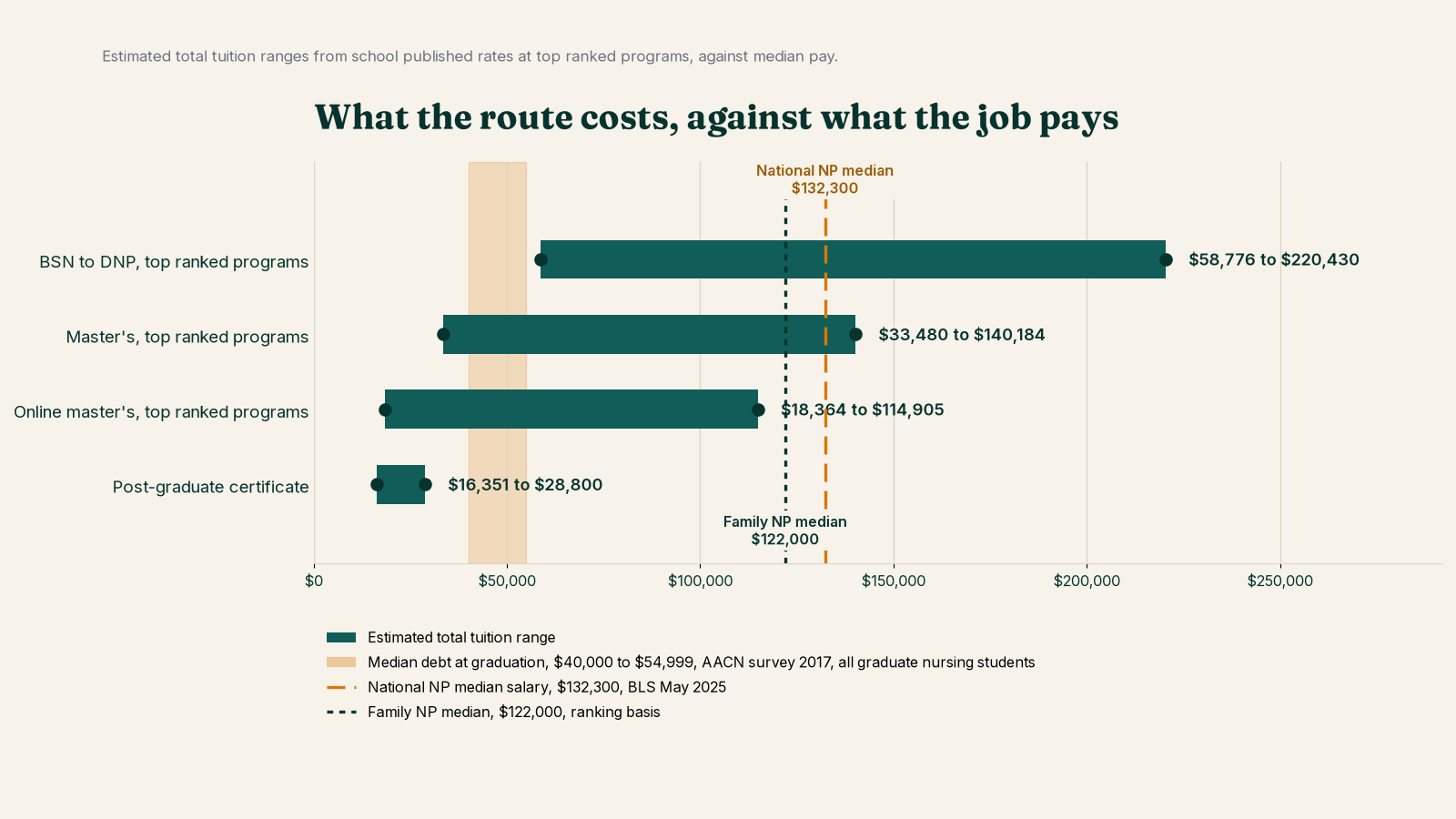
    Money is only one part of the price. Published post-graduate certificate totals show the scale for one common target. The University of Missouri listed $16,351.20 for a 24-credit PMHNP certificate at its 2026 to 2027 rates, and St. Catherine University listed $28,800 for 24 credits at its 2025 to 2026 rates. Those are program figures from the switching research behind the pay ranking, not quotes for every school.

    My own cost would start somewhere else. Switching specialties would cost me a fair amount of time and stress. My current post-acute situation is efficient and established, and adjusting to a new practice situation would be difficult, at least at first. That is not an argument against switching. It is the part of the price no tuition page lists. A clinician gives up fluency, relationships, and a system that already works, then spends a season as a beginner again.

    Switch when the new population is clearly the work you want, when the training route is real, and when the first job after the switch offers support rather than only a title. Do not switch only because a ranking moved or because your current setting is badly run. A bad setting can make the wrong specialty look guilty.

    A decision worksheet

    Write the answers down. Vague preferences survive every hard question, and written answers expose the trade.

    • Which patients do I want on an ordinary day, not in an exceptional case?
    • Do I want children in my practice, and if so, are they part of the panel or the center of it?
    • Do I want longitudinal relationships, acute episodes, psychiatric treatment, or some honest mixture?
    • Which setting gives me energy: a clinic panel, a facility team, a hospital service, an emergency department, or remote work?
    • What schedule can I still respect in ten years?
    • Who will mentor me in the first job, and what support surrounds the panel?
    • What does the local market offer new graduates in this route, not only experienced clinicians?
    • If I am wrong, what would a switch cost in education, time, stress, and lost fluency?

    If the answers point in two directions, trust the setting answer more than the prestige answer. I chose family practice for flexibility and still landed in a setting I had not pictured. The flexibility let the career move. The setting is where the career became good or bad on a daily basis.

    Choosing also has a pay side, and it should be read on dated figures rather than remembered headlines. The companion salary guide holds the national and state picture, and the specialty ranking holds the pay figures by specialty. This guide links to both and restates neither. Read the current figures there before you let pay move a decision.

    Get the one-page state pay sheet and the career guides that follow from this one. Join the Practice Brief list below.

    Frequently asked questions

    What is the most flexible nurse practitioner specialty?

    Family practice. It spans the lifespan and fits the widest range of settings. Flexibility is not the same as depth in every area, and an FNP working in a specialty service still needs role-specific mentoring and competence.

    Is AGNP better than FNP for working with older adults?

    Not automatically. AGPCNP training concentrates on adolescents through older adults, while FNP training spreads across the whole lifespan. The first job’s setting, mentoring, panel, and support can matter more than the route. My own post-acute career in older adult care has been built on an FNP credential.

    Can an FNP work in cardiology, oncology, or psychiatry?

    An FNP can work in a specialty service when the role fits the clinician’s education, certification, competence, and state recognition. The job setting does not create a new population focus. Psychiatry is the clearest boundary. A dedicated PMHNP role calls for psychiatric-mental health education and certification, not only an interest in mental health inside family practice.

    Can I change NP specialties later?

    Yes, but a new population focus normally requires a graduate or post-graduate program in that focus, the matching certification, and state recognition. A change of setting may require none of that when the new job sits inside the population you are already prepared to serve.

    Which NP specialty is in highest demand?

    No source behind this guide ranks current demand cleanly by specialty. The national projection is for nurse practitioners overall. Local demand differs by city, employer, experience level, and the support a role offers. Treat any simple answer to this question as marketing until it names its market and its data.

    Does the specialty or the setting matter more?

    In my experience, the setting. Mentors, support, schedule, and work culture decide how the job feels after the novelty of the credential wears off. Choose a population you can stand behind, then be at least as demanding about where and with whom you will practice it.

    Sources for this page

    APRN Consensus Model, Consensus Model for APRN Regulation, APRN Joint Dialogue Group Report, July 7, 2008, for the four APRN roles, the six population foci, congruence of education, certification, and licensure, and the treatment of specialty competence.

    American Association of Nurse Practitioners, Nurse Practitioners in Primary Care, position statement revised October 2025, for the licensed NP count, the primary care preparation share, the distribution of new graduations by certification exam, the list of primary care practice settings, and the statement that NP scope is not setting-specific.

    AANP Certification Board, Earn Your NP Certification, for its family, adult-gerontology primary care, psychiatric-mental health, and emergency NP exams and their entry-level or competency-based descriptions.

    Pediatric Nursing Certification Board, CPNP-PC and CPNP-AC certification steps, for the primary care and acute care pediatric entry routes, exam shape, and dual program eligibility.

    National Certification Corporation, How Do I Apply, for the WHNP-BC and NNP-BC certification routes.

    AACN Certification Corporation, Frequently Asked Questions About ACNPC-AG Certification, for the adult-gerontology acute care credential, its Consensus Model alignment, and its five-year certification period.

    US Bureau of Labor Statistics, Occupational Outlook Handbook, nurse anesthetists, nurse midwives, and nurse practitioners, for projected NP employment growth of 41 percent from 2025 to 2035 and about 137,800 added jobs. The handbook is the source carried by the companion salary guide, where the national wage figures also live.

    American Nurses Credentialing Center, Pediatric Primary Care Nurse Practitioner Certification, PPCNP-BC, checked again on October 27, 2026. The page is framed around renewal and maintenance, which is why this guide presents PNCB as the pediatric entry route.

    Full claim by claim sourcing is kept with this page’s production file and checked at every refresh.

    For clinician education only — not medical advice.
  • Nurse Practitioner Salary and Income Guide

    Nurse Practitioner Salary and Income Guide

    By Daniel Borkert, FNP-C
    Last reviewed October 22, 2026. Figures checked against the sources named below on October 22, 2026.

    My first two offers were $100,000 and $110,000. I took the higher one, and I had no real idea whether either of them was good. Every salary figure on the page carries its source and its data date, because salary pages usually fail in one simple way. They mix a median from one year, a mean from another, and a job board average from last week, and present the blend as one number. Where this page combines sources, or the years behind two figures differ, it says so at the figure. Where two honest sources disagree, both figures are shown and the difference is explained.

    The short answer

    Nurse practitioners in the United States earn a median annual wage of $132,300, and a median hourly wage of $63.61. The mean annual wage is $137,300, pulled above the median by high earners in acute care, procedural, and high cost states. The middle half of nurse practitioners earn between $117,990 and $156,700 a year. All four figures are from the Bureau of Labor Statistics Occupational Employment and Wage Statistics program, May 2025 release, for nurse practitioners, occupation code 29-1171.

    Figure Amount
    Median annual wage $132,300
    Mean annual wage $137,300
    Median hourly wage $63.61
    25th percentile $117,990
    75th percentile $156,700
    10th percentile $101,340
    90th percentile $174,420

    Notes for this table are at the bottom of this page.

    The sections below unpack what moves a given nurse practitioner toward the bottom or the top of that spread. Specialty gets a short treatment here, because this site keeps the full specialty ranking on its own page. State, setting, and experience get full treatment here, because those are the levers a working nurse practitioner can actually compare against an offer letter.

    How to read these numbers

    Five factors will keep any salary figure honest, on this page and everywhere else.

    First, know whether a figure is a median or a mean. The median is the midpoint earner. Half of nurse practitioners earn more, half earn less. The mean is an average, and in a profession with a long high earning tail, the mean sits above the median. A page that quotes the mean as the typical salary overstates what a typical offer looks like by about $5,000 a year at current figures.

    Second, know the data date. Wage surveys describe the past. The May 2025 BLS release is the most recent full national wage survey for this occupation as of this page’s review date, and it replaced a May 2024 median of $129,210. The year to year move was about 2.4 percent. Any page still quoting $129,210 is a year behind, and any page quoting a figure with no date at all should be read with suspicion.

    Third, know what a wage survey counts. BLS wage figures are straight time gross pay, not total compensation. They include base pay and incentive pay, including commissions and production bonuses. They exclude overtime premiums, severance pay, shift differentials, nonproduction bonuses such as sign-on bonuses, on-call pay, and the employer’s cost of benefits, which in hospital employment can be worth a substantial share of total compensation. Two offers with identical salaries can be very different jobs once call pay and differentials are counted.

    Fourth, know the source type. BLS figures come from an employer survey and describe what employers report paying. Job board figures come from current postings and self reports, move daily, and skew toward employers who are hiring hard. Survey figures from compensation firms describe the respondents who chose to answer. This page leads with BLS wherever BLS publishes the cut, and names any secondary source where it does not.

    Fifth, know whose pay is being counted. BLS counts nurse practitioners as their own occupation. Nurse anesthetists and nurse midwives are separate occupations with their own figures, and none of their pay is in the numbers on this page.

    Inside the nurse practitioner occupation, BLS publishes no split by specialty, so every figure here blends family practice, psychiatric, acute care, pediatric, and the rest in the mix employers actually reported. That blending is why the specialty section further down rests on named compensation surveys instead, and why a state figure describes a workforce rather than a single job. The survey also covers employees only, so income from practice ownership sits outside it entirely.

    The national picture

    About 336,300 nurse practitioners held jobs in the United States in 2025, per Bureau of Labor Statistics employment data. The occupation is projected to grow 41 percent from 2025 to 2035, adding about 137,800 jobs, one of the fastest growth rates in the economy. That is a projection about the coming decade, not a measurement of today’s labor market, and this page reports it as a projection only. Its practical meaning for a reader weighing an offer is narrower: employers expect to keep hiring into a credential that takes years to produce.

    The distribution itself is worth reading slowly. The 10th percentile sits at $101,340, which means nine out of ten nurse practitioners earn more than that. The middle half of the profession earns between the 25th percentile at $117,990 and the 75th percentile at $156,700. That spread is a snapshot of the whole workforce at one moment, not a map of any one career. Where a given clinician sits inside it depends on specialty, setting, state, and hours, and BLS publishes no split by experience that would let this page say more than that.

    The top tenth earn above $174,420. Figures beyond that, the $200,000 salaries that circulate in forums, exist, but they concentrate in a few places, high cost states, acute care and procedural roles, locum tenens contracts, and practice ownership, and they are not the shape of a typical employed offer.

    One comparison puts the occupation in context. Registered nurses earned a median of $97,550 in May 2025, and physician assistants earned a median of $135,880, both per BLS. The nurse practitioner median of $132,300 sits about $34,750 above the registered nurse median. It sits just below the physician assistant median, a gap small enough that setting and state routinely reverse it in individual offers.

    Nurse practitioner salary per hour

    The median hourly wage is $63.61, BLS OEWS, May 2025. The annual median assumes full time, year round work at 2,080 hours, so the hourly figure is the better tool for anyone comparing part time, per diem, or contract offers.

    Hourly pay in practice varies more than the median suggests. Per diem and locum tenens work usually pays a higher hourly rate than a salaried role in the same market, in exchange for no benefits, no paid leave, and no schedule guarantee. Salaried roles quote an annual figure but are worked in hours, and a salaried clinic job with a four day week can be worth more per worked hour than a higher annual figure attached to a five day week with evening call.

    When you compare offers, convert everything to an hourly rate at your actual expected hours, including call, before you compare the totals. It is the comparison least likely to lie to you, because it prices the job you will actually work rather than the job as titled.

    Nurse practitioner salary by state

    State is one of the largest single drivers of pay, and it is the driver new graduates most often misjudge, because the highest nominal wages sit in the highest cost states. The table below lists the annual mean wage for every state and the District of Columbia, from the BLS OEWS May 2025 release, in descending order. State figures are shown as means, and they are labelled as means throughout, so they are never confused with the national median above.

    State Annual mean wage
    California $176,760
    Oregon $155,780
    New Jersey $155,750
    New York $153,900
    Massachusetts $152,320
    Washington $152,180
    Alaska $149,120
    District of Columbia $146,470
    New Mexico $143,510
    Rhode Island $143,150
    Hawaii $142,910
    Connecticut $142,340
    Arizona $140,600
    Vermont $139,400
    New Hampshire $138,070
    Nevada $137,410
    Utah $137,060
    Iowa $136,940
    Minnesota $135,890
    Montana $135,290
    Wisconsin $135,160
    Maine $134,210
    Oklahoma $134,200
    Idaho $133,420
    Maryland $133,360
    Delaware $132,900
    Michigan $132,790
    Wyoming $132,680
    Colorado $132,540
    Pennsylvania $132,070
    Nebraska $131,710
    Texas $131,420
    Missouri $130,970
    Illinois $130,940
    North Carolina $130,870
    Florida $130,410
    Arkansas $130,260
    Virginia $129,060
    Georgia $128,800
    Kansas $127,940
    West Virginia $126,780
    Louisiana $126,630
    Indiana $126,600
    North Dakota $126,370
    Mississippi $125,340
    South Dakota $125,160
    Kentucky $125,010
    South Carolina $124,170
    Ohio $122,910
    Tennessee $115,510
    Alabama $110,970

    Notes for this table are at the bottom of this page.

    Read the table with cost of living in hand. California’s mean runs about $65,800 above Alabama’s, and California prices consume much of that difference in the metros where the jobs are.

    The more useful reading is the middle of the table. Texas and Florida pay near the national median, and they employ more nurse practitioners than almost any other state, Texas the most at about 26,000 and Florida about 21,800, which makes them the markets where a typical offer is easiest to benchmark. A nurse practitioner weighing a move should compare the specific offer against the state mean, then discount it mentally for local housing costs, rather than chasing the top row of any state table.

    Pay after cost of living

    That mental discount can be done with published numbers. The Bureau of Economic Analysis publishes Regional Price Parities by state, a price level index where 100 equals the national average. Dividing each state’s May 2025 mean wage by its price parity gives the wage restated in national average dollars. The price parities are the most recent BEA release and describe 2024, one year behind the May 2025 wages, and that gap is stated here rather than hidden because no fresher edition of this series exists.

    Read the adjusted figures as a comparison tool. Prices vary inside every state, and a state mean blends metro and rural jobs on both sides of the division, so no adjusted figure predicts pay in a specific city.

    Adjusted rank State Mean wage, May 2025 Price parity, 2024 Adjusted mean wage
    1 California $176,760 110.7 $159,646
    2 Iowa $136,940 87.8 $156,036
    3 New Mexico $143,510 92.2 $155,631
    4 Oklahoma $134,200 87.8 $152,773
    5 Oregon $155,780 103.4 $150,714
    6 Arkansas $130,260 86.9 $149,833
    7 Nebraska $131,710 90.1 $146,177
    8 Alaska $149,120 102.4 $145,683
    9 Missouri $130,970 90.8 $144,213
    10 Mississippi $125,340 87.0 $144,147

    California keeps first place, and that is the most useful correction in this section. The common reading that California pay is an illusion created by California prices does not survive the arithmetic at state level, because the nominal lead is wider than the price gap. Behind California the order changes character. Six of the adjusted top ten rank eighteenth or lower on pay alone, and the new names are midwestern and southern states whose nominal pay looked ordinary. Iowa is second, Oklahoma fourth, Arkansas sixth, Nebraska seventh, Missouri ninth, and Mississippi tenth.

    Adjusted rank State Mean wage, May 2025 Price parity, 2024 Adjusted mean wage
    42 Ohio $122,910 92.8 $132,483
    43 South Carolina $124,170 93.7 $132,449
    44 Illinois $130,940 100.0 $130,995
    45 Hawaii $142,910 110.0 $129,976
    46 Colorado $132,540 103.1 $128,615
    47 Virginia $129,060 101.1 $127,651
    48 Maryland $133,360 105.0 $127,059
    49 Florida $130,410 103.4 $126,105
    50 Tennessee $115,510 91.9 $125,732
    51 Alabama $110,970 88.8 $124,934

    Want the full ranking? The free NP Pay by State one-pager has all 50 states and DC with the cost of living adjustment applied, not just the top and bottom ten. Get it by email.

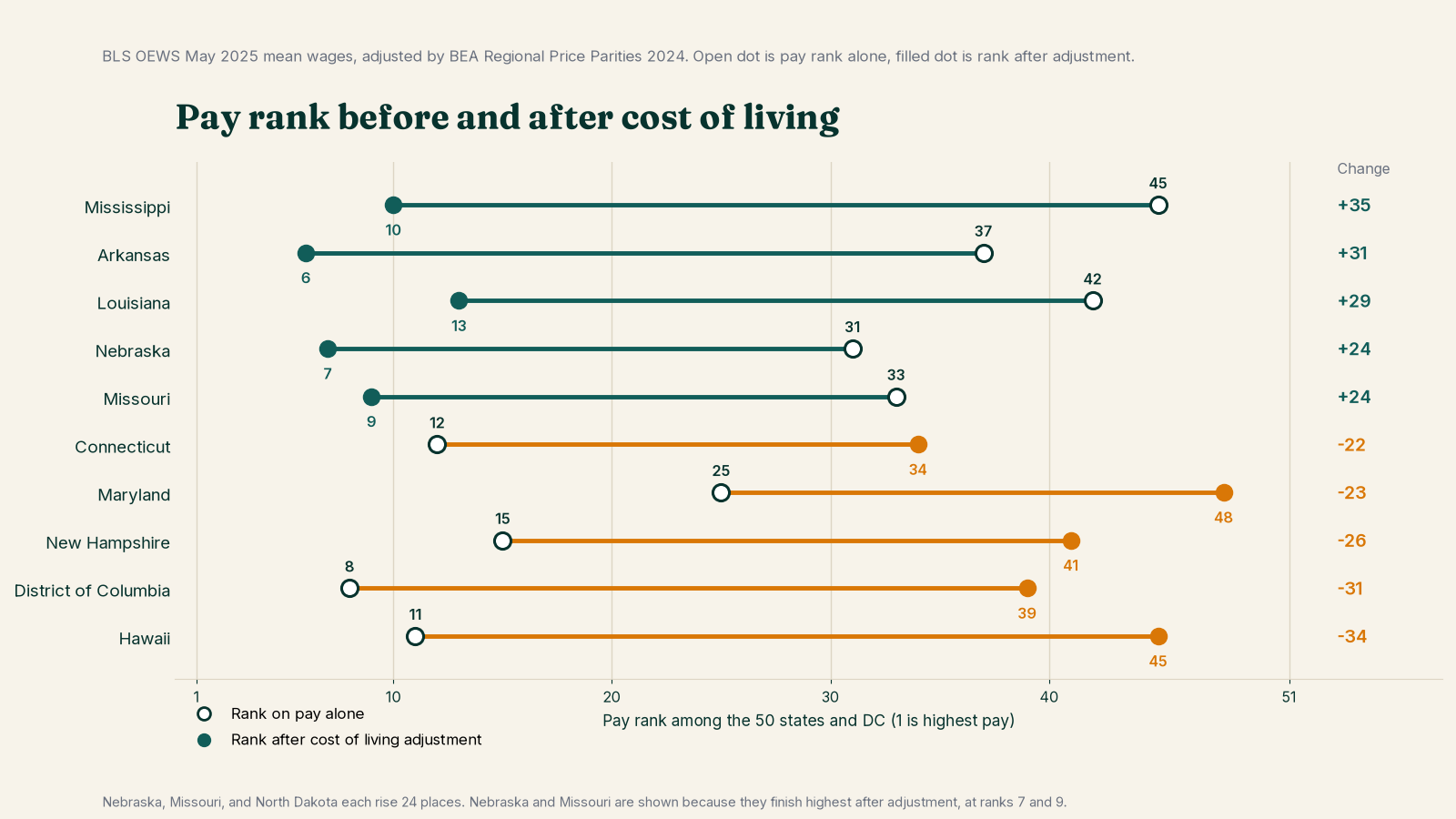
    The largest single moves run in both directions. Mississippi climbs 35 places, from forty-fifth on pay alone to tenth after adjustment, and Arkansas climbs 31 places, from thirty-seventh to sixth. Louisiana climbs 29 places to thirteenth. Hawaii falls furthest, 34 places from eleventh to forty-fifth, because its pay is good rather than exceptional while its price level is second only to California’s. The District of Columbia falls 31 places to thirty-ninth, New Hampshire falls 26 places to forty-first, and New Jersey and New York leave the top five for fourteenth and seventeenth.

    Horizontal chart of the ten states whose nurse practitioner pay rank changes most after cost of living adjustment, five rising and five falling, BLS OEWS May 2025 means adjusted by BEA Regional Price Parities 2024.
    Pay rank before and after cost of living adjustment. Source: BLS OEWS May 2025 state mean wages, adjusted by BEA Regional Price Parities 2024.

    The bottom of the table barely moves. Alabama is last on pay alone and last after adjustment, and Tennessee is fiftieth on both lists, because low pay in a low cost state is still low pay. What adjustment changes most is the size of the gaps. California’s nominal lead over Alabama is about $65,800. After adjustment it is about $34,700. Adjusting for state price levels removes roughly half of the apparent gap between the two state means.

    Nurse practitioner salary by setting

    Setting is the second large driver, and it interacts with specialty, because high acuity settings are where the high acuity specialties work. The Bureau of Labor Statistics publishes industry wages for the combined group of nurse anesthetists, nurse midwives, and nurse practitioners in its Occupational Outlook Handbook, and the pattern in that combined data is consistent with what nurse practitioners see in individual offers, so it is shown here with its basis labelled rather than hidden.

    Setting Median annual wage
    Outpatient care centers $143,370
    Hospitals, state, local, and private $142,240
    Educational services $135,170
    Offices of physicians $131,940
    Offices of other health practitioners $129,990

    Notes for this table are at the bottom of this page.

    Two readings matter. First, the largest single employer group in this combined data, offices of physicians at 46 percent of advanced practice jobs, sits second from the bottom of this table. Only offices of other health practitioners, at $129,990, pay less. A large share of advanced practice clinicians work in a setting near the bottom of the pay table, which is worth knowing before you assume a hospital offer is generous or a clinic offer is cheap.

    Second, the gap between the top and bottom of this table is about $13,000, which is real money but smaller than the state gap and smaller than the specialty gap. Setting alone rarely rescues a weak offer, and it rarely ruins a strong one.

    What the table cannot show is the texture. Hospital roles more often carry shift differentials, weekend premiums, and call pay on top of base, none of which appears in these wage figures. Clinic roles more often carry predictable hours. Comparing a hospital base against a clinic base without asking about differentials and call is comparing half of each offer.

    Post-acute care runs on a different mechanism, and my pay history is the evidence I know best. My visits are priced by the Medicare Physician Fee Schedule, and that schedule has no inflation update built into it. Its conversion factor fell from $36.09 in 2020 to $32.35 in 2025, and nurse practitioners billing under our own number are paid 85 percent of the physician amount. The nursing home’s separate Medicare per diem is a different stream entirely. Its net payment updates rose in each final rule from fiscal 2023 through fiscal 2026, but that money pays the facility, not my professional billing.

    So my base pay has barely moved since 2018, and my raises have come only as productivity bonuses. That is my own market as I have lived it: a payment stream with no inflation update underneath a salary, held flat for eight years. When I started, my pay sat well ahead of the average nurse practitioner salary; the wider field has since caught up. I have covered some of the difference by working a little more, but the rate itself has not moved.

    Nurse practitioner salary by specialty

    Specialty is the third driver, and the one students ask about first. BLS does not publish pay by nurse practitioner specialty, so every specialty figure in circulation comes from compensation surveys, and surveys disagree with each other more than readers expect. This guide carries a summary only. The full ranking, the reasoning, and the tradeoffs live on the companion page.

    Specialty Reported median
    Neonatal NP $150,000
    Psychiatric mental health NP $145,000
    Acute care NP $135,000
    Emergency NP $135,000
    Family NP $122,000
    Adult gerontology NP $120,000
    Women’s health NP $120,000
    Pediatric NP $118,000

    Notes for this table are at the bottom of this page.

    Treat these as survey medians, not as promises. They describe full time practice as reported to survey compilers, they are not adjusted for state or setting, and a family nurse practitioner in California will out-earn the neonatal median in a low paying state. The honest use of this table is orientation. It tells you the shape of the spread, about $32,000 from the pediatric baseline to the neonatal top, and it tells you where to dig next, which is the ranking page and then your own state’s data.

    What moves an individual offer

    Experience, read through the distribution

    BLS does not publish wages by years of experience, and any page that presents precise salary by year figures is estimating from survey self reports. This page will not do that, because the wage distribution cannot substitute for the missing data. The percentiles in the tables above describe the whole workforce at one moment. They are a cross-section, not a career ladder, and no band in them should be read as the new graduate band or the experienced band.

    What the distribution can honestly tell a reader is the range of outcomes the market currently produces, from $101,340 at the 10th percentile to $174,420 at the 90th. Where an individual offer lands inside that range is driven by the levers this guide can measure, specialty, setting, state, and hours, together with experience in ways the published data does not separate out. The gains that come from changing specialty, setting, or state are visible in the tables on this page. What experience alone adds, this data does not measure, so this page does not price it. BLS publishes no wage split by experience, and any figure that claims to show one is an estimate built on something else.

    Employment type

    The same job pays differently depending on how you are engaged. A W-2 employed role bundles base salary with benefits, malpractice coverage, retirement matching, and paid leave, and the wage figures on this page describe that world. A 1099 contractor role quotes a higher rate and bundles nothing, and the contractor is buying their own malpractice policy, funding their own retirement, and absorbing their own unpaid time off.

    Locum tenens sits at the far end, the highest hourly rates in the profession, paid for flexibility and for working where staffing has failed. None of these is the best choice in the abstract. The comparison only works when each offer is reduced to total annual value at your expected hours, including the benefits you would have to replace.

    One package, taken apart

    In 2018 I had two offers on the table. An outpatient primary care clinic in the Everett, Washington area offered $100,000. A post-acute care role in Tacoma offered $110,000, built around seeing fifteen patients a day. I took the post-acute role.

    The $110,000 was never the whole pay. The original package added full benefits with healthcare, paid CME, licensing costs, malpractice insurance with tail coverage, and three weeks of time off, plus bonuses for extra patients seen. Call was essentially uncompensated, treated as part of base salary.

    The company was later acquired, and the package changed shape. Paid CME went away. Time off increased, after hours and weekend call disappeared, and the bonuses for extra patients grew significantly. My schedule is one I set myself, with no minimum or maximum hours, and productivity is measured in patients seen and quality measures, not hours.

    My base today sits in the $120,000s, with bonuses bringing total compensation to $140,000 to $180,000, and my actual work week often runs 25 to 35 hours, bought back by experience and efficiency, with daytime call amounting to one to three short phone calls. The pieces I would protect first are no after hours or weekend call, a clear and predictable bonus structure, and schedule flexibility. Employer stability belongs on the same list. Earlier in my career I worked for a startup, and the constant uncertainty was itself a cost.

    Practice authority and ownership

    In full practice authority states, nurse practitioners can practice without a collaborative agreement. But practice authority, practice ownership, and independent billing are three separate questions. Authority comes from the state practice act, ownership from state business and corporate practice law, and billing from payer enrollment and reimbursement rules, and a state can answer the three differently. Where they line up, ownership is one of the few routes that regularly takes nurse practitioner income above the employed distribution altogether. Owned practice income does not appear in wage surveys at all, because owners are not wage employees, which is one more reason the top of the survey distribution understates the top of actual nurse practitioner earnings. The tradeoff is that ownership income is business income, with business risk, overhead, and unpaid administrative work inside it.

    A short word on negotiation

    Salary negotiation for nurse practitioners is a small topic in search volume and a large one in a career. I have lived one anchoring myself, when an outside offer became a retention bonus and reset every pay conversation that followed it, a story told a few paragraphs down. A first salary deserves the same seriousness, because the conversations that follow it tend to start from it. The working principles are few and unglamorous. Benchmark against the state mean and the distribution band for your experience, not against a classmate’s offer in a different state. Negotiate the whole package, because call pay, differentials, CME time and money, and schedule are often more movable than base. Get the final terms in writing before you resign anywhere.

    And remember the context you are negotiating in. Employers know the 41 percent growth projection too, and in my experience a tight hiring market is the strongest negotiating asset a nurse practitioner has. A polite, specific, data backed ask is a normal part of hiring a nurse practitioner in 2026, not an imposition.

    A few years into my post-acute role, another company offered me a similar job with a large bonus package. I took it back to my current employer and negotiated a large bonus of my own, tied to staying at least another year. I am still there, years later. The lesson is not complicated. Retention money exists for experienced clinicians, and the credible way to learn whether it exists for you is to hold an outside offer your employer believes you might actually take.

    Reading an actual offer against this data

    The point of a guide like this is a single moment, an offer letter in your hand and a decision to make. Work through it in four steps.

    First, place the offer against your state. Find your state’s mean in the table above and note where the offer sits relative to that mean. An offer at the state mean has met one reference point, the average across every nurse practitioner job in the state. That is a starting check, not a verdict, because the mean blends specialties, settings, and experience levels that a single offer does not. An offer well below it needs a reason, such as a residency style first year, a four day week, or a loan repayment benefit, and the reason should be visible in the package.

    Second, place the offer in the distribution. The percentiles describe the whole workforce, not a career schedule, so use them as a range check. An offer sitting near the bottom of the distribution needs its explanation wherever you are in your career, and the explanation belongs in the package, not in the recruiter’s summary of it.

    Third, adjust for setting and specialty using the tables above, in that order, because the setting table and the specialty table describe overlapping parts of the same gap and should not be stacked as if they were separate premiums. An acute care role in a hospital should sit above the national median on both counts, but it is one premium, not two.

    Fourth, convert to total value. Add the employer retirement contribution, the value of paid leave you will actually take, CME money and time, malpractice coverage, and any call or differential pay you can reasonably forecast. Subtract what the role costs you that a salaried comparison role would not, such as a longer commute priced honestly or unpaid call nights. The offer that wins on base salary loses this calculation often enough that the calculation is worth the twenty minutes it takes.

    One more check sits outside the arithmetic, and it is the one new nurse practitioners most often misjudge, in my experience. The largest gap is rarely the salary figure. It is underestimating what the role includes.

    How much call, and whether it is paid. How many patients a day are expected. How a bonus actually triggers, in the written terms rather than the recruiter’s summary. And how stressful the workplace is, which is hard to price and easy to underestimate when you are new. The job is not an easy one, but it is rewarding in many ways, and the reward survives a hard look at the terms far better than a surprise.

    If the offer still looks light after all four steps, the negotiation section above is the next read. The data on this page is the evidence base for that conversation, and it refreshes every year when the new BLS release lands.

    Get the figures in your inbox

    Salary data goes stale on a schedule. The BLS release updates once a year, and survey figures drift between releases. Get the one page version of the state table, NP Pay by State, with the national median and mean and every state’s mean, median, and hourly pay on a single sheet you can keep with an offer letter. Join the Practice Brief list and the sheet comes to your inbox, along with the updated figures when the next BLS release lands and the new practice and career guides as they publish.

    Frequently asked questions

    What is the average nurse practitioner salary?

    The mean annual wage is $137,300 and the median is $132,300, BLS OEWS, May 2025. The median is the better answer to what a typical nurse practitioner earns, because the mean is pulled upward by high earners.

    How much do nurse practitioners make per hour?

    The median hourly wage is $63.61, BLS OEWS, May 2025. Contract and per diem rates run higher and carry no benefits.

    Which state pays nurse practitioners the most?

    California, at an annual mean wage of $176,760, BLS OEWS, May 2025, with the cost of living caveat covered in the state section above.

    Do nurse practitioners make $200,000 a year?

    A small minority do. The 90th percentile is $174,420 at May 2025 figures, so earnings above $200,000 sit above the 90th percentile wage and concentrate in high cost states, acute care and procedural roles, locum contracts, and practice ownership. It is a real outcome and a poor planning assumption.

    How does nurse practitioner pay compare with physician assistant pay?

    Closely. Physician assistants earned a median of $135,880 in May 2025 against the nurse practitioner median of $132,300, both per BLS. State, setting, and specialty reverse that order in individual markets every day.

    Table notes

    National figures table

    1. Median annual wage and median hourly wage: Median, BLS OEWS, May 2025.

    2. Mean annual wage: Mean, BLS OEWS, May 2025.

    3. Percentile figures (10th, 25th, 75th, and 90th): BLS OEWS, May 2025.

    Pay by state table: BLS OEWS, May 2025.

    Pay by setting table: Median, combined APRN group, BLS, May 2025.

    Pay by specialty table: Compensation surveys incl. CompHealth compiled data, 2025 to 2026.

    Sources for this page

    US Bureau of Labor Statistics, Occupational Employment and Wage Statistics, May 2025 release, nurse practitioners, occupation 29-1171, national and state wage estimates. US Bureau of Labor Statistics, Occupational Outlook Handbook, nurse anesthetists, nurse midwives, and nurse practitioners, pay and outlook sections, May 2025 data, including 2025 to 2035 employment projections. US Bureau of Labor Statistics, OEWS May 2024 release, for the prior year median. Compensation surveys including data compiled by CompHealth, 2025 to 2026, for specialty medians, which BLS does not publish. Full claim by claim sourcing is kept with this page’s production file and checked at every refresh.

    Board & Bedside also makes FNP board prep for students and new graduates. The question bank, flashcards, and mock exam are in our shop.

  • Highest Paid Nurse Practitioner Specialties

    Highest Paid Nurse Practitioner Specialties

    By Daniel Borkert, FNP-C
    Last reviewed October 22, 2026. Figures checked against the sources named below on October 22, 2026.

    The highest paid nurse practitioners in America work in two places few students picture when they choose a specialty: a neonatal intensive care unit, and a psychiatric unit. Neonatal and psychiatric mental health nurse practitioners sit at the top of every current compilation this page checked, in one order or the other depending on the source, and both sit at or near the top of the field. Acute care and emergency practice form the next tier. Family practice, the largest specialty in the profession, sits near the middle of the pay distribution it anchors, and in the ranking basis compilation the primary care specialties cluster within about $4,000 of each other at the median. The second compilation spreads the comparable primary care figures wider, about $7,000.

    What follows is the ranking with its method stated, the figures dated, and the tradeoffs written by a practicing nurse practitioner rather than copied from a job board. Headline, state, and hourly figures live in the companion salary guide, and this page links there rather than restating them.

    How this ranking was built

    Method matters more on this page than on most, because the Bureau of Labor Statistics does not publish pay by nurse practitioner specialty. BLS reports one wage line for all nurse practitioners, a median of $132,300 in the May 2025 OEWS release, and every specialty figure anywhere comes from compensation surveys. Surveys differ in who answers, whether they count base salary or total cash compensation, and how current they are. A ranking that hides that is decoration.

    This ranking is ordered by the first source family below, and the other two are shown beside it so the reader can see where sources agree and where they argue.

    • Source family one, the ranking basis. National medians from compensation surveys including data compiled by CompHealth, published 2025 to 2026. These are reported medians for full time practice by population focus specialty.
    • Source family two, the cross check. A second compilation of reported survey medians, published by NP Hub in its 2026 update of this same page type. Shown because it orders the top two the other way, which is itself information.
    • Source family three, the employer survey. SullivanCotter 2026 Advanced Practice Provider Compensation and Productivity Survey, data effective January 1, 2026, drawn from 892 organizations and more than 160,900 advanced practice providers, as reported by Becker’s Hospital Review in September 2026. This survey reports median total cash compensation, meaning base salary plus annual incentives and excluding premium pay such as shift differentials and call pay. Total cash figures run higher than base salary medians for the same work, and the survey’s roles are employed positions in reporting organizations, described at subspecialty level rather than by population focus. It is used here as a cross check on employed, hospital based pay, never blended with the survey medians.

    No figure from any family has been averaged with another. Where a specialty cannot be matched cleanly across families, the table says so.

    One disclosure about the ranking basis itself. Its publisher’s summary table and its own deeper specialty sections disagree by a few thousand dollars on a few specialties, family practice by $4,000 and acute care by $5,000. This page uses the summary table figures throughout, consistently, and shows the second compilation beside them so readers can see the range of what is reported.

    The ranking

    Reported medians by specialty, with data dates in the column heads. This table is the citable summary of this page, and it is rebuilt at every annual refresh.

    Rank Specialty CompHealth median, 2025 to 2026 Second compilation median, 2026
    1 Neonatal NP $150,000 $140,000
    2 Psychiatric mental health NP $145,000 $150,000
    3 Acute care NP $135,000 $138,000
    3 Emergency NP $135,000 $137,000
    Not ranked Pediatric acute care NP — $130,000
    5 Family NP, the baseline $122,000 $121,000
    6 Adult gerontology NP $120,000 $122,000
    6 Women’s health NP $120,000 $128,000
    8 Pediatric NP, primary care $118,000 —

    Table notes and the employer survey cross-check are in the notes at the bottom of this page.

    One row is flagged rather than ranked. The ranking basis compilation does not separate acute care pediatrics from primary care pediatrics, so the pediatric acute care row carries the second compilation’s median, flagged as such, in the position that figure earns.

    Read the employer survey column with its basis in mind. Its family medicine figure of $147,396 looks like a contradiction of the $122,000 survey median until the basis is stated. Total cash compensation counts incentives, the respondents are organizations rather than individuals, and employed hospital system roles pay differently from the full market the other compilations sample. The column is evidence about employed pay at large organizations. It is not a second estimate of the same median, and this page never treats it as one.

    Two structural facts survive every source. The spread from the top of the ranking to the family practice baseline is roughly $28,000 to $29,000 at the median. Measured instead against the lowest paid primary care specialty, pediatric primary care, the spread is about $32,000. Either way, real money and not a fortune. And the top of the ranking is occupied by specialties built on shortage plus acuity, psychiatric care and neonatal intensive care, which is the pattern the rest of this page explains specialty by specialty.

    A scope note before the details

    Certified registered nurse anesthetists earn a median of $236,590, BLS, May 2025, far above anything on this page. CRNA is a separate advanced practice role with its own degree path and its own certification, not a nurse practitioner specialty, and it is not ranked here. Any list that places it at the top of an NP ranking is answering a different question. The same applies to nurse midwives, a separate role with a May 2025 median of $134,040 per BLS. This ranking covers nurse practitioner population focus specialties only.

    Neonatal nurse practitioner

    Reported median $150,000 in the ranking basis compilation and $140,000 in the second compilation, with the employer survey’s neonatal-perinatal role at $168,032 in total cash compensation. Whichever source a reader trusts, neonatal practice sits at or near the top, and the reasons are structural. Neonatal nurse practitioners work in level III and level IV neonatal intensive care units, attend high risk deliveries, and manage some of the most fragile patients in medicine, including premature infants on ventilators. The workforce is small, the training pipeline is narrow, and a NICU cannot staff around a vacancy the way a clinic can.

    The route in is the most experience gated on this page. Neonatal programs are graduate degrees with certification through the National Certification Corporation, and most require registered nurse experience in a NICU before admission, commonly around two years. That gate is part of why the pay holds. The supply of qualified applicants cannot expand quickly, because the prerequisite experience itself takes years to accumulate.

    The tradeoffs are the mirror of the pay. The work is hospital based and shift based, with nights, weekends, and holidays as a permanent feature rather than a season. The emotional load is real and specific, caring for infants who may not survive, alongside families in the worst weeks of their lives. And the specialty is geographically narrow. NICUs concentrate in larger hospitals and cities, so the high median is attached to a limited map of places a neonatal nurse practitioner can live and work.

    Psychiatric mental health nurse practitioner

    Reported median $145,000 in the ranking basis compilation and $150,000 in the second compilation, which places it first. The employer survey puts psychiatry at $156,472 for general psychiatry, $154,998 inpatient, and $152,482 outpatient, in total cash compensation. On any basis, psychiatric mental health is either the highest paid specialty in the profession or tied for that position. The explanation the survey sources and employers point to is shortage. The United States does not train enough psychiatric prescribers, and the PMHNP, whose route in is measured in years rather than the decade psychiatry requires, is the fastest route the system has to add prescribers at scale, which employers and telehealth platforms have bid up accordingly. That is an interpretation of the pay figures, consistent with them, and it is stated here as one.

    Certification is through the American Nurses Credentialing Center, across the lifespan. The practice shapes vary more than in any other specialty on this page, from inpatient units to outpatient clinics to fully remote telepsychiatry, and the pay varies with them. Telehealth lowered the geographic barrier to high paying contracts, which is part of why this specialty’s reported range is so wide in every compilation.

    The tradeoff the forums keep circling is saturation, and it deserves a plain answer. Entry level telehealth roles in saturated metropolitan markets are more competitive than they were several years ago, because PMHNP program enrollment grew fast in response to exactly the pay figures on this page. That is a market entry problem in specific segments, and it is worth being precise about what the data on this page can say about it. The figures here are cross-sectional medians, one snapshot per source. They cannot show whether the specialty’s ceiling has moved or whether its entry level floor has softened, because no source on this page tracks the same measure over time. What they do show is that the medians still sit at the top of the profession while entry level competition has visibly increased in some segments.

    Experienced PMHNPs, child and adolescent work, addiction settings, and underserved regions remain shortage markets by every account this page found.

    Acute care nurse practitioner

    Reported median $135,000 in the ranking basis compilation and $138,000 in the second compilation as adult gerontology acute care. The employer survey’s closest roles are medical critical care at $150,229 in total cash compensation and hospitalist nocturnist work at $157,604, second among the survey figures cited on this page only to neonatal-perinatal medicine at $168,032, which shows what nights are worth in employed acute care.

    Acute care nurse practitioners, certified through ANCC or AACN in the adult gerontology acute care role, work in intensive care units, hospitalist services, emergency and trauma services, and specialty teams such as cardiology and surgery. Certification is population and acuity specific, and most programs expect or require registered nurse experience in acute or critical care settings before admission. The premium over primary care, roughly $13,000 to $17,000 at the median depending on source, is payment for acuity, for procedures, and for a schedule that includes nights, weekends, and call.

    The tradeoff is sustainability, and practitioners price it differently across a career. Acute care at thirty and acute care at fifty are different jobs on the same body. Many clinicians treat the acute care premium as compensation for a season of practice and plan a later move toward specialty clinic or primary care work, accepting the pay step down as the cost of a schedule they can keep. A ranking cannot make that decision, but it should not hide that the decision exists.

    Emergency nurse practitioner

    Reported median $135,000 in the ranking basis compilation and $137,000 in the second compilation, with emergency medicine at $149,905 in total cash compensation in the employer survey. Emergency nurse practitioners work in emergency departments and urgent care settings, managing undifferentiated patients across the lifespan, and the role is usually built on family nurse practitioner certification plus emergency specific certification through AANPCB’s ENP credential, which requires documented emergency practice experience, or on an acute care certification for adult focused departments.

    The pay logic is similar to acute care, shift based work, nights and weekends, procedural breadth, and a chronic staffing shortage in emergency departments that cannot close their doors. The tradeoff is the nature of the work itself, high variance, high interruption, and a patient stream that includes the most acute presentations and the least appropriate visits in the same hour. Emergency practice also concentrates in hospital markets, though urgent care widens the map somewhat.

    Pediatric acute care nurse practitioner

    Reported at $130,000 in the second compilation, the ranking basis compilation does not separate acute care pediatrics from primary care pediatrics, and the employer survey puts pediatrics critical care at $150,500 in total cash compensation. Certification is through the Pediatric Nursing Certification Board.

    This is a small specialty based in children’s hospitals, practicing in pediatric intensive care and acute care services. It shares the acute care pattern, high acuity, hospital schedule, pay above the pediatric primary care baseline, and it is included here so that the pediatric figures below are not misread. The $118,000 pediatric figure in the ranking is the primary care role.

    The primary care baseline, family, adult gerontology, women’s health, and pediatric

    A ranking of the highest paid specialties needs its baseline drawn honestly, because most nurse practitioners work in primary care and most readers of this page are choosing between a primary care route and a specialty route, not between neonatal and psychiatry.

    Family nurse practitioner, reported median $122,000 and $121,000 in the two compilations. The FNP is the largest specialty in the profession and the most flexible credential in it, certified through AANPCB or ANCC, spanning the lifespan in clinics, urgent care, retail health, community health, and increasingly in specialty practices that hire for breadth.

    Its median sits below the national all-NP median of $132,300, and the mix is the likely explanation rather than anything about family practice itself. The national figure is the median of the whole nurse practitioner workforce, a mix in which family practice is the largest single group but far from the only one, and the pooled median reflects that entire mix rather than any one specialty’s market. What the FNP median does not capture is optionality. No other certification opens as many doors, in as many places, with as much freedom to change setting later.

    Adult gerontology primary care, reported median $120,000 and $122,000. The AGPCNP cares for adolescents through the oldest adults, in primary care clinics, geriatrics practices, and post-acute and long term care settings. Its demand story is demographic and strong, an aging population with complex chronic disease, and its pay sits with the other primary care roles because it competes for many of the same positions as the FNP.

    Women’s health, reported median $120,000 and $128,000. The widest disagreement between the two compilations in the primary care group, and a reminder that survey medians for smaller specialties move with sample composition. WHNPs, certified through the National Certification Corporation, provide gynecologic, reproductive, and obstetric adjacent care in clinics and specialty practices. The employer survey’s nearest role, gynecology only practice within obstetrics and gynecology, reports $147,574 in total cash compensation, which reflects employed specialty practice rather than the broad market.

    Pediatric primary care, reported median $118,000. The lowest figure in the ranking and the section where this page most wants to prevent a misreading. Pediatric primary care pay sits at the bottom of the NP pay table. The structural explanation usually offered, and the one consistent with what is visible across medicine, is that pediatric reimbursement runs lower than adult reimbursement, and pediatricians likewise sit near the bottom of physician pay tables. This page offers that as the commonly cited explanation, not as a finding of its own sources.

    It is not a signal about demand or value. Shortages in pediatric practice are widely reported, and a clinician who wants this work is choosing a population, not making a financial error. Certification is through the Pediatric Nursing Certification Board.

    Subspecialty roles inside the employer survey

    Population focus is only one way to cut the data. The employer survey, which describes employed roles at reporting organizations, shows where total cash compensation concentrates at subspecialty level, and several of its figures are worth a reader’s attention. Cardiothoracic surgery roles report $156,495 and cardiovascular surgery $152,407. Dermatology reports $153,713. Invasive and interventional cardiology reports $150,553, and hematology and oncology $149,947.

    These are not separate certifications. They are what happens when a nurse practitioner, usually with an acute care or family certification and substantial experience, embeds in a high acuity specialty service. The lesson cuts against a common assumption. The highest employed pay in the profession attaches less to the letters after a name than to the service line a clinician works in and the scarcity of people who can do that work.

    Pay set against the rest of the decision

    Specialty Reported median, ranking basis Certification route Typical setting The tradeoff in one line
    Neonatal $150,000 NCC, graduate program with NICU experience commonly required first Level III and IV NICU Highest pay, narrowest map, nights for a career
    Psychiatric mental health $145,000 ANCC, across the lifespan Clinics, inpatient units, telehealth Shortage pay with a more contested entry level floor
    Acute care $135,000 ANCC or AACN, acute care experience commonly expected ICU, hospitalist, specialty services Acuity premium paid in schedule and call
    Emergency $135,000 FNP base plus ENP credential, or acute care route Emergency departments, urgent care Breadth and pace, shift work throughout
    Pediatric acute care $130,000 (second compilation) PNCB Children’s hospitals, PICU Hospital acuity premium over pediatric primary care
    Family $122,000 AANPCB or ANCC Primary care everywhere The most options, a mid table median
    Adult gerontology primary care $120,000 AANPCB or ANCC Adult primary care, post-acute Demographic demand, primary care pay
    Women’s health $120,000 NCC Gyn and reproductive health clinics A focused scope, survey figures that disagree
    Pediatric primary care $118,000 PNCB Pediatric practices The population is the reason, pay is structural

    The ranking basis compilation does not separate acute care pediatrics from primary care pediatrics, so this row carries the second compilation’s median and is flagged as such, consistent with its section above.

    Three questions worth more than the ranking

    For most readers, these do more work than the ranking itself.

    1. 1. How long is the route? Count any registered nurse experience a program requires before it will admit you. A specialty that pays $15,000 more and takes two additional years to enter has a payback period, not just a premium.
    2. 2. What does the work do to your schedule and your body across twenty years? The acute care premium is partly a payment for nights, and nights get more expensive with age.
    3. 3. How narrow is the map? A specialty practiced in forty hospitals within driving distance is a different asset from one practiced in four hundred clinics.

    Demand runs underneath all of it. BLS projects nurse practitioner employment overall to grow 41 percent from 2025 to 2035, and while BLS does not project by specialty, the shortage drivers named across the survey sources are consistent, psychiatric prescribers, neonatal and critical care staffing, and primary care access. A high median in a shrinking niche would be a warning, and this ranking cannot issue that warning in either direction. The projection covers the profession as a whole, not any specialty, so it says nothing here about whether a given specialty’s own demand is growing or shrinking.

    What the training costs

    The first of the three questions asks how long the route is. This section asks the same question in dollars, because the two answers multiply. A specialty that takes two extra years to enter charges twice, once in tuition and once in years spent earning the lower salary while the premium waits.

    Tuition first, and this time priced from the programs themselves. The estimates below are built from the schools U.S. News & World Report ranks at the top of nursing, its leading master’s and DNP programs and its leading online master’s programs.

    For each program, this page took the per credit tuition the school itself publishes, for the academic year the school states, and multiplied it by the program’s published credit total. Public university figures use the resident rate where a school charges one, and fees are excluded unless a school folds them into its per credit charge.

    Two California programs, UCLA and UCSF, publish annual charges rather than a per credit rate, so their totals are the published annual figure multiplied by the program’s length in years, and the UCSF annual figure includes its student health insurance premium, which is part of why it sits high in its range. Eight places across the three ranked lists could not be priced this way, because the school publishes no per credit rate or no credit total. Michigan, which charges by the term, is one of them. Those programs are left out rather than estimated.

    Route Estimated total tuition
    Master’s, top ranked programs $33,500 to $140,200
    BSN to DNP, top ranked programs $58,800 to $220,400
    Online master’s, top ranked programs $18,400 to $114,900
    Post-graduate certificate $16,000 to $29,000

    Notes for this table are at the bottom of this page.

    A note on the totals. Each is an estimate built on the school’s own published basis, and those bases differ in what they fold in. Some schools fold mandatory fees into the per credit charge and some do not, one annual total includes a student health insurance premium, and the rates come from the academic years the schools state. The method paragraphs above govern how each total was built, and the ranges should be read as school priced estimates rather than as quotes on an identical basis.

    The spread inside each row is the finding. The least expensive top ranked master’s on this list, at the University of Alabama at Birmingham, costs about a quarter of the most expensive, at NYU, and the two schools sit in the same U.S. News top ten. A ranked list tells a reader almost nothing about price until the schools’ own rates are laid beside it.

    The route most relevant to this ranking is the last row. A practicing nurse practitioner changing specialty rarely buys a second degree. The usual purchase is a post-graduate certificate stacked on the graduate degree already held, and psychiatric mental health is the most common target. Published totals for 24 credit certificates make the scale plain. The University of Missouri lists an estimated $16,351 for its online psychiatric mental health certificate, and St. Catherine University lists $28,800 in total tuition for the same credential at private rates.

    One regional check, because most readers price the programs near home alongside the ranked ones. In the Seattle area, the family nurse practitioner route is now a DNP at all three universities. The University of Washington charges $1,097 per quarter credit for its DNP under its fee-based model, and its published family nurse practitioner curriculum runs to 96 quarter credits, which puts tuition at about $105,300.

    Seattle University charges $1,002 per quarter credit for 2026-27, and its own published estimate for the RN to DNP runs $106,212 to $120,240. Seattle Pacific, where I trained, publishes a BSN to DNP of 100 quarter credits, and at the most recent per credit rate the university has published for nursing, $899 per quarter credit in 2022-23, tuition for that degree comes to about $89,900.

    The comparison with my own history puts the change in perspective. The family nurse practitioner degree the same school sells today is a longer doctorate that, priced at that last published nursing rate, comes to close to $90,000. My own degree there cost roughly half that, as the dated example below details.

    One dated example from my own history sits inside those ranges. My MSN at Seattle Pacific University, a private program I attended from 2016 to 2018, cost roughly $50,000 in total. I carried about $20,000 of it in student loans and paid the loans off within a year of starting work. Those are 2016 to 2018 prices, not current ones. The ranges above carry the present day picture, and tuition has moved since.

    What students carry out of these programs is debt rather than tuition receipts. The fullest national picture is the American Association of Colleges of Nursing survey of graduate nursing students, published in 2017 from responses by 2,235 students at 328 schools. Sixty-nine percent had taken out federal loans, and 74 percent of nurse practitioner students had.

    The median debt students expected to hold at graduation fell between $40,000 and $54,999. That figure covers all graduate nursing students, nurse practitioners among them, not nurse practitioners alone, and about one in six expected to owe more than $100,000. No newer national survey has replaced it, and it is dated on this page the same way every other figure is. Two cautions belong with it. The figures are from 2017, and tuition has climbed steeply since, as the program totals above show, so the amounts students borrow today are likely higher than these medians. And the most recent large study measures something different. A 2026 University of Michigan study of nearly 10,000 licensed nurses found that advanced practice nurses still carrying loans hold a median balance of about $66,000, with nearly three in ten of them owing more than $100,000. That is a current balance among practicing clinicians who still hold loans, not debt at graduation, so the two figures sit side by side as context. Neither proves what a student borrowing today will owe.

    Range chart of estimated total tuition by training route at top ranked programs, from $16,351 for a post-graduate certificate to $220,430 at the top of the BSN to DNP range, with a shaded band for median debt at graduation of $40,000 to $54,999 from the AACN survey of 2017 covering all graduate nursing students, and reference lines at the national nurse practitioner median salary of $132,300 and the family nurse practitioner median of $122,000.
    Estimated total tuition by training route at top ranked programs, set against median pay and median debt at graduation. Sources: school published rates as described in the text, AACN survey 2017, BLS OEWS May 2025.

    Against the ranking’s gaps, the mid-career switch is the one piece of arithmetic that consistently surprises. The move from family practice to psychiatric mental health is a move from a $122,000 median to a $145,000 median, a gap of $23,000 a year. Set against certificate tuition of $16,351 to $28,800, the tuition alone is recovered in roughly nine to fifteen months of the gap.

    The assumptions are stated so the reader can discount them properly. The gap is counted at the median from the first day, loan interest and taxes are ignored, and only tuition is priced. A switcher starts at the new specialty’s floor rather than its median, and certificate clinical hours can displace paid work. The honest payback runs longer than the arithmetic one, and the tuition arithmetic on its own seldom settles the choice. The time priced costs on the other side of the ledger are the heavier side of it.

    The remaining costs are the ones no tuition bill collects, and this page has named them already. Neonatal programs commonly require about two years of registered nurse experience in a NICU before admission, and acute care programs expect or require acute or critical care experience, so the most gated specialties charge their first price in years at registered nurse pay before tuition begins.

    The second charge comes after graduation, in the years spent at a new specialty’s floor while seniority rebuilds, when the gap actually earned is smaller than the median gap in the ranking. Both charges are priced in time rather than dollars, and neither appears on any program’s tuition page.

    What this ranking cannot tell you

    Rankings earn trust by stating their limits, and this one has four that matter.

    It cannot price your market. Every figure here is national. A specialty’s national median and its median in your state can differ by more than the entire spread of this table, which is why the state question in the FAQ below is answered the way it is.

    It cannot fully separate base pay from total pay. The ranking basis counts reported medians from surveys of individuals, the employer survey counts total cash compensation at organizations, and real offers add differentials, call pay, and bonuses on top of either. Two clinicians in the same specialty at the same hospital can be paid on visibly different structures.

    It cannot see small specialties clearly. Survey samples for neonatal, pediatric acute care, and women’s health practice are smaller than for family practice, so their medians move more between editions. The women’s health disagreement between the two compilations on this page, $120,000 against $128,000, is that effect in the open. The same boundary covers post-acute care and rehabilitation, or physiatry, practice. These are settings rather than specialties, staffed mainly by family and adult gerontology clinicians and priced by their setting’s economics rather than by specialty, with the setting pay story told in the salary guide.

    And it cannot measure the parts of a job that decide whether the pay was worth it. Panel size, call burden, staffing ratios, autonomy, and the quality of the team around you decide most of job satisfaction in practice, and none of them appears in any salary table. The ranking answers the money question honestly so that the other questions get a fair hearing.

    If you are choosing, and if you are already practicing

    If you are a nursing student or an RN choosing a program, the ranking is the start of the decision, not the decision. The companion guide walks through choosing a specialty on fit, setting, and training route as well as pay. If you are a practicing nurse practitioner reading this against your own pay, the salary guide has the state and distribution tables that locate a specific offer.

    And if your question is whether a specialty change is worth it mid career, price the whole move, the program cost, the experience gate, the years at a new specialty’s floor while you rebuild seniority, against the median gap, which for most moves is $13,000 to $30,000 a year once you arrive.

    Get the ranking in your inbox

    This ranking is rebuilt every year when the new survey data lands, because a ranking is only worth reading while its data dates are current. Start with the companion one-pager, NP Pay by State, the state means and medians behind every specialty figure on this page, on a single sheet. Join the Practice Brief list and the one-pager comes to your inbox, and the rebuilt ranking, with its new data dates, follows at each refresh, alongside the new practice and career guides as they publish.

    Frequently asked questions

    Which nurse practitioner specialty makes the most money?

    Neonatal and psychiatric mental health, in one order or the other depending on the source. Reported medians put neonatal at $150,000 and psychiatric mental health at $145,000 in one current compilation and the reverse, $140,000 and $150,000, in another. Both sit at or near the top in either compilation, which is the consistent finding across both.

    Why do sources disagree about the top specialty?

    Because BLS does not publish specialty pay, so every figure is a survey figure, and surveys differ in respondents, in whether they count base salary or total cash compensation, and in date. This page shows its sources side by side instead of picking the one that makes the cleanest headline.

    Is psychiatric mental health saturated?

    At the entry level, in saturated metropolitan telehealth segments, competition has clearly increased as program enrollment grew. The specialty’s medians remain at the top of the profession, and experienced, child and adolescent, addiction, and rural practice remain shortage markets. Both things are true at once.

    Does specialty or state matter more?

    State, at the extremes. The gap between the highest and lowest paying state means is larger than the gap between the top specialty median and the primary care baseline, and a family nurse practitioner in California can out-earn a neonatal nurse practitioner in a low paying state. Specialty is the lever you choose once. State is the lever that prices everything else.

    Are these figures what a new graduate will be offered?

    No. Survey medians describe the middle of the whole specialty, including experienced clinicians, so a specialty median is the wrong yardstick for a first offer. New graduates should benchmark an offer against the distribution in the salary guide instead, which shows the full range of what the market pays and where a first offer can be located inside it.

    Table notes and cross-check

    Acute care NP: in the second compilation, its figure is given as adult gerontology acute care.

    Adult gerontology NP: in the second compilation, its figure is given as adult gerontology primary care.

    Pediatric acute care NP is not separated in the ranking basis, so the ranking basis gives it no median of its own; the $130,000 shown for it in the table comes from the second compilation.

    Pediatric NP, primary care, is not separated from acute care pediatrics in the second compilation, so it has no second compilation median.

    Employer survey cross-check, SullivanCotter 2026, median total cash compensation, closest matching role:

    • Neonatal, $168,032 (pediatrics neonatal-perinatal medicine)
    • Psychiatric mental health, $156,472 (psychiatry, general)
    • Acute care, $150,229 (medical critical care)
    • Emergency, $149,905 (emergency medicine)
    • Pediatric acute care, $150,500 (pediatrics critical care, which is the acute care pediatric role, not primary care)
    • Family, $147,396 (family medicine)
    • Adult gerontology, $149,039 (internal medicine, nearest employed role)
    • Women’s health, $147,574 (obstetrics and gynecology, gynecology only, nearest employed role)
    • Pediatric primary care: no cross-check figure. The employer survey reports no pediatric primary care role; its only pediatric role is pediatrics critical care, which belongs to pediatric acute care above.

    Training cost table notes

    1. Master’s, top ranked programs: 7 programs priced from school published rates and credit totals.

    2. BSN to DNP, top ranked programs: 7 programs priced the same way; Duke publishes 73 to 94 credits by specialty, which sets the top of the range.

    3. Online master’s, top ranked programs: 9 programs priced the same way, at resident or flat online rates as each school publishes them.

    4. Post-graduate certificate: Published program totals, named in the text below.

    Sources for this page

    US Bureau of Labor Statistics, OEWS May 2025 release and Occupational Outlook Handbook, for the all-NP median of $132,300, the nurse anesthetist median of $236,590, and the nurse midwife median of $134,040. Compensation surveys including data compiled by CompHealth, 2025 to 2026, for the ranking basis medians. NP Hub, highest paid nurse practitioner salaries, 2026 update, for the second compilation of reported medians. SullivanCotter, 2026 Advanced Practice Provider Compensation and Productivity Survey, data effective January 1, 2026, as reported by Becker’s Hospital Review, September 2026, for median total cash compensation by employed role. The tuition pages, catalogs, and cost schedules of the ranked schools named in this page’s production file, with program selection from the U.S. News & World Report rankings of master’s, DNP, and online master’s programs in nursing, for the training cost table. American Association of Colleges of Nursing, survey of graduate nursing student debt, published 2017, for the borrowing figures. Full claim by claim sourcing is kept with this page’s production file and checked at every refresh.

    Board & Bedside also makes FNP board prep for students and new graduates. The question bank, flashcards, and mock exam are in our shop.